Answering the search for versatile XLR and TRS combo jacks, this guide highlights five practical options designed for musicians, audio engineers, and installers. Each product supports XLR and 1/4″ TRS connections, offering easy integration with mixers, amps, and stage gear. The selections target users who need clean signal paths, quick disconnects, and durable panel- or rack-mounted solutions. Read on to find which option fits your setup best, from studio to live performance environments.
| Product | ||
|---|---|---|
| XMSJSIY 2 in 1 XLR & 6.35mm Socket Combo | Panel Mount, 2-in-1 | Pro performers needing quick cable changes on stage or rack panels |
| QIANRENON Combo Jack to XLR Plug Adapter Mount Short Cable | XLR/TRS Combo to XLR Male | Installers and builders creating fixed patches in walls or enclosures |
| QIANRENON XLR Combo Jack to TRS 6.35mm | XLR/TRS Combo to TRS 6.35mm | Routing to mixers or amps with TRS inputs in compact layouts |
| SIUNIMAS Hotswap XLR/6.5/6.35 Combo Box | Multi-speaker or multi-amp setups requiring several outputs | |
| MCSPROAUDIO 2ft Pigtail TRS/XLR Panels | Panel Mount Pigtail | Quick, drop-in replacements for standard D-hole panels |
XMSJSIY 2 in 1 XLR & 6.35mm Socket Combo

The XMSJSIY unit combines XLR and 1/4″ 6.35mm sockets into a single panel-mount connector. It supports two connection methods for XLR and 6.35mm cables, reducing the need to swap sockets when changing gear. The shell is built from high-quality plastic, and internal pins are gold-plated for reliable signal transmission. Best for performers who frequently re-rack gear and require a compact, robust adapter that can auto-lock with XLR plugs.
Best for: live performers and studio technicians who must switch between microphone and line-level connections quickly. Caution: plastic housing may be less durable under heavy constant use compared to metal alternatives.
QIANRENON Combo Jack to XLR Plug Adapter Mount Short Cable

This short-cable assembly features an XLR/TRS combo jack on one end and a standard XLR male connector on the other. The mount is designed for secure installation in wall panels, audio boxes, or patch panels with a 20mm x 23mm footprint. It’s ideal for installers who need a fixed, reliable connection point with straightforward mounting hardware.
Best for: building fixed-panel interfaces in studios or venues. Caution: mounting requires screws and proper alignment; not ideal for temporary field setups.
QIANRENON XLR Combo Jack to TRS 6.35mm

This adapter provides a combo XLR jack to a 6.35mm TRS male output. It’s well-suited for linking mics or line-level devices to balanced TRS inputs on mixers or interfaces, with a compact short-length cable for tidy routing. The setup supports essential splitting of professional signals where a TRS path is preferred.
Best for: compact studio racks and on-stage patches. Caution: short length limits flexibility in some rig configurations; consider longer variants if distance is a factor.
SIUNIMAS Hotswap 3Pin XLR 4-Channel Box
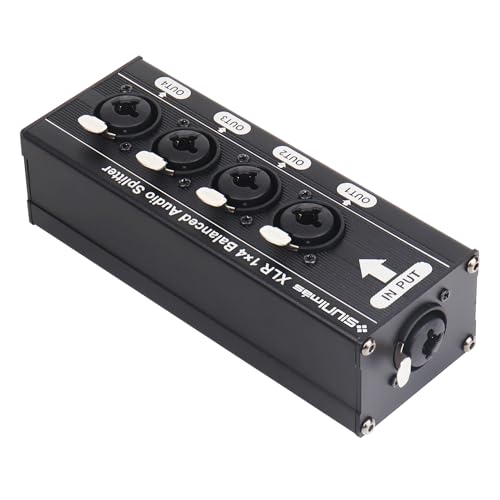
The SIUNIMAS box offers 1-in to 4-out distribution with a combo XLR and 1/4″ input. It is made from durable aluminum alloy and is ideal for expanding a system to drive multiple powered speakers or amplifiers. This solution is best for venues or studios that need to branch one input into several outputs without signage delays.
Best for: expanding a single source to multiple outputs in professional setups. Caution: may require careful grounding and cable management to prevent hum in long runs.
MCSPROAUDIO 2ft Pigtail: 1/4 TRS/XLR Female to XLR Female

This 2-foot pigtail offers a quick drop-in replacement for standard D-hole panels, transitioning TRS/XLR female combinations to XLR female plugs. It’s designed for installations where soldering isn’t desirable and speed matters. The product is especially useful for updating existing panels with new XLR/TRS capability.
Best for: installers replacing old connectors without soldering. Caution: length is fixed at 2 feet; plan routing accordingly.
Buying Guide: Choosing The Right XLR/TRS Combo Jack
- Connection needs: Do you need a combo jack on a panel, a short patch cable, or a distribution box? Choose based on whether you primarily route to XLR devices, TRS inputs, or multiple outputs.
- Mounting style: Panel-mount versus fixed wall or patch-panel installations affect durability and ease of access. For permanent setups, mount stability matters most.
- Signal path and quality: Gold-plated contacts and shielding reduce noise. Consider oxygen-free copper conductors for high-fidelity paths in live or recording environments.
- Durability vs. portability: Metal housings tend to endure heavier use; plastic housings save weight but may be less rugged in touring conditions.
- Length and routing: Short cables simplify stage clutter, but longer runs may be necessary for certain venues. Plan cable paths to minimize hazards and interference.
- Compatibility: Ensure the combo jack matches your microphone, console, or amplifier’s input type and impedance for optimal performance.
Frequently Asked Questions
- What is a combo jack? A combo jack accepts either XLR or 1/4″ TRS connections, allowing flexible use with different gear.
- Are combo jacks suitable for live sound? Yes, they are designed to simplify connections on stages and in racks, reducing gear swaps during performances.
- Do these adapters require soldering? Some mounting adapters are designed for solderless installation, while others require basic mounting hardware.
- Which is best for wall installations? Short, fixed-mount combo jacks with secure mounting holes are ideal for wall or panel installations.
- Can I use TRS and XLR on the same jack? A true XLR/TRS combo jack supports both formats, but verify compatibility with your equipment to avoid impedance mismatches.
- Do these products improve signal quality? They enable robust connections and proper shielding, reducing hum and contact resistance when used correctly.