Choosing the right XLR to speaker cable affects signal integrity, noise rejection, and compatibility with mixers, speakers, and amplifiers. The table below summarizes five strong options selected for balanced performance, connector types, and construction. Each product section below includes the image and features to help compare suitability for stage, studio, or PA use.
| Product | Connector Type | Key Feature |
|---|---|---|
| Monoprice XLR Male to 1/4-Inch TRS Male Cable | XLR Male → 1/4″ TRS Male | Balanced design with braided shield, 16AWG |
| Amazon Basics XLR Male to Female Microphone Cable | XLR Male → XLR Female | All-copper conductors, zinc alloy connectors |
| EBXYA XLR Cable 50ft (2 Packs) | XLR Male → XLR Female | Oxygen-free copper, high-density braided shield |
| Cable Matters TRS To XLR Cable – 6ft | 1/4″ TRS → XLR Male | OFC conductors, copper braided shielding |
| Cable Matters 2-Pack Premium XLR To XLR Cables | XLR Male → XLR Female | OFC conductors, professional mic-grade construction |
Monoprice XLR Male To 1/4-Inch TRS Male Cable

This Monoprice cable converts an XLR balanced output to a 1/4-inch TRS balanced input, commonly used to connect mixers to active speakers or direct boxes to amplifiers. The cable uses 16AWG conductors for lower resistance and a braided shield to reduce interference.
Listed features note the cable’s ability to prevent ground loop issues and provide high-fidelity, low-noise performance in studios and live stages. The gold-plated contacts improve contact reliability. Use when your speaker input accepts TRS balanced line-level signals.
Amazon Basics XLR Male To Female Microphone Cable

This Amazon Basics XLR cable is a general-purpose balanced mic cable suitable for connecting microphones, PA systems, and speakers with XLR inputs. It uses all-copper conductors and inner copper spiral shielding to reduce noise interference.
Durability features include zinc alloy 3-pin connectors with nickeling and a flexible 6.0mm PVC jacket. The product is appropriate where both endpoints are XLR and a reliable, shielded balanced connection is required for minimal hum and interference.
EBXYA XLR Cable 50ft 2 Packs
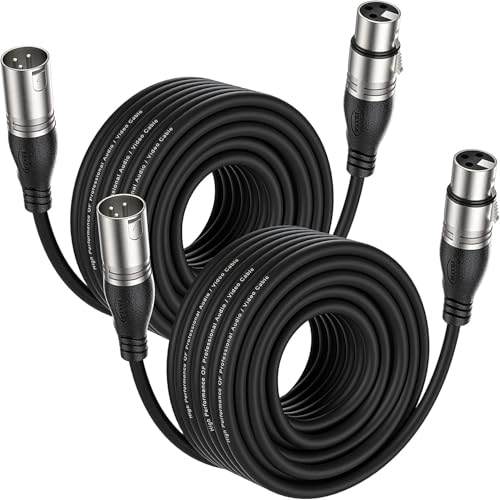
The EBXYA 50ft XLR cables come in a pack and emphasize anti-noise design with a high-density braided shield and oxygen-free copper conductors. The length supports stage runs and FOH to stage connections while aiming to preserve signal fidelity.
The connectors use a 3-pin balanced configuration (ground, hot, cold) with a locking mechanism to secure connections. The PVC jacket provides flexibility for routing and handling. These are suitable for longer balanced runs where shielding and conductor quality are priorities.
Cable Matters 1/4 Inch TRS To XLR Cable

This Cable Matters TRS-to-XLR cable is intended for balanced interconnections between equipment with XLR and 1/4-inch TRS jacks. The product lists oxygen-free copper (OFC) conductors and copper braided shielding for hum cancellation.
Specification notes the TRS→XLR cable is not for microphone use in some cases (depends on source level and wiring). It is commonly used for line-level balanced connections between DI boxes, interfaces, mixers, and speakers supporting TRS inputs.
Cable Matters 2-Pack Premium XLR To XLR Cables

These Cable Matters XLR-to-XLR cables are designed for professional microphone and line-level use. They feature oxygen-free copper conductors and a balanced design to minimize interference and maximize audio clarity.
The 2-pack format supports redundancy or multiple channel setups. The soft PVC jacket protects the cable while preserving flexibility for studio and stage routing. These cables are a standard choice when both devices accept XLR connections for balanced audio paths.
Buying Guide: Choosing The Right XLR To Speaker Cable
Selecting the correct cable depends on device compatibility, signal type, run length, and interference environment. The following sections highlight the most important considerations.
Connector Compatibility
Confirm the input and output connectors on your source and destination. Common pairings include:
- XLR (balanced) to XLR (balanced) — standard for microphones and many speaker inputs.
- XLR (balanced) to 1/4″ TRS (balanced) — used when speakers or interfaces accept TRS line-level balanced inputs.
- XLR to unbalanced connectors (RCA or TS) — requires care; signal level and wiring differences can cause noise or level mismatches.
Signal Level And Wiring
Ensure the cable wiring matches signal expectations. Balanced cables carry hot (+), cold (-), and ground. When converting between balanced and unbalanced connections, expect level drops or phase changes without proper DI or transformer. Use balanced-to-unbalanced adapters only when you understand the signal chain.
Shielding And Conductor Quality
Braided shielding and oxygen-free copper (OFC) conductors improve noise rejection and frequency response. For long runs, thicker conductors (lower AWG) reduce resistance. Choose cables with dense shielding in environments with stage lighting, wireless gear, or nearby power cables.
Cable Length And Signal Integrity
Longer runs increase capacitance and potential signal degradation. For runs over 50 feet, select high-quality balanced XLR cables with solid shielding and OFC conductors. Consider using line-level DI boxes or stage snake systems for complex setups.
Durability And Connector Construction
Look for solid connector housings (metal preferred), secure locking mechanisms on XLRs, and strain relief at each end. Flexible jackets (PVC or rubberized) help with routing and reduce connector stress in live scenarios.
Use Case Scenarios
- Studio: Prefer XLR-to-XLR OFC cables for mic and monitor connections to preserve fidelity.
- Live PA: Use balanced XLR-to-TRS or XLR-to-XLR with locks and durable jackets for stage runs.
- Portable/Runs Between Devices: Choose pre-terminated TRS↔XLR cables only if connector types match and signal levels are appropriate.
Multiple Comparison Perspectives
When comparing cables consider:
- Electrical Performance — conductor material, gauge, and shield density.
- Mechanical Reliability — connector plating, locking, and jacket durability.
- Compatibility — correct pin wiring and matching of balanced/unbalanced expectations.
- Length And Use Environment — stage vs studio, interference sources, and portability needs.
Following these guidelines will help you match the appropriate cable type to your equipment and application, ensuring balanced audio, minimized noise, and reliable connections for performance or recording.