Wireless rear speaker transmitters make adding surround channels easier without running long speaker cables. Below is a summary of five well-regarded kits selected for stability, latency, power, and compatibility with A/V receivers.
| Product | Key Strength |
|---|---|
| Nodelay S-AIR100-PRO | 5.8G Low Latency, 80W+80W Output, Volume Adjustment |
| DYNASTY PROAUDIO WSA-5RP | Dual-band 5.2/5.8GHz, Built-in 2×25–50W Amp |
| DYNASTY PROAUDIO WSA-5RP-PLUS | Higher Class D Power, Metal Chassis, 2×100W @4Ω |
| OSD Nero 5.8GHz Kit | Compact 5.8GHz Wireless, Subwoofer Output, Up To 100ft Range |
| BIC America WTR-Sys | 4-Channel Transmitter/Receiver, Designed For Powered Subs/Speakers |
Nodelay S-AIR100-PRO Wireless Kit

The Nodelay S-AIR100-PRO uses 5.8G wireless transmission to deliver an ultra-low latency (about 20ms) connection between transmitter and receiver. It emphasizes lossless sound quality and stable, interference-resistant audio suitable for home theaters.
Its amplifier capability is listed as 80W+80W (4Ω) default with options to adjust output power to better match passive surround speakers. The kit also provides surround speaker volume adjustment to fine-tune rear levels relative to room layout.
Use cases include converting passive bookshelf or in-wall rears to wireless while retaining fine volume control and higher power drive for demanding speaker loads.
DYNASTY PROAUDIO WSA-5RP
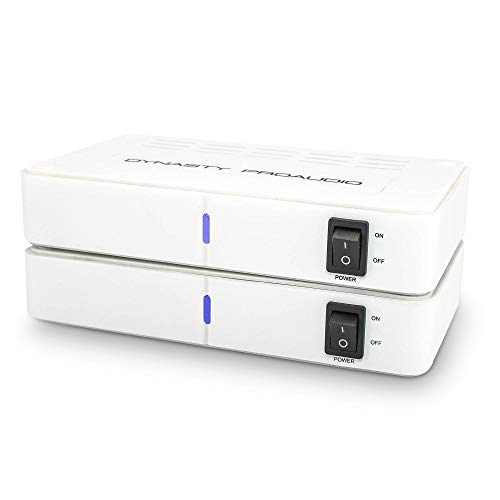
The WSA-5RP kit provides 5.2/5.8GHz dual-band selectable wireless with an advanced 106 RF channel auto-selection to minimize interference from routers and other devices. It targets near lossless audio and transmission stability.
Connectivity includes speaker line level input and stereo RCA, enabling integration with most A/V receivers or preamps. Built-in Class D amplification is rated at 2×25W RMS (8Ω) / 2×50W RMS (4Ω), allowing direct drive of passive surround speakers without a separate amp.
This kit suits users who want an integrated amp in the wireless receiver and dual-band control to avoid typical Wi‑Fi congestion.
DYNASTY PROAUDIO WSA-5RP-PLUS

The WSA-5RP-PLUS retains the dual-band 5.2/5.8GHz wireless approach and 106 RF channel selection, while offering increased amplifier capacity in a metal chassis. Amplifier ratings are listed as 2×100W RMS @4Ω (2×50W @8Ω), using Class D topology.
It shares easy stereo RCA and line-level inputs for receiver integration. The higher power output is designed for larger or less-efficient rear speakers and for users who need more headroom without an external amp.
Objective strengths include robust power handling and chassis durability; wiring convenience is preserved through standard line inputs.
OSD Nero 5.8GHz Wireless Kit

OSD Nero focuses on ease of placement and interference avoidance by using the 5.8 GHz band, which tends to be less crowded than 2.4 GHz. The system claims up to 100 feet of range and provides a subwoofer output in addition to rear amplification.
The product positions itself as a practical option for rental properties or rooms where running cable is impractical. The feature set emphasizes uninterrupted audio and simplified rear speaker expansion.
Ideal scenarios include modest-sized living rooms where wireless reliability in the 5.8 GHz band and a compact footprint are priorities.
BIC America WTR-Sys Wireless Kit
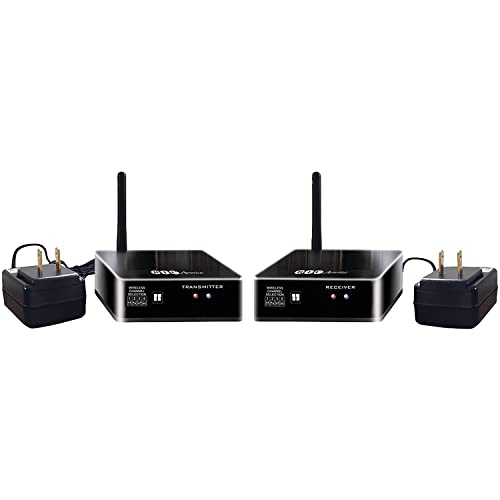
The BIC WTR-Sys is a 4-channel transmitter/receiver system intended for powered subwoofers and powered speakers. It simplifies wireless hookup for powered devices and is designed to solve wiring challenges quickly.
A key compatibility note: for powered speaker hookup the A/V receiver must have variable pre-amp out RCA jacks. The system’s multi-channel approach can suit setups that require multiple wireless outputs from a single transmitter.
This kit is objective in its focus on powered speaker/subwoofer use rather than driving passive speakers directly from the receiver unit.
Buying Guide: Choosing A Wireless Rear Speaker Transmitter
When selecting a wireless rear speaker transmitter, evaluate these core considerations to match the product to your room, speakers, and receiver.
- Wireless Band And Interference: 5.8GHz solutions often experience less congestion than 2.4GHz, but range and wall penetration differ. Dual-band units that offer 5.2/5.8GHz selectable channels provide flexibility to avoid local interference.
- Latency: Look for low-latency values (e.g., ~20ms or lower) if you watch video content; higher latency can cause audio lip-sync issues. Some kits advertise 20–25ms or lower.
- Amplifier Output / Speaker Type: Determine whether your rear speakers are passive (require amplifier) or powered. Kits with built-in Class D amps (specs like 2×25–100W) can drive passive speakers directly. Verify impedance matching (4Ω vs 8Ω).
- Inputs And Integration: Confirm transmitter inputs match your receiver’s outputs: options include RCA, speaker line-level, or pre-amp outs. Some kits require variable pre-amp outputs for powered speakers.
- Range And Room Layout: Vendors specify ideal ranges (line-of-sight vs through walls). Consider signal degradation across floors, thick walls, or long distances; higher frequencies tend to attenuate more through obstacles.
- Channel Selection And Auto-Switching: Advanced RF channel selection (e.g., 100+ RF channels auto-switching) helps avoid local wireless device conflicts.
- Adjustability: On-device or receiver-side surround level adjustment is useful to balance rears with front channels without reconfiguring the AVR.
- Build And Heat Dissipation: Metal chassis and proven Class D designs can be preferable if you plan sustained high-volume use; check thermal considerations and placement ventilation.
- Use Case Alignment: If you need a wireless subwoofer feed, choose kits with a dedicated subwoofer output. For passive rears, select units with adequate amplifier ratings and compatible impedance.
- Installation Simplicity: Plug-and-play kits simplify setup; confirm whether pairing is automatic and if cabling (RCA/3.5mm) is included.
Comparison Perspectives:
- Performance Focus: Prioritize low latency, dual-band RF, and auto channel selection for clean sync and minimal dropouts.
- Power Focus: Choose higher-rated amp kits (e.g., WSA-5RP-PLUS) for larger or inefficient passive speakers.
- Simplicity And Compatibility: For powered speakers or subs, pick systems designed for line-level outputs like BIC WTR-Sys or sub-specific kits.
- Range And Environment: For multi-room or rooms with many obstructions, favor lower-frequency 2.4GHz units for range or dual-band units that let you tailor performance.
Use the technical match—band, latency, power, and inputs—as your primary filter when deciding which wireless rear speaker transmitter best suits your home theater setup.