If you’re seeking true wireless freedom for practicing, recording, and live performances, a 2.4GHz or 5.8GHz wireless guitar system is your best bet. These picks suit players who want cable-free setups, reliable latency, and solid battery life for gigs, rehearsals, and studio work. Below are five top options, each chosen for different needs—compact practice setups, live stage reliability, or multi-channel versatility.
Buyer quick glance: the table summarizes each product’s core strengths and best-use scenario. This helps compare at a glance and then dive into specifics below.
| Product | Best For | Key Advantage |
|---|---|---|
| INGPARTNER 2.4GHz Wireless Guitar System (A9 Black) | Casual gigging players | Simple plug-and-play with clear LED status |
| LEKATO 5.8GHz Wireless Guitar System (WS-60) | Stage players needing strong interference resistance | 5.8GHz band for reduced congestion |
| Wireless Guitar System 2.4GHz 6 Channels (New Bee) | Bass and multi-instrument use | 6-channel design for versatile setups |
| WENTELMUSIC A9 Wireless Guitar System | Home practice to small venues | Low latency and easy pairing |
| Flatsons 5.8GHz Wireless Guitar System (TR-U2) | Gigging musicians in crowded RF environments | Longer battery life and multiple channels |
INGPARTNER 2.4GHz Wireless Guitar System A9 Black

The INGPARTNER A9 wireless system offers plug-and-play operation with a rechargeable transmitter and receiver. It highlights an easy setup: turn on and go, with color-coded lights indicating charging and guitar type. Best for players who want a straightforward, minimal-fuss experience.
- Best for: beginners and casual performers who value simplicity and quick setup.
- Why selected: reliable uncompressed 2.4GHz transmission with a stated range up to 100 feet and minimal latency.
- Caution: ensure a 5V charger is used to avoid battery damage.
LEKATO 5.8GHz Wireless Guitar System (WS-60)
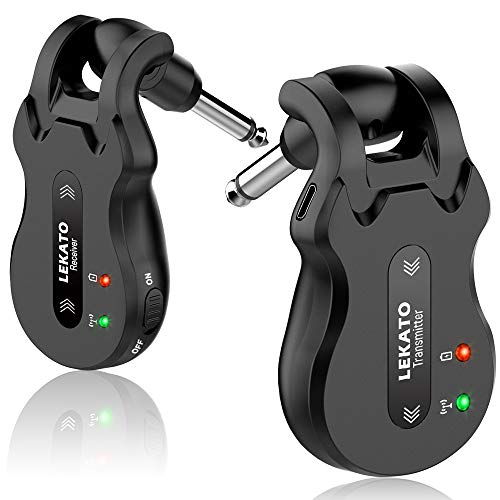
This LEKATO model uses a 5.8GHz band, which tends to resist common 2.4GHz interference in busy RF environments. It supports 24-bit/48KHz audio with latency under 6 ms and a practical range around 100 feet. It’s a strong pick for live performers who need stable signal in crowded rooms.
- Best for: players performing in venues where Wi‑Fi and Bluetooth traffic is heavy.
- Why selected: higher anti-interference capability compared to 2.4GHz systems.
- Caution: check compatibility with your instrument’s output and ensure the plug fits your guitar’s jack.
2.4GHz Wireless Guitar System Transmitter Receiver A12

The A12 system emphasizes crystal-clear 24-bit audio with no latency and a 100-foot range. It is rechargeable and designed for simple pairing, making it suitable for players who want a dependable wireless link without complicated setup. It supports both electric guitar and bass use cases.
- Best for: players seeking reliable 2.4GHz performance with straightforward pairing.
- Why selected: robust 24-bit/48KHz audio and longish range for studio and small venues.
- Caution: latency claims are dependent on environment; avoid congested RF spaces when possible.
Flatsons 5.8GHz Wireless Guitar System (TR-U2)

Flatsons uses the 5.8GHz band and promises high-fidelity sound with low distortion across 44.1kHz/24-bit audio. With a claimed 6+ hours of battery life and smart auto-sleep, it’s designed for extended gigs and rehearsals. The 270° rotatable plug assists compatibility with various guitar bodies.
- Best for: performers who need long battery life and dependable operation in crowded RF environments.
- Why selected: clear, high-quality audio with a longer runtime and auto-sleep to conserve power.
- Caution: as with other 5.8GHz systems, ensure the venue allows this band and check device compatibility with your guitar’s jack.
Buying Guide
- What to consider: RF band (2.4GHz vs 5.8GHz). 2.4GHz is universal but can suffer in Wi‑Fi-heavy spaces; 5.8GHz reduces interference but may have limited popularity in some venues.
- Latency and range: Look for latency under 6 ms for live playing and a practical range that fits your space, whether home practice, studio, or onstage.
- Power and charging: Rechargeable units with dual charging or quick-charge options minimize downtime between sets.
- Connectivity and compatibility: Check input/output options (1/4″ plugs, stereo vs mono) and whether the system supports active and passive pickups.
- Ease of use: A plug-and-play design with simple pairing reduces setup time before performances.
- Battery management: Auto-sleep features help preserve battery life; consider systems with indicator lights to monitor status quickly.
Frequently Asked Questions
Do wireless guitar systems introduce noticeable latency?
Most modern systems advertise latency under 6 ms, which is generally imperceptible to players during standard performances. Actual latency can vary by environment and device.
Can I use a wireless guitar system with any amp?
Yes, most wireless systems output a standard instrument signal that can connect to amps, audio interfaces, or direct-to-PA setups, though some devices may need adapters for certain inputs.
Which band is best for live venues with lots of Wi‑Fi?
The 5.8GHz systems typically offer better interference resistance in congested RF spaces, making them a safer choice in crowded venues.
Is it better to choose a system with multiple channels?
Multi-channel systems provide flexibility when using multiple guitars or connecting to multiple outputs, reducing the need to re-pair.
Are these systems safe for battery life during long gigs?
Look for models with rechargeable batteries, indicator lights, and auto-sleep modes; these features help ensure you won’t run out of power mid-performance.