Choosing an in-wall volume control lets you manage multi-room audio, protect amplifiers, and tailor listening levels per zone. Below is a concise comparison of the selected in-wall volume controls for quick reference, followed by focused product reviews and a buyer’s guide to help you match features to your installation needs.
| Product | Type | Power / Channels | Key Feature |
|---|---|---|---|
| OSD SVC100 | Rotary In-Wall | 100W / Pair | Impedance Matching, Multi-pair support |
| Pyle PVCD15 | Dual Rotary Plate | 120W Load Handling | Dual independent knobs, fits gang box |
| Recoil VC-R100 | Rotary In-Wall | 100W / Pair | 12-step adjustment, multi-pair support |
| Herdio 100W | Rotary In-Wall | 100W / Pair | 12-position precision, wide compatibility |
| Monoprice MVR-100 | Rotary In-Wall | 100W Per Channel | 4–16 Ohm support, 12 position rotary |
OSD 100W In Wall Volume Control
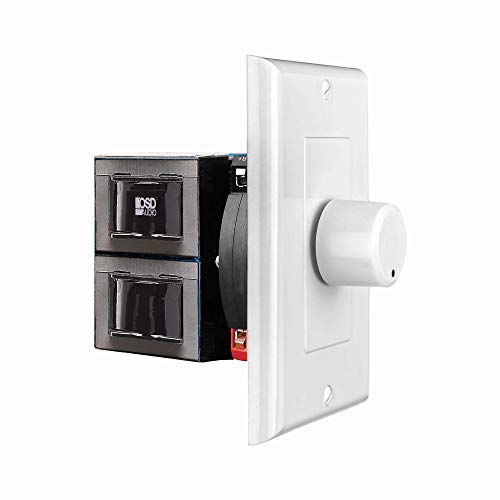
The OSD SVC100 is a 100 watt per channel rotary volume control designed for zone-based systems. It offers front-mounted adjustable jumpers to support up to eight pairs of 8-ohm speakers, allowing parallel connections across multiple zones.
Key features include impedance protection to stabilize the load returning to the amplifier and reduce overheating risk. The control maintains minimal bass roll-off, aiming for a fuller low-frequency response in connected speakers.
This unit is suited to installations where amplifier protection and the ability to drive many speakers from a single control are priorities. It uses a single rotary knob to manage the level of a paired speaker run independently from the main amp volume.
Pyle In-Wall Dual Knob Volume Control Plate
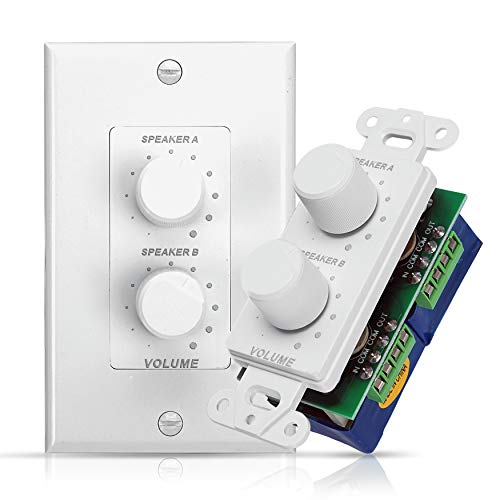
The Pyle PVCD15 installs in a standard junction/gang box like a light switch and features two independent rotary faders for controlling two speaker outputs or zones from a single plate.
This controller emphasizes ease of installation and straightforward operation: set the amplifier low, power on, and use the in-wall knobs to fine-tune remote speaker levels. The design is compatible with many home theater and multi-room setups.
Its dual-knob layout suits locations where two nearby speaker pairs require independent level control, such as adjacent rooms or indoor/outdoor speaker pairs. The unit is presented as a practical option for installers who prefer a standard wall-plate footprint.
Recoil VC-R100 In-Wall Volume Control

The Recoil VC-R100 is a 100W per channel impedance-matching in-wall control with adjustable jumpers and included faceplates in white and ivory. It provides a 12-step linear rotary control for fine volume adjustment.
Designed for hi-fi applications, this control supports multiple speaker connections—advertised up to eight pairs—while aiming to preserve full frequency response without significant low-frequency roll-off.
Its flush mounting and aesthetic plates make it suitable for visible living areas where both performance and appearance matter. The unit targets users who need an impedance-matching passive solution with clear step increments for repeatable settings.
Herdio 100W Flush In Wall Volume Controller

The Herdio 100W volume control emphasizes precise 12-position adjustment and broad compatibility. It is positioned for both professional and residential installations and claims smooth, low-noise rotation for accurate level setting.
Key attributes include the ability to drive multiple speakers in parallel and a high-quality build meant to withstand frequent use. The manufacturer highlights compatibility across many audio systems and a durable mechanical design.
This controller is aimed at users who want a reliable tactile feel and consistent step changes in volume, useful in rooms where repeatable settings are desirable or where multiple users might interact with the control.
Monoprice Rotary Speaker Volume Controller
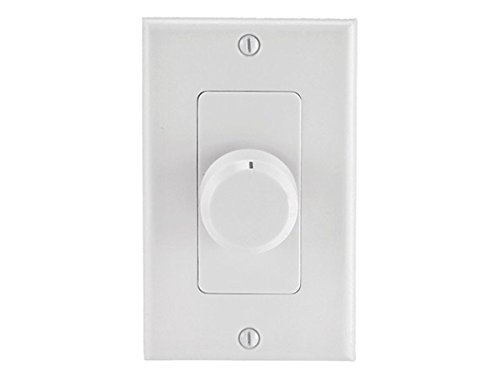
The Monoprice MVR-100 is a rotary wall plate control rated for 100 watts per channel and compatible with 4–16 ohm speaker loads. It offers a 12-position rotary range including an off position.
As a compact single-gang unit, this control appeals where wall space is limited. The product focuses on straightforward functionality and a recognized brand reputation for economical, dependable AV accessories.
Note that the MVR-100 does not include a mounting bracket, so installers should confirm gang box compatibility before purchase. Its simple feature set makes it a practical option for single-zone control needs.
Buying Guide: How To Choose Wall Speaker Volume Controls
Choosing the right wall volume control requires evaluating power handling, impedance behavior, control type, installation constraints, and long-term reliability. Below are the core considerations and comparison perspectives to guide your selection.
Power Handling And Wattage
- Match To Amplifier Output: Select controls rated equal to or above your amplifier’s continuous output to avoid overheating. Many options are 100W per channel; confirm amplifier RMS ratings.
- Multiple Speaker Loads: If running several speakers in parallel, ensure the controller supports the combined load without exceeding thermal limits.
Impedance Matching And Protection
- Impedance Matching Models: Controls with impedance protection (like impedance-matching transformers) help stabilize the load on the amplifier when multiple speaker pairs are connected.
- Passive Versus Active: Most wall controls are passive and require no power. Impedance-matching passive designs offer protection without introducing electronics into the signal path.
Control Type And Usability
- Rotary Knob: Provides tactile, continuous feel and often stepped detents for repeatable positions.
- Dual Knob Plates: Useful where two nearby speaker runs require independent control from a single wall location.
- Sliding Controls: Offer visual position cues and smooth adjustment; choose based on aesthetic and ergonomic preferences.
Installation And Compatibility
- Gang Box Fit: Confirm the control fits standard single or double gang boxes. Some plates expect a specific depth or mounting bracket.
- Wiring Considerations: Check the number of terminals and labeling for input/output and jumper placement when connecting multiple speakers.
- Faceplate Options: Available colors and finishes matter if the control is in a visible area; some units include multiple plates.
Audio Performance And Frequency Response
- Low-Frequency Roll-Off: Look for units that advertise minimal bass roll-off if preserving low-end response is important for your speakers.
- Step Resolution: 12-position controls offer repeatable settings; continuous pots may allow finer adjustments but may lack tactile reference points.
Durability And Long-Term Use
- Build Quality: Heavy-duty mechanical components reduce wear from frequent adjustments in shared spaces.
- Brand Support: Consider manufacturers with clear documentation and support channels for retrofits or replacements.
Comparison Perspectives
- Multi-Room Scale: For many pairs across a home, choose impedance-matching controllers that support multiple parallel connections.
- Single Zone Simplicity: For one pair of speakers, a simple rotary control (Monoprice, Herdio) often suffices and simplifies wiring.
- Aesthetics vs Functionality: Dual-plate designs trade wall real estate for two independent channels—suitable for grouped zone control versus discreet single-gang solutions.
Use the considerations above to prioritize protection, ease of installation, and the control style you and your household will use most. Confirm compatibility with your amplifier and speaker impedance before final selection.