Find the best VHF radio with GPS for safe, reliable marine communication. This guide highlights five dependable models chosen for different boating needs—from handheld flexibility to fixed-mount reliability. Best for small craft, coastal sailors, or crewed vessels, these options combine built-in GPS with NOAA weather, DSC distress, and clear audio. The top picks are evaluated on GPS accuracy, channel coverage, durability, and ease of use in emergencies.
| Product | Best For | Why It Stands Out |
|---|---|---|
| Cobra MR F77W GPS Fixed Mount | Fixed-mount boats; safety-focused | Built-in GPS, versatile 1/25W output, NMEA-style features |
| Retevis RM40 Marine Radio | Budget handhelds; quick rescue | GPS updates in real time; DSC, MOB alarm |
| Uniden UM725GBT | Tech-savvy crews; Bluetooth users | GPS built-in; Bluetooth; largest display in class |
| Uniden UM725G | All-around fixed-mount compatibility | IPX8 submersible; built-in GPS; text messaging |
| Standard Horizon GX1410GW | Navigation-centric crews | Built-in WAAS GPS; high-res display; durable |
Cobra MR F77W GPS Fixed Mount VHF Radio
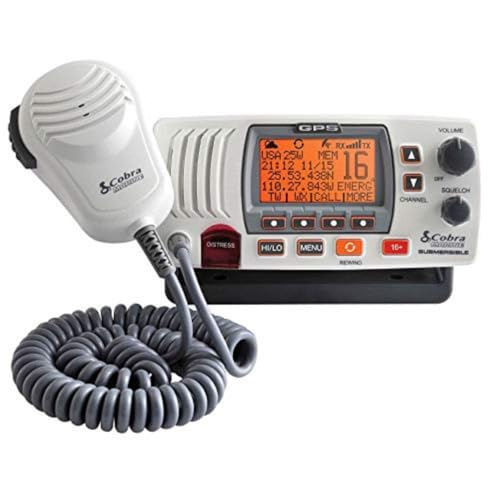
The Cobra MR F77W combines a built-in GPS receiver with VHF marine channels, offering 1 or 25 watts of power for short and long-range communication. The radio is submersible and features an LCD display along with a noise-cancelling microphone. This model is best for boaters who need reliable fixed-mount performance and immediate location sharing in distress.)
Best for: Boats that require fixed-mount reliability with integrated GPS for rapid emergency signaling. Limitations: May lack some advanced digital features found on higher-end models.
Retevis RM40 Marine Radio With GPS

The RM40 adds built-in GPS with real-time location updates, DSC distress calls, and a MOB alarm. It supports international channels and includes a 1500mAh battery for extended handheld use. Its DSC functions allow quick distress messaging and location sharing with responders.
Best for: Water enthusiasts and coastal navigators seeking a feature-rich handheld with emergency location sharing. Caution: Battery life and weatherproofing should be considered for prolonged offshore use.
Uniden UM725GBT Marine VHF Radio

The UM725GBT offers built-in GPS with Bluetooth connectivity, enabling easy pairing with smartphones. It supports all USA, Canada, and international channels, includes NOAA weather channels, and provides NMEA outputs for GPS and DSC data integration. It is a strong choice for tech-oriented crews who want integration with mobile devices.
Best for: Crew members who value device integration and modern connectivity. Caution: Bluetooth usage may require additional setup in busy marinas.
Uniden UM725G Marine VHF Radio (GPS Built-In)

This Uniden unit emphasizes a built-in GPS with comprehensive channel coverage and DSC capabilities, alongside text messaging for private crew conversations. It covers all US, Canada, and international channels at 1/25 watts and provides a large display for easy operation in rough seas.
Best for: Boats needing a reliable, GPS-enabled VHF radio with modern messaging features. Limitation: Some users may prefer more advanced integration options beyond DSC and GPS features.
Icom IC-M330G Ultra Compact VHF With GPS

The Icom IC-M330G is designed for compact spaces yet delivers GPS-enabled distress communication with strong audio performance. Its small footprint is ideal for tight helm configurations while maintaining a robust DSC safety feature set. It emphasizes ease of installation and reliable navigation.
Best for: Sailors needing a compact, GPS-equipped VHF with dependable DSC safety in tight spaces. Caution: The ultra-compact form factor may constrain large display visibility in some cockpits.
STANDARD HORIZON GX1410GW Eclipse Series

The GX1410GW Eclipse Series combines a 25W fixed-mount VHF with a WAAS GPS receiver for quick position sharing. It features a high-resolution display and a user-friendly menu system (E2O), along with IPX8 submersible durability. The model suits crews who need straightforward navigation and robust weather alerts.
Best for: Vessels prioritizing an ITU-R M493-16 Class D design with reliable GPS mapping and clear display. Caution: Some users may prefer a more feature-rich DSC suite depending on operations at sea.
Buying Guide: Key Purchase Considerations
- GPS Integration: Look for built-in GPS (WAAS if available) to enable location sharing in distress and smoother navigation updates.
- Transmit Power and Coverage: Choose 1W/25W dual output when possible to balance range and battery life for handhelds; fixed-mount units often default to 25W for coastal ranges.
- DSC and Weather: Ensure DSC distress capability and NOAA weather alerts for timely weather updates and emergency signaling.
- Durability and Water Resistance: IPX ratings (IPX7/8) indicate how well a radio stands up to splashes or immersion; fixed-mount units are typically more rugged.
- Display Size and Usability: Large, high-contrast displays reduce eye strain in rough seas; consider menu simplicity (E2O or similar) for quick operation.
- Compatibility and Connectivity: Some models offer Bluetooth or NMEA interfaces for GPS data sharing with other devices; plan integrations before purchase.
FAQ
- Do VHF radios with GPS require a subscription? No. GPS data and DSC distress do not require a subscription, though some features may be enhanced by connected devices.
- Is IPX8 waterproof better than IPX7 for marine radios? Yes, IPX8 typically allows submersion deeper or longer than IPX7, which is beneficial if the radio may be submerged.
- Can I use GPS data with other marine electronics? Many radios offer NMEA0183/NMEA2000 interfaces to share GPS data with chart plotters and multifunction displays.
- What’s the advantage of 25W over 1W on VHF radios? 25W provides longer range, especially important for open water or long-distance signaling, while 1W conserves battery life on handhelds.
- Are handheld VHF radios with GPS adequate for offshore sailing? They can be, but fixed-mount radios often offer greater durability and power; evaluate your vessel size and usage.
- Do I need GPS if a radio has DSC? GPS improves location accuracy for DSC calls and distress positions, making it highly recommended.