Choosing the right wall mount for tower or large bookshelf speakers requires matching weight capacity, adjustability, and installation type. The table below summarizes five mounts selected for strong load ratings, full-motion adjustability, and universal compatibility. Each product section that follows includes features, pros, and practical notes based on the manufacturer’s listed specifications.
| Product | Brand | Max Load | Key Feature |
|---|---|---|---|
| Mount-It! Bookshelf Speaker Wall Mount (MI-SB37) | Mount-It! | 55 lbs | Side-clamp design, cable management |
| Howonder Speaker Wall Mount HD-319 (2 Pack) | Howonder | 100 lbs | Tilt, adjustable distance from wall |
| DAGCUXIN Speaker Wall Mount DX-319 (2 Pack) | DAGCUXIN | 100 lbs | Tilt, adjustable wall distance |
| Howonder All Metal Speaker Wall Mount HD-618 (2 Pack) | Howonder | 30 lbs | Wide swivel and tilt range |
| Nbguigdstr Universal Speaker Wall/Ceiling Mount | Nbguigdstr | 30 lbs | 180° horizontal & vertical adjustment |
Mount-It! Bookshelf Speaker Wall Mount, MI-SB37
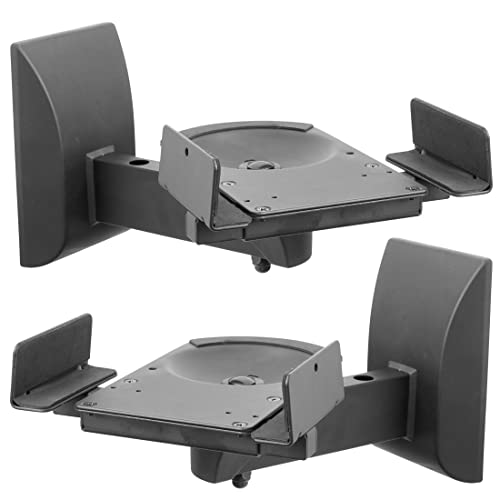
Compatibility And Design: This pair of brackets is built for medium to large bookshelf or satellite speakers with widths between 5.38″ and 11.13″. The side-clamp form factor secures speakers without top or bottom supports.
Load Capacity And Materials: Constructed from solid steel with ABS covers, each mount supports up to 55 lbs. Cable management is integrated into the design for cleaner installations.
Notes: The product lists compatibility with many major speaker brands. Verify speaker width before purchase. Installation requires mounting into studs or appropriate anchors for heavy loads.
Howonder Speaker Wall Mount HD-319 (2 Packs)

Capacity And Adjustment: Specified to hold up to 100 pounds, this mount is targeted at professional audio and larger PA-style speakers. Features include a 45° tilt and selectable wall distances (10″, 12″, 14″).
Construction And Installation: Made of solid steel, the bracket emphasizes secure installation for heavier speakers. The adjustable distance lets users optimize the speaker position for room acoustics or clearance.
Notes: For heavy loads, anchor points and wall type (concrete, brick, studded drywall) should be confirmed. Use recommended hardware for safe support of large tower-like speakers.
DAGCUXIN Speaker Wall Mount DX-319 (2 Packs)

Heavy-Duty Support: The DX-319 mirrors HD-319 specifications with a 100-pound per-pair rating and a 45° tilt range. The bracket allows adjustable projection from the wall to set ideal speaker placement.
Material And Use Cases: Solid steel construction targets PA and professional speakers, or large tower-style units requiring strong anchoring. Adjustable distance offers flexibility for room setups and visual clearance.
Notes: Confirm mounting surface and use appropriate fasteners for rated loads. Adjustable hardware helps tailor aim but verify alignment and torque on mounting bolts after installation.
Howonder All Metal Speaker Wall Mount HD-618 (2Packs)

Swivel And Tilt Range: This all-metal mount provides 90° vertical and 150° horizontal rotation, enabling precise aiming for surround or tower speaker arrays. It is rated to support up to 30 lbs.
Durability: The manufacturer notes a long service life and suitability for indoor or outdoor use. The compact footprint suits smaller tower or bookshelf speakers that fall within the weight limit.
Notes: Ideal for medium-weight speakers where wide adjustability is a priority. For heavy tower speakers, choose higher-capacity brackets or multiple anchor points.
Nbguigdstr Universal Speaker Wall/Ceiling Mount Brackets

Full Motion Adjustment: These brackets offer 180° horizontal and vertical adjustment to fine-tune sound projection and imaging. Each bracket supports up to 30 lbs.
Installation Notes: Hardware is included but may be specified for solid and brick walls only. The listing flags limitations for hollow plaster or boarded surfaces, so select appropriate anchors for drywall installations.
Notes: Suitable for smaller tower models or satellite speakers when weight limitations are observed. The multi-axis adjustment helps when aiming speakers in non-standard room layouts.
Buying Guide: Choosing A Mount For Tower Speakers
Load Capacity And Safety Margin: Select a mount with a rated capacity comfortably above the speaker’s weight. For tower or large speakers, choose mounts rated for at least 20–30% more than the speaker weight to allow a safety margin.
Mount Type And Speaker Interface: Determine whether the speaker has mounting points, a flat base for clamps, or requires side-clamp or shelf-style brackets. Side-clamp and shelf brackets suit wider bookshelf/tower designs, while bolt-on mounts suit speakers with threaded inserts.
Wall Construction And Anchors: Match hardware to wall type. Use stud mounting for highest strength with heavy speakers; for concrete or brick, use proper masonry anchors. Avoid relying solely on drywall anchors for heavy loads.
Adjustability (Tilt/Swivel/Distance): For optimal imaging and bass response, choose mounts offering both tilt and swivel. Adjustable distance from the wall helps avoid rear-ported speaker obstructions and improves dispersion.
Multiple Attachment Points: For very heavy tower speakers, consider mounts that distribute load across multiple studs or a dedicated cleat. Some professional mounts use reinforcement plates or dual attachment points.
Material And Corrosion Resistance: Solid steel frames offer higher durability for heavy speakers. For outdoor or humid environments, look for corrosion-resistant finishes or stainless components.
Compatibility And Size Limits: Check the bracket’s width and clamp range against the speaker cabinet dimensions. Verify clearance for speaker terminals and cables when planning placement.
Installation Complexity: Consider whether the mount includes all required hardware and whether installation will need two people for aligning heavy speakers. For permanent installations, plan for torque checks after a few weeks.
Acoustic Positioning: Think about listener height and the room’s primary seating area. Wall mounts are best used to position tweeters at ear level when seated and to angle speakers toward the listening position.
Future Flexibility: If you may upgrade to heavier speakers, choose a mount with higher capacity or adaptable mounting options to avoid redoing hardware later.
Comparison Perspectives: Compare by capacity (30–100+ lbs), adjustment range (tilt/swivel/depth), mounting style (clamp vs bolt-on), and installation requirements (stud vs masonry anchors). Prioritize safety and proper load distribution for tower-class speakers.