Ground loop noise can ruin low-frequency performance from subwoofers and amplifiers. This guide reviews five ground loop isolators and isolation transformers suited for subwoofer setups, with features, compatibility notes, and practical use cases to help you choose the right device for home or car audio systems.
| Product | Brand | Type / Key Feature |
|---|---|---|
| Blue Jeans Cable Audio Isolation Transformer | Blue Jeans Cable | Isolation transformer designed for subwoofers/full-range audio |
| Conext Link RCA Stereo 2 Channel Isolator | Conext Link | RCA two-channel isolator, filters DC current in signal path |
| Duttek RCA Ground Loop Noise Isolator | Duttek | Gold-plated RCA male-to-female hum eliminator |
| Isolation Transformer / Ground Loop Isolator (MCM) | MCM | Broadband isolation transformer intended for RF/coax isolation and AC hum |
| BESIGN Ground Loop Noise Isolator (3.5mm) | BESIGN | 3.5mm inline isolator for devices and Bluetooth receivers |
Blue Jeans Cable Isolation Transformer

The Blue Jeans Cable unit is an audio isolation transformer explicitly marketed for subwoofers and full-range audio. It includes an instruction sheet to help diagnose hum issues and a revised design intended to improve performance.
Features listed by the manufacturer include an assembly in Seattle and a guided setup process. This product separates the signal ground between components to interrupt ground loop currents while maintaining audio integrity.
Best suited for home theater subwoofers and amplifier chains where a dedicated transformer-grade isolation is preferred. Installation requires proper RCA wiring and attention to signal polarity.
Conext Link RCA 2-Channel Isolator

The Conext Link isolator is a dedicated RCA stereo two-channel device designed to eliminate humming and buzzing between the source and amplifier caused by ground loops.
Key listed features include filtering out DC current in the signal path and a cylindrical metal housing for durability. It is intended for systems using RCA interconnects, making it directly applicable to most powered subwoofer connections.
Because it specifically references filtering DC and ground loop hum in the signal path, this unit is appropriate when the hum is audible through the subwoofer but wiring is otherwise standard.
Duttek RCA Ground Loop Isolator
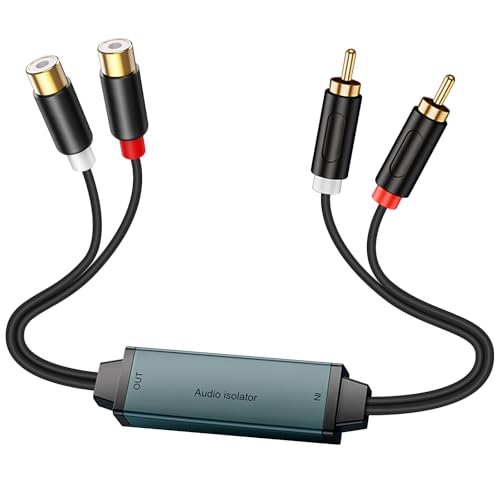
The Duttek isolator is a plug-and-play RCA male-to-female device described as an instant hum eliminator for car, home theater, DJ, and subwoofer setups. It highlights universal compatibility and gold-plated connectors.
Manufacturer features emphasize ease of installation (IN to source, OUT to speaker), compatibility with various audio gear, and low-frequency hum suppression. No extra wiring or power is needed.
Typical use cases include connecting a subwoofer or amplifier where the hum is introduced via RCA leads. The compact form factor is convenient for tight rack or vehicle installations.
MCM Isolation Transformer / Isolator
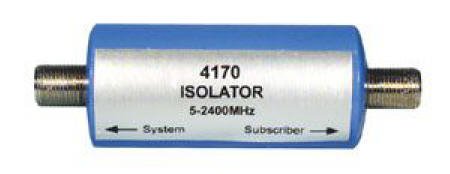
MCM’s product is described as an isolation device with an operational bandpass and notes relating to RF and coaxial applications. It is intended to isolate AC hum between RF devices via coax connections.
Manufacturer notes warn that the device does not provide a path for AC or DC voltages and is not for satellite/dish data streams. It recommends powering isolated devices from the same outlet or power strip.
While primarily oriented toward RF/coax scenarios, the underlying isolation principle can reduce hum in some audio chains, but it is important to verify interface compatibility and frequency response before using on a subwoofer audio line.
BESIGN 3.5mm Ground Loop Isolator

The BESIGN inline isolator uses a 3.5mm cable to address hiss, buzz, and interference caused by ground loops, commonly in setups using phones, Bluetooth receivers, or portable players feeding a subwoofer input.
Features include explicit compatibility with devices that have 3.5mm jacks, and the product is marketed for both car and home stereo systems. It targets noise from shared power sources in Bluetooth or auxiliary configurations.
This isolator is practical when a subwoofer input is driven by a Bluetooth receiver or smartphone via a 3.5mm-to-RCA adapter; it interrupts loop currents on the low-level signal before they reach the amplifier.
Buying Guide: Choosing A Ground Loop Isolator For Subwoofers
Identify The Hum Source — Determine whether the noise is a true ground loop (steady 60Hz hum or low-frequency buzz) or alternator/engine whine in vehicles (frequency varies with RPM). Ground loops typically persist with engine off but powered devices connected.
Match Connector Type — Use an isolator with the same connectors as your signal chain: RCA is standard for subwoofers and AV receivers, while 3.5mm inline units suit Bluetooth adapters and portable sources. Using adapters can add points of failure.
Isolation Method — Isolation transformers deliver galvanic isolation and often better low-frequency integrity. Passive inline RCA isolators are convenient and effective for many cases. Verify the device’s stated purpose for audio use.
Frequency Response And Low-End Integrity — Subwoofers require accurate low-frequency transmission. Choose isolators or transformers that maintain low-frequency response without attenuation or phase issues. Manufacturer documentation or reviews can indicate performance on bass frequencies.
Signal Loss And Impedance — Some isolators can slightly reduce signal level or alter impedance. Devices designed for audio typically minimize this, but if gain is critical, verify whether an inline attenuator or gain adjustment will be necessary downstream.
Build Quality And Connectors — Metal casings and gold-plated RCA contacts improve durability and contact reliability. For in-vehicle use, ruggedized bodies are preferable to withstand vibration.
Compatibility With Amplifiers And Receivers — Ensure the isolator allows correct wiring for subwoofer LFE or stereo low-level inputs. When using stereo-to-mono summing or converters, confirm that the isolator can be integrated without introducing ground or phase problems.
Electrical Safety And Powering Considerations — Isolation devices do not carry AC power between components. Do not attempt to pass power through the isolator. If multiple devices share the same AC outlet, try plugging audio gear into a common power strip to reduce potential differentials.
Vehicle-Specific Considerations — For alternator whine or electrical system noise, look for isolators marketed for car audio and note any suggestions to use high-quality RCA cables. Alternator noise may require a different filter or a power-line fix rather than a simple audio isolator.
Installation Tips — Place the isolator close to the audio source or amplifier input, keep RCA runs short, and route power cables separately from audio interconnects. Test with and without the isolator to confirm that the hum reduction is effective.
Multiple Comparison Perspectives — Compare: transformer-based isolation (Blue Jeans, MCM) for robust galvanic isolation versus compact RCA inline isolators (Conext Link, Duttek) for convenience. 3.5mm inline options (BESIGN) work well for Bluetooth or portable sources. Consider application, expected low-frequency performance, and connector compatibility when selecting.