Choosing the right stereo speaker switch box helps you route audio to multiple rooms, compare amplifiers, or protect your amplifier from impedance issues. Below is a quick summary of five well-known options and their core features to help you compare at a glance.
| Product | Type | Key Feature |
|---|---|---|
| Pyle 4-Zone Speaker Switch Selector (PSS4) | 4-zone distribution | SPEAKER SELECTOR, Supports 4 Pairs |
| Pyle 6-Zone Speaker Switch Selector (PSS6) | 6-zone distribution | Up To 6 Separate Speaker Pairs |
| Pyle 4 Channel Speaker Selector (PSLSW4) | 4-zone with volume control | Independent Volume For Each Pair |
| ADWITS 2-Channel Speaker Switcher | 2-way selector | 2 Pair Control, 150W RMS Per Channel |
| SOLUPEAK 2-In-1-Out / 1-In-2-Out Switcher | A/B amp & speaker comparator | Switch Between Amps Or Speaker Pairs, Banana Jacks |
Pyle 4-Zone Speaker Switch Selector – PSS4
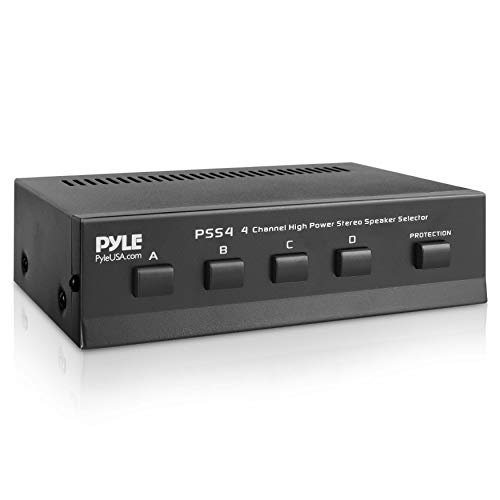
This unit is a compact 4-zone speaker selector designed to connect one stereo amplifier to up to four pairs of speakers. The product listing highlights it as a SPEAKER SELECTOR, with push-button switches for each zone. Connections are typically screw-terminal style and it’s intended for multi-room or multi-zone setups.
Use cases include sending the same stereo signal to different rooms or switching speaker pairs on and off. As a passive device, it does not require external power. Check impedance compatibility when connecting multiple speakers to prevent overloading the amplifier.
Pyle 6-Zone Speaker Switch Selector – PSS6

The Pyle PSS6 expands the zone count to six speaker pairs, giving broader distribution options for larger homes or venues. The listing emphasizes the capability to connect Up To 6 Separate Speaker Pairs To Your Stereo System.
The selector uses individual switches for each pair so you can activate zones independently. It’s suitable where a single amplifier must serve many rooms; however, confirm your amplifier’s power and impedance handling before connecting multiple pairs simultaneously.
Pyle 4 Channel Speaker Selector Switch – PSLSW4
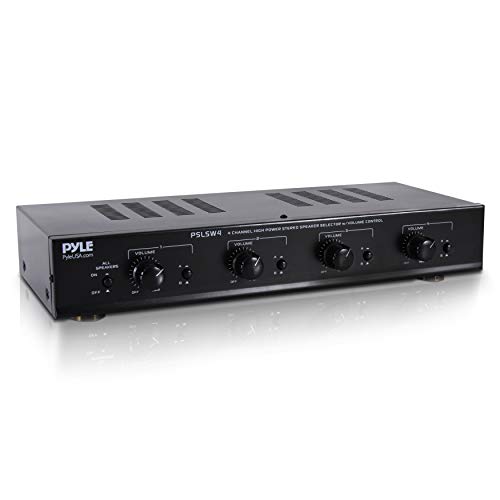
The PSLSW4 is marketed for multi-zone control with independent volume adjustments. Key features include a 100W max per channel rating, support for up to four speaker pairs, screw-type terminals accepting up to 14 AWG, and independent volume controls for each zone.
This model suits users who want per-room level control without adding individual amplifiers. Its push-button activation and volume knobs allow mixing zones or running combinations. Verify speaker impedance (typically 8 ohms) and aggregate load limits to ensure amplifier safety.
ADWITS 2-Channel Speaker Switcher Selector Box

This ADWITS unit is a 2-way stereo speaker control designed to let one amplifier drive two pairs of speakers or to switch between them. The listing calls out 150W RMS per channel and the option to play either pair or both simultaneously.
The device is suitable for simple A/B selection in small systems, or for low-cost distributed audio in residential or commercial applications. Terminal clamps make wiring straightforward. Ensure combined impedance and power distribution are within your amplifier’s safe range.
SOLUPEAK 2-In-1-Out / 1-In-2-Out Amp Switcher
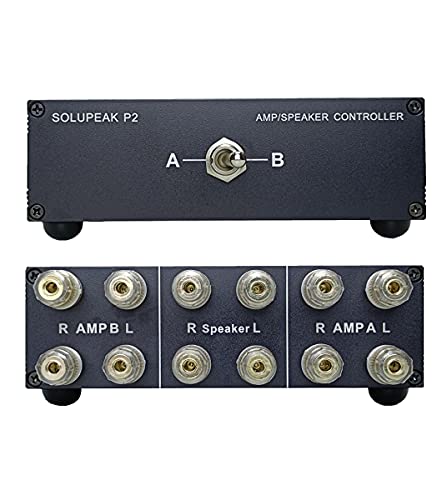
The SOLUPEAK switcher is a passive A/B comparator that can operate as 2-in-1-out (two amplifiers to one speaker) or 1-in-2-out (one amp to two speaker pairs). The listing notes it uses gold-plated banana jacks and supports quick A/B switching. It’s not designed for simultaneous A+B operation in some modes.
This unit is useful for comparing amplifiers, testing speaker pairs, or quickly swapping signal paths. As a passive device, it requires no power and is plug-and-play. Note the limitation that some configurations only allow one output at a time rather than parallel outputs.
Buying Guide: How To Choose A Stereo Speaker Switch Box
Selecting the right speaker switch box involves matching functionality to your setup. Below are the main considerations to evaluate before purchase.
Zone Count And Flexibility
Determine how many speaker pairs you need to control. 2-way boxes are fine for simple A/B switching. 4-, 6-, or 8-zone boxes suit multi-room audio. Consider future expansion when picking zone count.
Impedance And Amplifier Protection
Multiple pairs in parallel reduce overall impedance. Choose a selector with impedance matching or a load protection scheme if you plan to drive several pairs at once. Always confirm your amplifier’s safe load range and power handling.
Power Ratings And Continuous Handling
Look at both RMS and peak power specifications when provided. Some units list per-channel wattage (e.g., 100W or 150W). Ensure the selector can handle your amplifier’s continuous output to avoid overheating or failure.
Volume Control And Zone-Level Adjustment
Integrated volume knobs for each zone allow independent level control without extra hardware. Choose this if you need per-room volume customization; otherwise a simpler push-button selector may suffice.
Connection Types And Wire Gauge
Terminal styles vary: screw terminals, spring clamps, or banana jacks. Confirm compatibility with your speaker wires and whether the unit accepts thicker gauge wire (e.g., up to 14 AWG). Gold-plated jacks offer corrosion resistance and better contact quality.
Passive vs Active Units
Most switch boxes are passive (no external power) and simply route signals. Active units may offer impedance matching, protection circuits, or amplified distribution. Choose an active model if you need load protection or signal buffering.
Simultaneous Operation vs A/B Only
Some boxes allow A, B, or A+B operation (simultaneous outputs). Others operate strictly as A/B comparators. If you want to drive multiple zones at once, confirm simultaneous operation capability and verify aggregate load implications.
Build Quality And Installation
Metal housings and robust connectors increase longevity in frequent-use installations. Consider mounting options and the physical footprint for rack or shelf placement. Clear labeling of terminals simplifies wiring during setup.
Use Cases And Application Fit
- Multi-room Home Audio: Prefer multi-zone with per-zone volume control and load protection.
- Simple A/B Comparison: Choose a compact passive A/B switcher with banana jacks for quick swaps.
- Commercial Installations: Look for higher channel counts, rugged construction, and clear wiring options.
Safety And Best Practices
Always power down your amplifier when connecting or disconnecting speaker wires. Avoid connecting too many speaker pairs in parallel without impedance matching. When in doubt, consult the amplifier manual or a qualified technician to prevent damage.