Looking to improve your vehicle’s audio without a complete overhaul? The best car speakers deliver clearer highs, tighter bass, and less distortion at higher volumes. This guide highlights five top options, each suited to different drivers—whether you want a factory-like replacement, Bluetooth convenience, or a robust, high-power upgrade. The listed products balance efficiency, sound quality, and ease of installation, helping you choose the right match for your car and listening style. Below is a quick buying table to compare key choices at a glance.
| Product | Best For | Why It Stands Out |
|---|---|---|
| Pioneer F-Series TS-F1634R 6.5” (Pair) | Stock replacement | High efficiency, solid 200W max, 2-way coaxial |
| AGPTEK Car Speaker With Bluetooth 5.3 | Convenience on the go | Bluetooth 5.3, hands-free, clip-on visor use |
| BOSS Chaos CH6530 6.5” (Pair) | Budget upgrade | 3-way design, higher power handling |
| Pioneer TS-F6935R 6×9 (Pair) | All-around upgrade | 3-way, good for larger cabs, strong highs |
| Kenwood KFC-1666R (Pair) | Quality, classic choice | Cloth woofer, balanced dome tweeter, reliable |
Pioneer F-Series TS-F1634R 6.5” 2-Way Speakers (Pair)

Power Handling: 200W max (25W nominal) with 4-ohm impedance supports a dynamic, punchy sound. The 2-way coaxial design combines a woofer and tweeter for a balanced full range. With 88dB sensitivity, you can achieve clear output at moderate power without excessive distortion.
Best for: Car owners seeking a straightforward factory replacement that improves clarity and volume without complex tuning. Choose this if you want a clean, reliable upgrade that preserves OEM power levels.
Limitation: Higher-wower setups may benefit from mid-range or additional components to maximize bass performance beyond stock levels.
AGPTEK Car Speaker With Bluetooth 5.3

Features include a built-in 3W microphone for hands-free calls, Bluetooth 5.3 for quick connections, and a visor-clip design for easy mounting. It supports music playback from Bluetooth or TF card and lets Siri/Google Assistant be summoned via the M button.
Best for: Drivers who want quick, portable audio enhancements with hands-free calling and smart assistant access. Ideal for small-to-mid size vehicles where discreet placement is preferred.
Caution: Prolonged use of fast charging on the device may affect the charging IC; avoid excessive fast-charging sessions.
BOSS Chaos CH6530 6.5” Car Door Speakers (Pair)

Dimensions listed: 6.6 x 6.6 x 2.4 inches with 4-ohm impedance and 2.1-inch mounting depth. A solid option for an affordable, 3-way upgrade that adds clarity across low-to-mid frequencies and increases overall volume without extra amps.
Best for: Budget-conscious buyers who want a tangible upgrade over stock speakers without complex installation. Better suited for front or rear door mounting in standard sedans or compact SUVs.
Limitation: Without specifying a dedicated tweeter crossover details, some high-end dynamics may require additional tuning for peak clarity.
Pioneer TS-F6935R 3-Way Coaxial 6’x9’ (Pair)

Power Handling: 230W max (30W nominal) with 4-ohm impedance. The 3-way coaxial setup integrates a woofer, midrange, and tweeter for well-balanced sound across low, mid, and high frequencies. Sensitivity is 87dB, enabling louder outputs with lower distortion at higher volumes.
Best for: Vehicles that benefit from a high-frequency spread and a broader soundstage, especially in larger cabins or trucks where 6×9 speakers can deliver robust bass with controlled highs.
Limitation: A 3-way design may require careful placement and potentially more mounting depth to achieve optimal performance in tighter doors.
Kenwood KFC-1666R Road Series 6.5” (Pair)
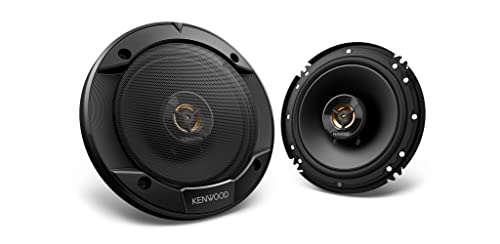
Features a 6.5″ 2-way coaxial design with cloth woofer cones and balanced dome tweeters. The 4-ohm impedance and a broad frequency response support clean highs and solid lows, while the rugged magnet design adds durability in daily driving conditions.
Best for: Audiophiles seeking a reliable, high-quality option that balances performance and cost. Good for front or rear installation where space and mounting compatibility align with standard 5-1/4″ cutouts.
Limitation: Peak power handling is strong, but real-world bass response depends on enclosure and vehicle acoustics; consider pairing with an aftermarket amp if chasing deep bass in a smaller car.
Buying Guide: Key Purchase Considerations
- Sound goals: Are you chasing clearer highs, stronger bass, or a balanced all-around upgrade? Pick a design (2-way, 3-way) that matches your priorities.
- Power availability: Ensure your head unit or amp can supply adequate RMS power for the chosen speakers. Higher max wattages require compatible amplification for best results.
- Size and fit: Measure mounting depth and hole size. 6.5″ and 6″ x 9″ are common, but some cars require special adaptations or spacers.
- Vehicle compatibility: Stock replacements are quickest for no-fuss upgrades. For vehicles with premium systems, replacing only certain channels can preserve overall balance.
- Installation ease: Coaxial designs simplify installation; component sets may require more wiring and crossovers but can offer superior sound separation.
- Durability and environment: Look for speakers built to handle ambient temperatures and road conditions. ABS baskets and robust magnets improve longevity.
Frequently Asked Questions
- Do car speakers need to be matched to an amp?
- What is a 2-way vs 3-way coaxial speaker?
- Is a higher sensitivity rating always better?
- Can I install new speakers myself?
- Should I replace all speakers at once?
Not always. Many coaxial speakers work well with head-unit power, but larger upgrades may benefit from an external amp to maximize output and clarity.
A 2-way design uses a woofer and tweeter, while a 3-way adds a midrange driver to improve mid-frequency clarity and overall balance.
Higher sensitivity means more volume per watt, but it also depends on head-unit power and room acoustics inside the car. Balance sensitivity with power availability.
Yes, many car speaker upgrades are DIY-friendly with basic tools. Check your vehicle’s door panel design and reference installation guides for each model.
Replacing multiple speakers can yield a more cohesive soundstage. If budget or compatibility is a concern, start with the most critical channels (front doors or front stage).