In-wall speaker volume controls let you tailor audio levels by room or zone without changing the main amplifier. Below is a quick summary of the selected products, followed by focused reviews and a practical buying guide to help choose the right wall switch for your setup.
| Product | Brand | Key Feature |
|---|---|---|
| OSD SVC100 In Wall Volume Control | OSD Audio | 100W Impedance Matching, Front Jumpers |
| Pyle PVCD15 Dual Knob In-Wall | Pyle | Dual Independent Rotary Controls, 120W Load Handling |
| Recoil VC-R100 Flush Rotary Control | RECOIL | 100W, 12-Step Rotary, Multi-Speaker Support |
| Rockville VOL70100 Wall Volume Control | Rockville | 70V/100V Commercial Use, 11-Step Attenuation |
| Monoprice Rotary Speaker Volume Controller | Monoprice | 100W Per Channel, 4–16 Ohm Compatibility |
OSD SVC100 In Wall Volume Control
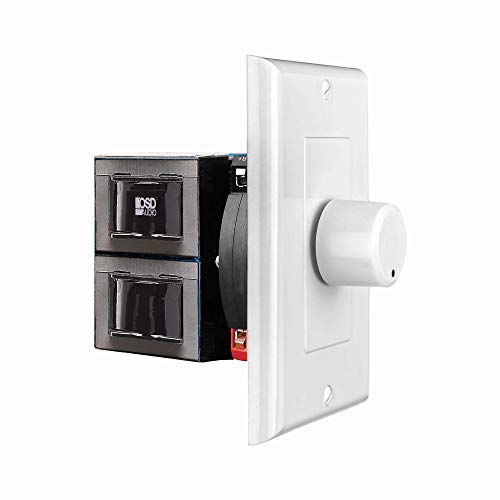
The OSD SVC100 is a passive in-wall volume control rated at 100 watts per channel. It includes front-mounted adjustable jumpers to support multiple parallel speaker pairs and offers impedance matching to stabilize load seen by the amplifier when multiple speakers are paralleled.
- High Power Handling: Maintains minimal bass roll-off at rated power.
- Impedance Protection: Helps prevent amplifier overheating in multi-speaker setups.
- Use Case: Suitable for homeowners adding zones while preserving amplifier stability.
Pyle PVCD15 Dual Knob In-Wall Control
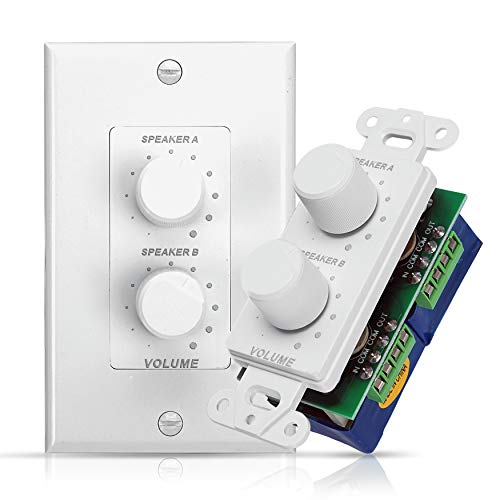
The Pyle PVCD15 is a dual-knob in-wall volume control that fits a standard junction box and handles up to 120W load. It provides two independent rotary controls so two speaker channels or two speaker pairs can be adjusted separately from a single wall plate.
- Dual Rotary Faders: Independent control for two stereo channels or two speaker sets.
- Easy Installation: Fits standard gang boxes and installs like a light switch.
- Operation Tip: Designed to be used with amplifier main volume set appropriately for remote attenuation.
Recoil VC-R100 Flush Rotary Volume Control

The Recoil VC-R100 is a flush-mounted, 12-step rotary in-wall controller rated at 100W per channel. It includes adjustable jumpers to support up to eight pairs of 8-ohm speakers while preserving hi-fi frequency response and minimizing low-frequency roll-off.
- 12-Step Adjustment: Discrete positions allow repeatable volume stops including off.
- Multi-Speaker Support: Jumpers permit multiple parallel speaker pairs with impedance considerations.
- Design: Flush plate with included faceplates for a clean wall appearance.
Rockville VOL70100 70V Commercial Volume Control

The Rockville VOL70100 is tailored for commercial distributed audio systems using 70V/100V lines. It provides 11-step attenuation including an absolute off position, and a detachable Euro-block terminal for quick wiring in single-gang boxes.
- 70V/100V Compatibility: Designed for commercial paging, retail, and hospitality audio networks.
- Durable Construction: Dust-protected internals and rugged ABS frame for demanding environments.
- Precision Control: Eleven attenuation steps help balance zones in multi-room installations.
Monoprice Rotary Speaker Volume Controller
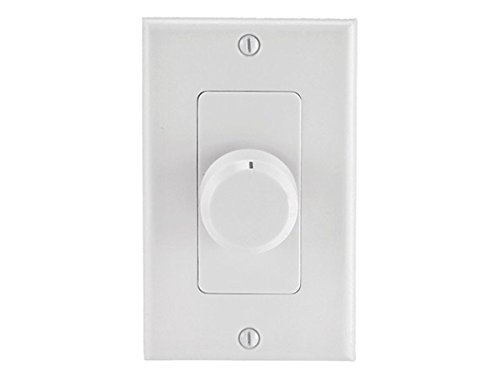
Monoprice’s rotary-type controller (MVR-100) supports up to 100W per channel and works with 4–16 ohm speaker loads. The control offers twelve positions including off, intended for single-gang mounting in residential audio zones.
- Wide Impedance Range: Works with common speaker impedances in home systems.
- 12-Position Rotary: Discrete steps for predictable volume adjustment.
- Note: Some models may not include a mounting bracket—verify box contents prior to installation.
Buying Guide: Choosing The Right In-Wall Speaker Volume Control
This guide covers technical and practical considerations to match a volume control wall switch to your audio system and usage scenarios.
Power Handling And Impedance
Match power ratings (watts) between the volume control and the amplifier to avoid overheating or reduced performance. For most home systems, 100W per channel controls are sufficient. Check impedance compatibility: many passive controls list 4–16 ohm, while some offer impedance matching features for parallel speaker arrays.
Number Of Speakers And Zoning
Decide how many pairs or zones you’ll run in parallel. Controls with adjustable jumpers or explicit multi-pair support (up to 8 pairs on some models) help maintain amplifier load stability when multiple speakers are paralleled.
Type Of System: Residential vs Commercial
For commercial distributed audio (restaurants, offices), choose a 70V/100V
Control Style And User Interface
Options include rotary knobs (discrete steps or continuous), dual knobs for two independent channels, and vertical sliders. Choose based on aesthetics, user familiarity, and desired precision (stepped vs continuous adjustment).
Installation And Mounting
Confirm the control fits standard single or double gang electrical boxes and whether additional faceplates or brackets are included. Euro-block or screw terminals simplify wiring; detachable connectors ease replacement without rewiring the entire wall.
Frequency Response And Audio Quality
Look for descriptions noting minimal bass roll-off or preservation of hi‑fi frequency response, especially when planning to control low-frequency content. Passive designs avoid introducing electronics that could color sound, but impedance matching features help maintain full-range output when multiple speakers are connected.
Durability And Environment
For outdoor or dusty environments, choose a control with protective internals or rugged frames. Commercial units often include dust protection and more robust materials for long-term reliability.
Compatibility And System Setup Tips
- Set the amplifier’s main volume appropriately when using remote attenuators to avoid clipping or distortion.
- For multi-zone systems, label controls and map zones to the amplifier outputs to prevent accidental misconfiguration.
- When parallel-connecting speakers, use impedance-matching features or consult amplifier ratings to avoid exceeding minimum impedance limits.
Consider these perspectives—power and impedance matching, zoning capacity, control style, installation needs, and environment—when selecting an in-wall speaker volume control for reliable performance and predictable audio results.