Choosing the right speaker volume control box affects sound distribution, amplifier safety, and room-level convenience. The table below summarizes five useful options across multi-zone selectors, in-wall controllers, and line-level attenuators so you can compare form factor and core features at a glance.
| Product | Type | Key Feature |
|---|---|---|
| Pyle 4 Channel Speaker Selector Switch | Multi-Zone Selector | 4 pairs, independent volume |
| Monoprice SSVC-4.1 4-Channel Selector | Multi-Zone Selector | Impedance protection, 4 zones |
| Pyle 6Channel Speaker Selector (PSPVC6.5) | Multi-Zone Selector | 6 pairs, individual volume |
| OSD SVC100 In-Wall Volume Control | In-Wall Rotary | Impedance matching, 100W/channel |
| TENEALAY RCA Line Volume Controller RC11 | Line-Level Attenuator | RCA analog input/output, mini knob |
Pyle 4 Channel Speaker Selector Switch
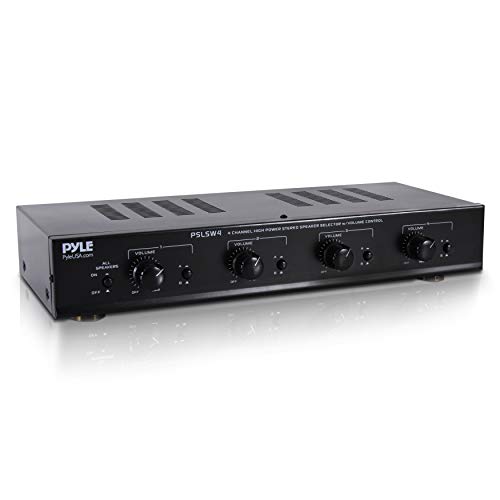
This multi-zone A/B speaker distribution controller supports up to four speaker pairs and provides independent volume control for each zone. It is rated for 100 watt max per channel and designed for use with 8 ohm speakers. The unit uses screw-type connector terminals that accept up to 14AWG speaker wire.
Features include push-button activation for each pair, allowing zones to be combined or used individually. This model is compact and suitable for tabletop placement near a receiver or amplifier. It is aimed at simple home theater and multi-room setups that require manual zone-level control.
Monoprice SSVC-4.1 4-Channel Selector
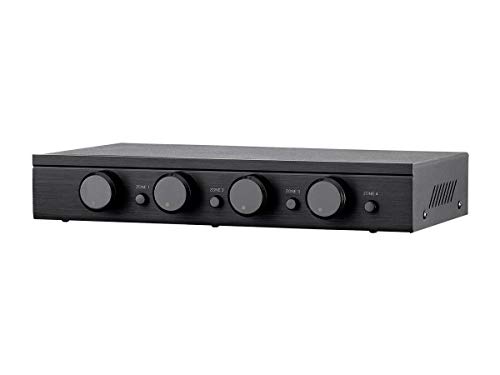
The Monoprice SSVC-4.1 is a single input 4-channel speaker selector with volume controls and automatic impedance protection circuitry. It supports continuous handling of 100 watts per channel and higher peaks, with explicit amplifier impedance guidance for multiple speaker selections.
Individual zone on/off buttons and dedicated volume knobs give straightforward control of each pair. The built-in impedance protection is designed to protect amplifiers when multiple speakers are paralleled, making this unit suitable for safer multi-room connections without external impedance-matching devices.
Pyle 6Channel Speaker Selector Hub

This Pyle hub controls up to six speaker pairs with individual volume settings, intended for flexible multi-zone audio management. The selector is described as compatible with a wide range of amplifiers and supports various speaker sizes from 4 to 12 inches.
Its design targets installations where convenience is needed to change a room’s volume without adjusting the amplifier directly. The multi-pair support and individual volume capability make it a central choice for larger homes or light commercial spaces that require distinct zone control.
OSD SVC100 In Wall Volume Control
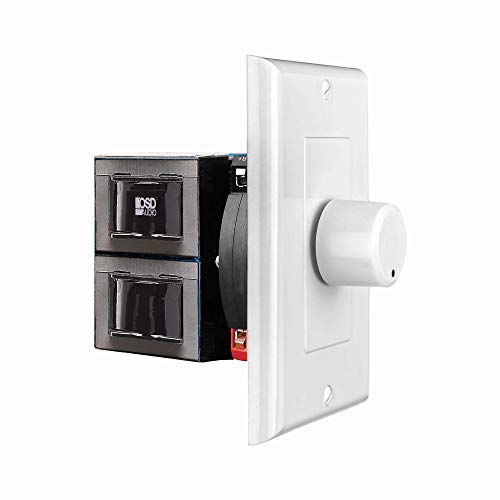
The OSD SVC100 is an in-wall rotary volume control rated at 100 watts per channel and includes front-mounted jumpers allowing multiple pairs to be tied in. It provides volume adjustment for a pair of speakers independently of other zones.
Notable is the impedance protection feature that helps stabilize the load seen by the amplifier when parallel connections are present. The SVC100 is suitable where a low-profile, wall-mounted control is preferred over tabletop selectors and is often used in built-in home audio installations.
TENEALAY RCA Line Volume Controller RC11

The TENEALAY RC11 is a mini line-level attenuator with RCA input/output sockets and a compact rotary knob. It does not amplify; instead, it provides quick adjustment of line-level volume between source and amplifier or powered speakers.
This device is useful for controlling volume where discrete adjustment of a single source is needed—such as for a subwoofer or an auxiliary input—without altering amplifier settings. Its small footprint makes it convenient for desktop or rack-mounted arrangements requiring simple, direct level control.
Buying Guide: Choosing The Right Speaker Volume Control Box
Selecting the appropriate volume control box depends on system size, amplifier compatibility, form factor, and safety features. Below are key factors to evaluate when comparing products.
1. Zone Count And Scalability
Decide how many zones or speaker pairs you need to control. 4- and 6-zone selectors allow centralized control for multiple rooms. For single-pair control, an in-wall or line-level attenuator may be sufficient.
2. Impedance Protection And Amplifier Safety
Look for impedance matching or protection if you will run multiple speakers in parallel. Units with automatic protection or matching circuits reduce stress on the amplifier and help prevent overheating or damage.
3. Power Handling And Speaker Compatibility
Match the controller’s power rating to your amplifier and speakers. Typical ratings are listed per channel (for example, 100W per channel) and you should ensure the controller supports your speakers’ ohm load and the amplifier’s minimum impedance.
4. Form Factor: In-Wall vs. Rack/Tabletop vs. Line-Level
In-wall controls provide a clean, fixed installation for a specific room. Tabletop or rack-mounted selectors centralize multiple zones near the amp. Line-level controllers (RCA attenuators) are best for source-level volume control or powered speakers.
5. Control Granularity And User Interface
Consider whether you need simple on/off zone buttons, discrete rotary knobs for each zone, or sliding controls. Ease of use matters for frequent adjustments and for households where non-technical users will operate the system.
6. Wiring And Installation Requirements
Check connector types (screw terminals, binding posts, RCA jacks) and wire gauge support. Some multi-zone units accept up to 14 AWG speaker wire and require space for a tabletop or in-wall junction box for installation.
7. Compatibility With Existing Equipment
Confirm the controller integrates with your amplifier’s output type and speaker impedance. For multi-amp setups or powered speakers, a line-level attenuator might be the appropriate approach to avoid speaker-level wiring complexity.
8. Use Case Comparisons
- Small Home, 1–2 Rooms: In-wall rotary or RCA attenuator for minimal footprint.
- Medium Home, Multiple Rooms: 4-zone selector with impedance protection for easy zone control.
- Large Home / Light Commercial: 6-zone selector or rack-mounted hub for many zones and flexible routing.
- Protecting Amplifiers: Prefer units with explicit impedance matching/protection features.
9. Installation And Maintenance
Assess whether professional installation is needed, especially for in-wall controllers and permanent multi-zone wiring. Ensure ventilation and placement avoid heat buildup on higher-power selector units.
10. Future Expansion
Plan for potential system growth. Choosing a selector with spare zones or the ability to chain additional controllers can save rework when adding speakers or zones later.