Choosing the right rubber feet for speaker stands improves isolation, reduces resonance, and protects floors. The table below summarizes five top choices that fit different weights, sizes, and installation preferences. Use this guide to match feet to your speaker stands and listening goals.
| Product | Brand | Key Feature |
|---|---|---|
| Sound Addicted Subble 1.2" Silicone Feet (4 Pack) | Sound Addicted | Small 1.2" silicone hemispheres, 24 lb capacity each |
| Speaker Isolation Pads – 8-Pack Platinum Silicone | Hudson Hi‑Fi | Large 2.5" x 1.25" pads, Durometer 20 for heavy components |
| Black Tall Square Adhesive Rubber Bumper Pads (20) | GorillaGrit | 20-piece set, tall square adhesive feet for airflow and grip |
| Monosaudio 40x20mm Isolation Feet With 3M | Monosaudio | Aluminum body with removable rubber ring, heavy-duty support |
| Howonder 16 Pack 40mm x 10mm Rubber Feet With Screws | Howonder | 16 rubber feet with screws, large diameter and anti-static |
Sound Addicted Subble 1.2″ Silicone Feet (4 Pack)
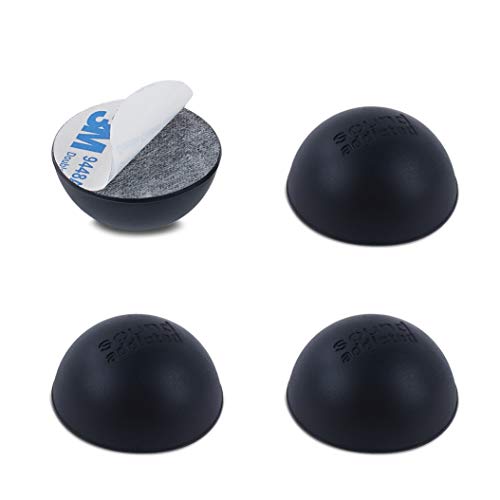
This set offers 1.2" silicone hemisphere feet with an extra-high durometer shore hardness of 35, designed to absorb vibration and reduce resonance under smaller speakers, amps, or DACs. Each foot claims to sustain up to 24 lb, making the set suitable for lighter stands or bookshelf speakers. The compact profile keeps the feet discreet under equipment while providing a non-skid surface.
Installation uses adhesive backing for quick placement. Recommended uses include amplifiers, turntables, CD players, and compact speaker stands where minimal visual impact and moderate isolation are desired.
Speaker Isolation Pads – 8-Pack Platinum Silicone Feet

These platinum silicone pads measure 2.5" wide and 1.25" tall and use a Durometer 20 (Shore A), optimized for heavier components. The design prioritizes vibration damping and claims to reduce resonance significantly, which is useful beneath larger speaker stands or subwoofers.
The pads are rated for wide temperature ranges and are described as non-scratch. Their larger footprint provides broad contact area for weight distribution and improved bass control on stands that need more isolation or platform-style feet.
Black Tall Square Adhesive Rubber Bumper Pads – 20 Pieces

This 20-piece set delivers self-adhesive square rubber feet measuring roughly 0.78" diameter and 0.38" height. Their tall profile helps create airflow under electronics and speaker stands while offering non-slip grip on hard floors.
Applications include lightweight speaker stands, electronics cabinets, and appliances where many small feet are preferred to cover multiple contact points. The adhesive installation is straightforward, and the pads function as spacers and protective bumpers as well as grip enhancers.
Monosaudio 40x20mm Speaker Isolation Feet With 3M Adhesive

Monosaudio combines a solid aluminum body with a removable non-slip rubber ring and 3M adhesive, offering a hybrid solution for heavy-duty speaker stands and subwoofers. The construction emphasizes high hardness and density to target low harmonic vibration points while damping unwanted resonances.
The product lists a very high load support per foot and includes a 4.5mm center hole for optional mounting hardware. This design is suitable for stands where a rigid mechanical interface coupled with rubber isolation is desired, and where heavier loads and precise decoupling are priorities.
Howonder Rubber Feet 16 Pack 40mm x 10mm With Screws

Howonder supplies 16 rubber feet with screws included, each 40mm in diameter and 10mm high with a 6mm screw hole. The feet are described as elastic, aging stable, flame-retardant, corrosion-resistant, and antistatic, making them versatile for many speaker stand installations.
Pre-drilled screw holes allow secure attachment to speaker stands that accept mechanical fasteners, adding longevity and reduced risk of adhesive failure. These feet are good for medium to large stands where multiple attached feet are preferred for stability and vibration control.
Buying Guide: How To Choose Speaker Stand Rubber Feet
Selecting the right rubber feet involves matching the feet to the stand type, load, floor type, and isolation goals. Below are key considerations and comparison perspectives.
Load Capacity And Foot Size
- Check Weight Ratings: Ensure each foot’s load capacity multiplied by the number of feet meets or exceeds the speaker stand and speaker weight.
- Foot Footprint: Larger pads distribute weight better and reduce point loading on soft floors; smaller hemispheres offer focused decoupling for stands with narrow legs.
Material And Durometer (Hardness)
- Softer Rubber/Silicone (Lower Durometer): Better at absorbing low-frequency vibrations, helpful for turntables and subwoofers.
- Harder Materials or Metal With Rubber Ring: Provide more mechanical stability and precise isolation for heavier stands but may transmit some high-frequency vibrations.
Attachment Method: Adhesive vs Screws vs Press-Fit
- Adhesive Pads: Quick to install and suitable for lighter stands or temporary setups; check adhesive quality and surface prep instructions.
- Screw-Mounted Feet: Best for permanent installations and heavier stands where adhesive could fail under load or temperature changes.
- Removable Rings Or Clips: Offer serviceability and allow tuning by swapping materials or heights.
Floor Type And Slip Resistance
- Hard Floors (Wood, Tile): Require non-marking, high-friction feet to prevent sliding and protect finishes.
- Carpeted Floors: Use larger-footprint pads or spikes (if available) to prevent sinking and to stabilize the stand.
Isolation Goals And Acoustic Priorities
- Maximize Bass Tightness: Softer silicone pads with larger contact area improve low-frequency damping.
- Preserve High-Frequency Detail: Harder mounts with minimal contact area can reduce mid/high transmission but may trade off some low-frequency control.
Durability, Temperature, And Environmental Resistance
- Check rated temperature ranges and aging resistance for long-term installations or in rooms with wide temperature swings.
- Consider flame-retardant and antistatic properties for studio or professional setups.
Practical Considerations And Installation Tips
- Measure stand leg diameter and contact area before purchasing to ensure compatibility.
- Clean surfaces thoroughly when using adhesive pads for best bond strength.
- When possible, test different foot types on a single stand to compare isolation and tonal effects before committing to a full setup.
Comparatively, choose silicone hemisphere or large pads for improved low-frequency damping, screw-mounted rubber feet for long-term stability, and hybrid metal-with-rubber solutions for heavy loads requiring precise mechanical decoupling. Balance between slip resistance, floor protection, and acoustic isolation to fit your room and equipment.