Find The Right On-Off Switch Or Selector for home audio, multi-zone setups, RVs, and DIY speaker projects. Below is a concise comparison of the top speaker on-off switches and selector solutions chosen for reliability, compatibility, and control features.
| Product | Type | Key Feature |
|---|---|---|
| Pyle PSS4 | 4-Zone Speaker Selector | Supports 4 pairs of speakers |
| OSD SVC205 | In-Wall Volume Control With On/Off | Volume knob plus on/off switch and impedance protection |
| Pyle PVCS2 | In-Wall A/B Speaker Selector | Push-button A / B / A+B configurations |
| Monoprice SSVC-4.1 | 4-Channel Selector With Volume | Individual zone on/off buttons and impedance protection |
| RecPro RV Speaker Switch | 3-Position RV Control Panel | Twist knob for Inside / Outside / Both |
Pyle 4-Zone Speaker Switch Selector – PSS4
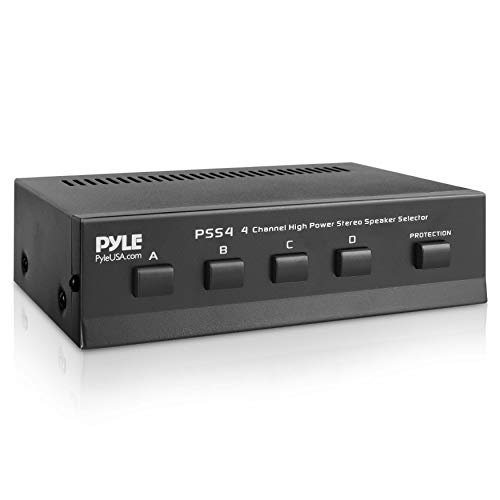
The Pyle PSS4 is a multi-channel distribution box designed to route a single amplifier to up to four speaker pairs. As a speaker selector, it provides individual A/B/C/D switches for zone control and supports high-powered stereo amps. It features terminal block connections suitable for bare wire and banana plugs.
Use cases include: dividing a single receiver among several rooms, centralized control for party setups, and simple zone activation. The PSS4 emphasizes manual on/off control per zone and mechanical switching, making it suitable where individual circuit isolation is desired without additional volume controls.
OSD 300W In-Wall Volume Control With On/Off – SVC205
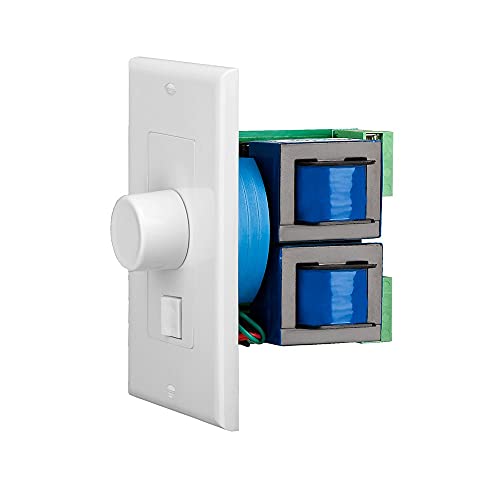
The OSD SVC205 combines a volume control knob with a built-in on/off switch and impedance protection. Rated at 100 watts per channel, it includes front-mounted jumpers to adapt when multiple speaker pairs are connected.
This in-wall unit is intended for fixed installations where discrete volume adjustment and the ability to turn sound off completely per zone are required. The impedance protection feature stabilizes the amplifier load when using parallel speaker connections, reducing risk to the amp when multiple outputs are active.
Pyle In-Wall Speaker Selector Switch – PVCS2

The Pyle PVCS2 is an in-wall push-button A/B speaker selector that fits standard junction boxes. It provides three configurations: select A, select B, or A+B simultaneously, via simple push-button operation and terminal block connectors.
This model is optimized for homeowners wanting a low-profile wall control to route audio between two speaker sets. The PVCS2 emphasizes ease of installation and clear mechanical on/off selection for each speaker group, suitable for indoor/outdoor switching or room selection tasks.
Monoprice SSVC-4.1 4-Channel Selector With Volume
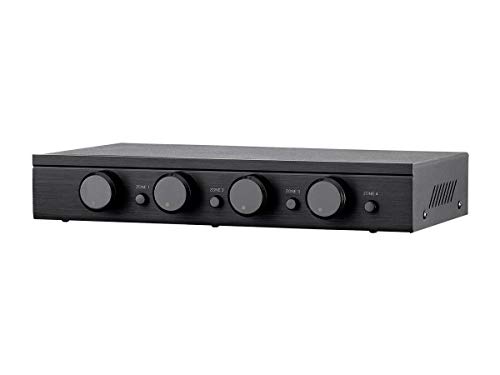
The Monoprice SSVC-4.1 supports a single input to four speaker channels and incorporates individual zone on/off buttons and volume controls. It features automatic impedance protection circuitry and handles continuous power at 100 watts per channel with higher peak capacity.
This unit is suited for multi-room distribution when per-zone level control and the ability to deactivate zones are necessary. The combination of volume knobs plus on/off buttons offers more granular control than simple selector switches for installations where different listening levels are desired across rooms.
RecPro RV Speaker Switch 3-Position Control Panel

The RecPro RV Speaker Switch is a compact 3-position control panel designed for RV and marine applications. The labeled twist knob allows selection between Inside, Outside, or Both, providing clear and accessible switching for on/off selection of speaker zones in mobile environments.
Its low-profile black surface integrates with RV interiors, and it’s specifically aimed at users who require a simple, labeled control panel for switching audio between interior and exterior speakers without complex wiring or large enclosures.
Buying Guide: Choosing The Best Speaker On-Off Switch
Selecting the right speaker on-off switch depends on application, amplifier compatibility, installation location, and desired control granularity. Below are core factors and multi-perspective comparisons to consider.
Application And Form Factor
- In-Wall Controls: Ideal for home builds where a clean wall-mounted control is preferred (e.g., OSD SVC205, Pyle PVCS2). They fit standard junction boxes and integrate with décor.
- Rack Or Shelf Units: Selector boxes like Pyle PSS4 or Monoprice SSVC-4.1 suit equipment racks, garages, or AV closets where centralized distribution is needed.
- Mobile/Compact Panels: RV or boat panels (RecPro) offer labeled, low-profile knobs suited for limited space and outdoor exposure.
Control Type And Functionality
- Simple On/Off Selectors: Mechanical push or rocker switches provide binary control per zone. Choose these for straight activation/deactivation without volume control.
- Volume Plus On/Off: Units combining volume knobs and an on/off switch (OSD, Monoprice) let you set levels per zone and fully mute via the switch—useful for multi-room listening where levels vary.
- Multi-Position Selectors: A/B/A+B or Inside/Outside/Both selectors are useful when switching between two listening areas or combining zones temporarily.
Amplifier Compatibility And Protection
- Impedance Protection: If you plan to connect multiple pairs in parallel, choose hardware with impedance protection or load stabilization (Monoprice SSVC-4.1, OSD SVC205 jumpers) to prevent amplifier overheating.
- Power Ratings: Ensure continuous and peak power handling aligns with your amplifier’s output. Mismatched ratings can reduce reliability or cause clipping.
- Minimum Impedance: Verify the selector’s minimum amplifier impedance when several speakers are active, especially with 4-ohm speakers.
Wiring, Installation, And Connectors
- Terminal Blocks vs. Screw Terminals: Terminal blocks (Pyle PVCS2, Pyle PSS4) are common and accept bare wire or banana plugs for easy wiring. Confirm connector style for your speaker cables.
- Mounting Requirements: In-wall models need standard junction boxes. Rack or shelf selectors require ventilation and space planning.
- Prewired Or Panel-Mount: For quick installs, prewired panels (RecPro) reduce wiring time. For custom setups, small selector boxes allow flexible cable routing.
Durability And Environment
- Indoor vs. Outdoor Use: Outdoor or marine installations require weather-resistant components. Look for sealed or rated panels if used externally.
- Mechanical vs. Electronic Switching: Mechanical switches are robust and easy to troubleshoot; electronic relays can offer quieter switching but may require additional power or introduce latency.
User Experience And Control Granularity
- Per-Zone Volume: If occupants require different listening levels, choose selectors with individual volume controls.
- Labeling And Interface: Clear labels and tactile feedback make frequent switching easier—important for RV and multi-room use.
- Automation Compatibility: If integrating with home automation, verify whether a simple mechanical switch suffices or if you need relay-based or remote-controllable modules.
Comparison Perspectives
- Budget vs. Feature Set: Basic mechanical selectors are cost-effective for simple on/off duties. Units with volume and impedance protection cost more but add safety and flexibility.
- Simplicity vs. Expandability: Simple A/B panels are easy to use but limited. Four-channel selectors and distribution boxes support expansion to multiple rooms without changing the amplifier.
- Fixed Install vs. Mobile Use: Choose in-wall or rack units for permanent installs; choose compact labeled panels for mobile environments where access and space are constrained.
When choosing, match the switch’s features to the specific listening scenarios, amplifier specifications, and installation environment to ensure safe operation and the level of control needed.