Best Single Channel Amp for Subwoofer: Powerful Mono and Subwoofer Boards
Finding the right single-channel amplifier for a subwoofer depends on power needs, enclosure type, and installation space. Below is a quick comparison of the selected products followed by focused reviews and a detailed buying guide.
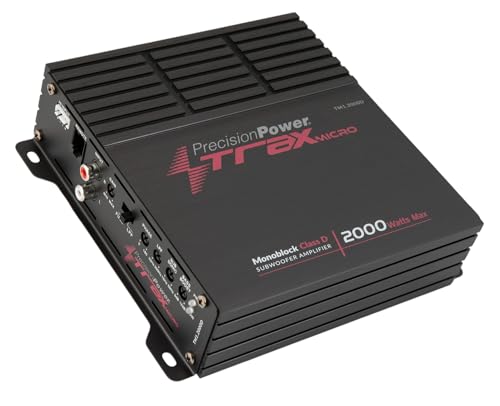
The Precision Power Trax Micro TM1.2000D is a high-output Class D monoblock designed for car subwoofers where maximum low-end is required in a compact package. It lists a peak-rated output of 2000W and uses nano amplifier technology to reduce size while maintaining efficiency.
Variable low-pass filter (35–250 Hz) and subsonic filter (10–50 Hz) let you tailor the subwoofer band for sealed or ported enclosures.
Built-in bass boost (0–12 dB at 45 Hz) and wired bass control for remote tuning from the cabin.
Protection features include thermal, short-circuit, and overload safeguards to protect the amp and subwoofer.
Best Suited For: Mobile installations needing a high-power monoblock in limited space. Consider power wiring and heat dissipation for sustained output.
The Stinger MT-1000.1M is a marine-rated Class D monoblock with an emphasis on durability and consistent performance in damp or harsh environments.
Designed with water-resistant components and robust build quality for boats or humid vehicles.
Includes remote control bass knob, subsonic filter, and adjustable low-pass filter for tuning sub output.
High efficiency Class D topology supports compact installs while delivering strong sustained power.
Best Suited For: Marine or automotive users who require a reliable monoblock with remote bass control and environmental protection. Check mounting and ventilation in enclosed spaces.
The Fosi Audio M04 is a compact mono amplifier for home theater and desktop subwoofer use. It uses a TI TPA3116 chip and offers a switch to alternate between subwoofer mode and full-range mono output.
100W output for a 2-ohm load, suitable for many passive subwoofers in small rooms.
Built-in low-pass filter and sub frequency control simplify setup without adding an external processor.
Compact chassis and quiet Class D operation make it suitable for bookshelf or cabinet installations.
Best Suited For: Home theater or desktop systems requiring a compact mono amp with on-board sub controls. Match the amp’s power rating to the subwoofer’s nominal rating and impedance.
Nobsound 100W Full Frequency Mono Channel Amp NS-03G
The Nobsound NS-03G is a compact mono amplifier targeted at small passive speakers or subwoofers. It uses the TPA3116D2 chip for efficient Class D amplification in a mini package.
100W power output and smooth volume control for desktop or near-field setups.
Small footprint and solid shell allow easy placement near speakers or electronics.
Note: It is not compatible with active/powered speakers—designed for passive loads only.
Best Suited For: Small rooms, DIY speaker projects, or desktop subwoofer applications where compact size and simplicity matter. Verify impedance compatibility before connecting.
The ARRAROWN ZK-HT21 is a 2.1 amplifier board that includes a dedicated subwoofer channel capable of high subwoofer output, making it an attractive option for DIY systems needing a powerful bass channel.
Provides 220W dedicated sub output plus stereo channels for full systems, driven by TPA7498E class D chips.
On-board sub volume and sub frequency adjustment (20–200 Hz) with treble and bass controls for system tuning.
Offers protections including overheat and reverse polarity, and supports wide DC input range (15–36V).
Best Suited For: DIY home or custom car systems where a dedicated sub channel is needed alongside stereo amplification. Requires appropriate power supply selection and wiring for peak performance.
Buying Guide: Choosing The Right Single Channel Amp For Your Subwoofer
When selecting a single-channel amplifier for a subwoofer, evaluate the following factors to match amp behavior to your sub and installation.
Power Rating And Headroom
Match the RMS power of the amplifier to the subwoofer’s RMS rating. Aim for modest headroom (amp RMS slightly higher than sub RMS) to reduce clipping risk. For short bursts, peak ratings can be higher, but sustained power matters most for reliability.
Impedance Compatibility
Confirm the amplifier supports the subwoofer’s nominal impedance (1Ω, 2Ω, 4Ω). Many class D monoblocks provide higher output into lower ohms—ensure stable operation and correct wiring for dual voice-coil subs.
Filters And Tuning Controls
On-board low-pass filters, subsonic filters, and bass boost enable precise tuning. Remote bass knobs are useful for automotive installs, while onboard frequency controls are convenient for home use.
Thermal And Protection Features
Look for thermal, short-circuit, overload, and reverse polarity protection. Class D designs are efficient but can still overheat under sustained high loads in tight spaces—mount and ventilate accordingly.
Form Factor And Mounting
Consider available space: full-sized monoblocks vs micro/nano amps vs amplifier boards. Marine-rated units offer water resistance for boats. Mini amps and boards suit DIY desktop and compact enclosures.
Power Supply Requirements
Ensure the vehicle or dedicated power supply can deliver necessary current. For amplifier boards and high-power monoblocks, use appropriately rated power adapters or battery/alternator setups to avoid voltage sag and protection trips.
Application: Car vs Home vs DIY
Choose automotive monoblocks for car and marine use; select home-oriented mono amps for furniture or AV setups. For custom speaker systems, 2.1 boards with a dedicated sub channel offer integration flexibility but require proper power management.
Connectivity And Compatibility
Check input options (RCA, high-level speaker inputs, Bluetooth) and whether the amp supports passive subwoofers only. Some compact units are not compatible with active/powered speakers.
Sound Character And Distortion
Look to amplifier chipsets and design (TPA3116, TPA3255, TPA7498E) for expected efficiency and low distortion. Class D amps provide high efficiency, but component layout and power delivery affect audible performance at high SPLs.
Budget And Value Considerations
Balance raw power needs against build quality and protective features. Higher-rated marine or automotive monoblocks add durability cost, while DIY boards give flexibility at lower price but require technical setup.
Using these perspectives—power, impedance, filters, thermal protection, and application—you can narrow choices from compact mono amps to large monoblocks and 2.1 boards depending on space, environment, and performance goals.