rf power meters are essential tools for measuring signal strength across wide frequency ranges. This guide highlights five top options for different use cases, from compact handheld meters for on-site checks to feature-rich spectrum analyzers. The best pick depends on your application: industrial control, RF engineering, field service, or general hobbyist testing. Below is a quick summary of the selected products and who they’re best for.
Quick comparison table
| Product | Best For | Key Strength | Notes |
|---|---|---|---|
| Generic RF Power Meter Compact Digital Display | Field technicians | Wide range (-60 to -5 dBm, up to 8 GHz) | Portable and affordable |
| RF Power Meter Logarithmic Frequency Detector (AD8362) | Broad dynamic range | 65 dB dynamic range, true power detection | Versatile for varying signal strengths |
| RF Explorer PRO Spectrum Analyzer (LATNEX) | Professional RF analysis | Spectrum, tracking generator, power meter | High-end features, GPS |
| RF Power Meter 1MHz–10GHz (Jolooyo) | General lab use | 0.1 dBm resolution, 1–10000 MHz | Wide frequency coverage |
| Portable Frequency Counter Meter (Wisoqu) | Walkie-talkie and car radio testing | Built-in dummy load, non-contact frequency read | Simple and practical |
Generic RF Power Meter Compact Digital Display

This compact RF power meter measures from -60 to -5 dBm and covers up to 8000 MHz. It features a lightweight, portable design with a clearly visible LED screen for easy on-site readings. Resolution is 0.1 dBm, supporting precise measurements in professional and industrial contexts.
Best for: Field technicians and shop-floor operators who need a portable, accurate meter with a wide frequency range. Why selected: It combines portability with a wide range and fine resolution, making it versatile for quick checks and routine diagnostics.
Caution: Limited data on waveforms or advanced features; best used for straightforward level measurements rather than complex modulation analysis.
RF Power Meter Logarithmic Frequency Detector AD8362

This detector leverages the AD8362 for a wide input dynamic range, from -75 dBm to 16 dBm in a 50-ohm system. It provides true power detection independent of waveform, enabling accurate measurements for complex modulated signals. The voltage-mode output is proportional to the logarithm of input power, simplifying measurements for power meters and detection tasks.
Best for: Engineers working with varying signal strengths and wide dynamic ranges, including broadband systems and complex modulation schemes. Why selected: Its true power detection and wide dynamic range support robust analysis across diverse signals.
Caution: The description is data-rich and partially repetitive; ensure compatibility with your measurement setup before purchasing.
RF Explorer PRO Spectrum Analyzer (LATNEX)

The RF Explorer Pro is a multipurpose instrument combining a spectrum analyzer, a signal tracking generator, and a power meter. It covers up to 3.3 GHz and includes a high-resolution touch screen, GPS-based RF heatmaps, and advanced features like frequency coordination (license required). This makes it suitable for professional RF troubleshooting and optimization.
Best for: Professional technicians and RF engineers who need an all-in-one analysis tool. Why selected: The integrated spectrum, generator, and power meter streamline field and lab workflows.
Caution: Some premium features require licensing; verify needs before purchase.
RF Power Meter 1MHz–10GHz (Jolooyo)
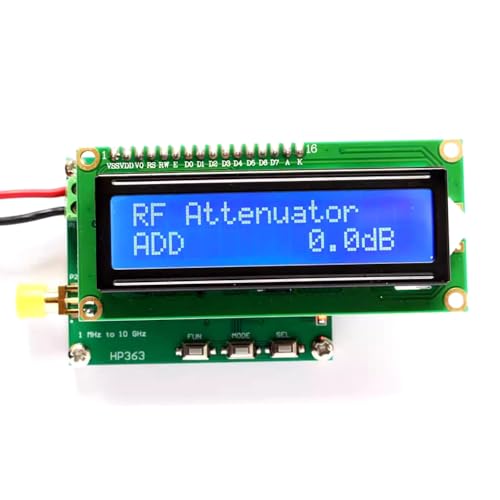
This meter spans a broad frequency range from 1 to 10000 MHz and offers a measurement power range of -50 to +0 dBm, with a resolution of 0.1 dBm. External RF attenuation can extend the range up to 100 dBm. It is well-suited for general lab work and field testing where wide coverage is needed.
Best for: Labs and field teams requiring broad frequency coverage and a moderate dynamic range. Why selected: The wide frequency span enables testing across many common RF bands with good resolution.
Caution: External attenuation may be needed for very high-power applications; ensure your setup accommodates this.
Portable Frequency Counter Meter (Wisoqu)

This handheld device measures frequency and power for walkie-talkies, car radios, and other RF equipment. It includes a built-in dummy load and supports non-contact frequency measurements with an external antenna. The unit is designed for everyday RF testing and quick checks on-site.
Best for: On-the-go testers and service technicians who need a simple, reliable tool for quick frequency checks. Why selected: Built-in dummy load and easy operation make it ideal for rapid site tests and field maintenance.
Caution: Functionality is basic compared to full-spectrum analyzers; best for basic measurement tasks rather than in-depth analysis.
Buying Guide
Key purchase considerations help match the right tool to your needs:
- Frequency range: Ensure the meter covers the bands you test most often. A wider range adds versatility but may increase cost.
- Dynamic range and resolution: A larger dynamic range and finer resolution enable accurate readings across weak and strong signals.
- Measurement type: Decide between simple power measurement, true power detection, or full-spectrum analysis with a tracking generator.
- Portability vs. capability: Handheld meters are convenient on-site, while bench-top models or all-in-one analyzers offer deeper analysis.
- Output options: Consider whether you need voltage or current outputs, or a log-scale voltage output for easy integration with other test equipment.
In-field testing vs. lab usage often dictates the best fit. For quick checks and service calls, portable meters are advantageous. For RF development or troubleshooting complex networks, an all-in-one spectrum analyzer with power metering is worth the investment.
FAQ
- What is a typical RF power meter used for? Measuring signal strength and power across RF bands to verify transmitter output and system performance.
- Do I need true power detection? True power detection ensures accuracy regardless of waveform, which is important for modern modulated signals.
- Can these meters handle 5G bands? Some meters cover up to several gigahertz, which includes many 5G bands, but verify the exact range before purchasing.
- Is an external attenuator always required? Not always; attenuation is only needed when input power exceeds the meter’s safe range.
- Do these devices require licenses for advanced features? Some high-end options may require additional licenses for features like RF heatmaps or intermodulation analysis.
- Which tool is best for beginners? A compact meter with straightforward readings and a built-in display is typically best for beginners and everyday field use.