Unlock immersive listening from your turntable with purpose-built bookshelf speakers and compact stereo solutions. This guide highlights five top Amazon picks that best align with “record player surround sound,” balancing clarity, bass depth, and compatibility for common setups—from standalone turntables to TV and PC use. Each option includes clear vocals, dynamic highs, and reliable integration with amplifiers or integrated receivers. Read on to compare features, connection options, and practical considerations for building a convincing vinyl-centered home theater.
| Product | Brand | Key Strength |
|---|---|---|
| RIOWOIS Passive Bookshelf Speakers for Record Player | RIOWOIS | Clear vocals with 4″ woofer and silk dome horn tweeter |
| Saiyin Powered Bluetooth Bookshelf Speakers for Record Player | Saiyin | Built-in amplification, Bluetooth 5.3, versatile connections |
| RIOWOIS Passive Bookshelf Speakers for Home Theater Surround Sound | RIOWOIS | Compact, 2.75″ woofer and 2″ tweeter, wood grain finish |
| Orroplus Powered Bookshelf Speakers Pair | Orroplus | 70W active/passive pair with multiple wired inputs |
| Elimavi 30W*2 Passive Bookshelf Speakers | Elimavi | 4″ woofer, compact, wood grain aesthetic |
RIOWOIS Passive Bookshelf Speakers for Record Player

These passive bookshelf speakers require an amplifier or receiver for operation. They are built to deliver crystal-clear vocals with a 4-inch woofer and a silk dome horn tweeter, aimed at capturing intimate vocal texture and instrument subtleties. They are designed for wall mounting, which helps create a compact surround environment when paired with a suitable amp. The primary limitation is the need for a separate power source, so pairing with a quality amplifier remains essential for achieving immersive sound.
Saiyin Powered Bluetooth Bookshelf Speakers for Record Player

This model blends built-in amplification with flexible connectivity. It features a 33mm dual-curved horn bass reflex port for refined midrange vocal clarity and deeper, distortion-free lows. Options include Bluetooth 5.3, Optical, TV-ARC, and AUX IN, making it suitable for turntables, TVs, PCs, or general home audio. The integrated power minimizes setup complexity while delivering robust, theater-like sound from a compact pair of speakers.
RIOWOIS Passive Bookshelf Speakers for Home Theater Surround Sound

Compact yet capable, these bookshelf speakers deliver up to 30W peak power with a 6-ohm impedance. The design pairs a 2.75-inch woofer with a 2-inch tweeter to produce balanced, detailed sound with a sense of space. Finished with a 3D wood grain for aesthetic appeal, they fit well in living rooms where vinyl playback sits alongside other media. As passive speakers, pairing with a reliable amplifier or receiver is required to reach their full potential.
Orroplus Powered Bookshelf Speakers Pair
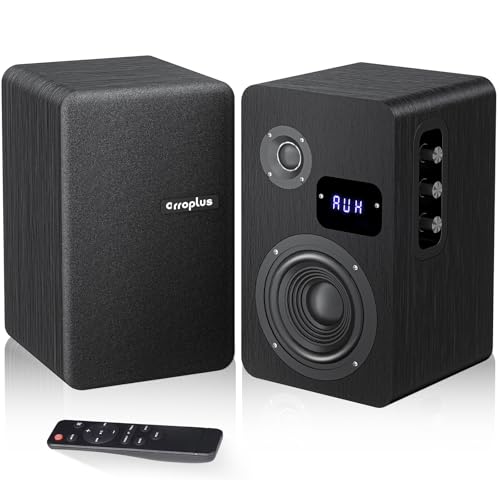
The Orroplus pair combines active and passive speakers that eliminate the need for a separate amplifier. With 70W continuous power and multiple wired inputs ( Optical, ARC, RCA, AUX, and BT), the system supports turntables, TVs, PCs, and streaming devices. The 4″ woofer and 1″ silk dome tweeter deliver crisp highs and clear midrange, while the built-in processing aims to minimize signal loss from digital-to-analog conversion. This setup suits multi-device living rooms seeking straightforward integration and solid room-filling sound.
Elimavi 30W*2 Passive Bookshelf Speakers

Elimavi offers compact passive speakers with a 4-inch woofer aimed at delivering a powerful low end without occupying large space. The 6-ohm impedance supports a wide array of amplifiers, making it a flexible option for turntable-based setups. The wood-grain finish adds warmth to room décor, and the speaker’s axis alignment is designed to minimize phase differences for more accurate stereo imaging. A suitable amplifier is required to drive the pair effectively.
Buying Guide: Key Purchase Considerations for Record Player Surround Sound
- Amplification: Passive speakers require an amplifier or receiver. Ensure your turntable output is compatible with your chosen amp’s input and power rating. If you want a simple plug-and-play solution, consider powered (active) bookshelf speakers to avoid a separate amplifier.
- Speaker impedance and power handling: Common bookshelf speakers use 4–8 ohms and modest wattage. Match impedance with your amplifier’s output and confirm peak power aligns with your room size to prevent distortion.
- Connectivity: Look for multiple input options (RCA, Optical, HDMI ARC, Bluetooth) to connect a turntable, TV, PC, and mobile devices. Bluetooth is convenient but may introduce latency; wired connections typically offer more reliable fidelity.
- Speaker placement and surround feel: Even with two speakers, you can simulate surround by placing speakers to the left and right of the listening position and using a subwoofer for bass extension. For real surround, add a center channel or rear speakers and a compatible receiver with discrete channels.
- Audiophile vs. practical setup: Horn tweeters and dedicated woofers can yield vivid vocals and expansive highs, but require proper room placement and an adequate amplifier. For room-friendly options, wood-grain finishes and compact form factors blend aesthetics with sound quality.
- Wall mounting and aesthetics: Some models offer wall-mount capability or compact footprints that suit small spaces. Aesthetics like wood grain and finishes help the setup blend with furniture and décor.
- Compatibility with turntables: Ensure the system can handle low-level phono audio or connect via a phono preamp if your turntable lacks one. This preserves signal integrity from record groove to speaker.
- Budget and upgrade path: Start with a sound baseline that fits your room and future plans. If you anticipate expanding to a full surround system, choose components with scalable inputs and matching timbre.