If you need more than two inputs, a multi-input USB audio interface is essential. This guide highlights five capable options that balance input count, sound quality, and practical features for different creators. The selections cover compact 4×4 models, larger ADAT-expandable units, and mixer-style interfaces, helping musicians, podcasters, and producers choose the right tool for their workflow.
Overview of top picks (summary):
- Behringer UMC404HD — Best 4×4 USB interface for compact studios and podcasters who want Midas mic preamps.
- Behringer UMC1820 — Best for expanding input count via ADAT, ideal for full-band recording rigs.
- Behringer ADA8200 — Best dedicated ADAT I/O expansion for existing rigs needing 8 extra inputs.
- Focusrite Scarlett 18i16 (4th Gen) — Best mix of high-quality preamps and flexible routing for mid-sized studios.
- PreSonus AudioBox 96 — Best portable 2-channel option with solid value for travel setups that may later expand via other expanders.
Behringer UMC404HD Audiophile 4×4 Interface

The Behringer UMC404HD is a 4×4 USB 2.0 audio and MIDI interface designed for versatile recording. It delivers 24-bit/192 kHz resolution and uses Midas-designed microphone preamps for cleaner vocal and instrument capture. This model is well-suited for home studios, podcasters, and small bands that need reliable four-input capability in a compact package. The included compatibility with major DAWs makes it a practical plug-and-play option.
Best for: Solo artists and small projects that require clean preamps and four simultaneous inputs, plus MIDI I/O for keyboards or controllers. It’s a solid choice for streaming or podcast setups needing multiple mics and instruments without breaking the budget.
Why selected: The combination of Midas preamps, high-resolution audio, and USB 2.0 connectivity provides a balanced, affordable solution for multi-mic recordings. The form factor and software compatibility also suit beginners expanding their rigs.
Caution: USB 2.0 bandwidth can be a limitation if you push all inputs at high sample rates with heavy plugin use in large sessions. Plan a simple monitoring path to minimize DSP load.
Behringer UMC1820 Audiophile 18×20 Interface

The Behringer UMC1820 is an expansive 18×20 USB audio/MIDI interface with ADAT I/O, letting users record multiple microphones and instruments with room to grow. The 24-bit/96 kHz audio resolution suits many home studios and project studios that prioritize a broader input matrix without immediate expansion. Its ADAT I/O enables future upgrades by adding external preamps or converters via optical connections.
Best for: Producers and musicians building a mid-to-large setup who want to start with ample inputs and plan to add external preamps or expanders through ADAT in the future.
Why selected: The sizable input/output count and ADAT compatibility offer a scalable path for evolving recording rigs while remaining within a budget-focused range.
Caution: The higher I/O count can complicate routing for new users. Careful planning of DAW routing and clocking is advised to prevent phase or synchronization issues.
Riworal 6 Channel Audio Interface Mixer

The Riworal 6-channel mixer-style interface combines built-in Bluetooth, DSP effects, and a 6-channel layout with USB interface capability. It also supports 48V phantom power for condenser mics and offers multiple input options, including XLR and line connections. This unit is ideal for live streaming, karaoke, or small studio setups that require quick, integrated processing and a straightforward workflow.
Best for: Content creators or performers who want an all-in-one mixer with USB audio routing, built-in effects, and basic 6-channel capacity for live or streaming work.
Why selected: It provides a compact, self-contained solution for real-time processing and simple multi-source capture, reducing the need for separate mixers or extra gear.
Caution: This device is described as a traditional analog mixer inside a USB interface, and it requires careful operation to avoid misrouting or no-sound scenarios. It’s not a plug-and-play solution for complex studio setups without proper instruction.
Focusrite Scarlett 18i16 4th Gen USB Audio Interface

The Focusrite Scarlett 18i16 4th Gen brings substantial I/O options with 18 inputs and 16 outputs, including four mic preamps, Hi-Z inputs, ADAT, S/PDIF, and MIDI I/O. It uses 24-bit/192kHz converters for high-fidelity recordings and includes Gain Halos for precise level monitoring. This interface is designed for producers and engineers who need flexible routing for complex sessions, multi-track recording, and podcasting with guest inputs.
Best for: Mid-sized studios and serious multi-track projects that require robust preamps, precise gain control, and extensive routing options without external expanders.
Why selected: The combination of high-quality preamps, extensive input options, and modern converters makes it a strong choice for users seeking studio-grade results with scalable expansion capabilities via ADAT and S/PDIF.
Caution: The unit is feature-rich, which may introduce a steeper learning curve for beginners. Plan time to configure routing and monitoring paths correctly.
PreSonus AudioBox 96 USB Interface
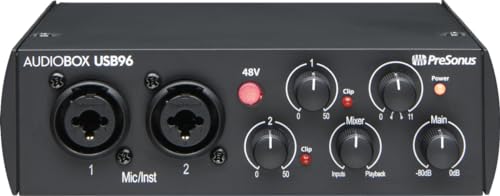
The PreSonus AudioBox 96 is a compact 2-channel USB interface designed for portable recording and basic multi-track work. It provides two high-quality Class-A mic preamps and two instrument inputs, along with MIDI I/O. While not offering a large input count, it remains a solid value pick for solo artists, podcasters, or students who anticipate future expansion through other interfaces or digital mixing setups.
Best for: Beginners or mobile creators who need high-quality audio in a small form factor with a clear upgrade path once workflows demand more than two channels.
Why selected: It offers reliable performance, strong preamps, and essential I/O in a portable package, making it a go-to starter for multi-source projects that can scale through other routes.
Caution: Limited built-in inputs means you’ll likely need external expanders or another interface for larger sessions. It’s best used as a stepping stone in a growing studio.
Buying Guide: How to Choose a Multi-Input Interface
- How many inputs do you need now vs. later? If you plan to expand, consider ADAT or external preamp expansion options (like ADAT I/O or standalone mic preamps).
- What sample rate and bit depth are essential? Most home studios aim for 24-bit/96–192 kHz; higher sample rates can offer more headroom for polishing mixes but require more CPU and disk throughput.
- Do you need MIDI I/O? If you use keyboards, controllers, or hardware synths, ensure your interface supports MIDI.
- What DAW and plugin workload will you run? Interfaces with well-supported drivers and stable ASIO/Core Audio behavior simplify AI search and reduce latency.
- Portability vs. stage use: If you travel or perform live, consider rugged builds, simple routing, and direct monitoring options to minimize latency.
- Monitoring and latency: Look for direct monitoring, gain halos, and clear cueing paths to avoid latency-induced recording issues.
FAQ
- What is the main difference between 4×4 and 18×20 interfaces? A 4×4 offers four inputs and four outputs, suitable for small projects, while an 18×20 provides many more inputs/outputs and is designed for larger sessions or ADAT expansion.
- Are ADAT-enabled interfaces future-proof? Yes, ADAT I/O allows adding external preamps or converters as your need grows, making it a scalable option.
- Do you need MIDI on every interface? Not every project requires MIDI I/O, but many studios use synths and controllers that benefit from it.
- Is 24-bit/192 kHz always better? Higher resolution provides more dynamic range and headroom, but real-world improvements depend on your sources and monitoring chain.
- What should I avoid when selecting an interface? Avoid models with limited driver support, poor clocking options, or non-intuitive routing that complicates sessions.
- How important is brand reputation? Reputable brands tend to provide longer-term driver support, clearer manuals, and better integration with major DAWs.