Choosing the right speaker cable affects signal integrity, power handling, and long-term reliability. Below is a quick comparison table of five selected cables from budget-friendly to audiophile-grade assemblies chosen for performance and build quality.
| Product | Type | Gauge / Length | Key Feature |
|---|---|---|---|
| WORLDS BEST CABLES WBC-GOLD-LOCAP-SPKR-12AWG | Pre-terminated Cable With Banana Plugs | 12 AWG / 20 ft | High-Purity OFC, Low Capacitance |
| Yoico Pro 12AWG 1/4″ To 1/4″ Speaker Cable | 1/4″ To 1/4″ Heavy Duty | 12 AWG / 50 ft | Industrial Grade Construction |
| iK iLoud MTM Master-Slave 4-Pin Link Cable | 4-Pin Master-Slave Link | Pure Copper / Multiple Lengths | Lossless Audio Transmission |
| Pig Hog PHSC5 High Performance 14 Gauge | High-Flex Speaker Cable | 14 AWG / 5 ft | Rubber Outer Covering |
| Kinter 14/16-Gauge Speaker Wire Spool | Spool, Polarity Marked | 14 or 16 AWG / 100 ft | High Strand Count, Flexible PVC |
WORLDS BEST CABLES WBC-GOLD-LOCAP-SPKR-12 AWG

This assembly targets the audiophile entry-level market with an emphasis on conductor purity and low electrical parameters. The cable uses 588 strands of 99.99% oxygen-free copper (OFC) across two 12 AWG cores in an expanded dumbbell layout to minimize capacitance and inductance. It includes 24K gold-plated Eminence banana plugs with reinforced shafts to support heavy gauge cable. The proprietary PVC-blend jacket emphasizes flexibility and durability.
Key technical strengths are low capacitance, low inductance, and premium connectors that help maintain signal transfer for high-resolution systems. The pre-terminated banana plugs simplify speaker hookups and reduce termination variability. This is a practical choice where low electrical interference and long-term connector reliability matter.
Yoico Pro 12AWG 1/4″ To 1/4″ Speaker Cable

The Yoico Pro cable is built for stage and high-power loudspeaker use. It features 12 AWG copper conductors in a heavy-duty PVC jacket and quick-lock twist latching connectors on each 1/4″ end. The construction is described as industrial-grade, aimed at sustaining frequent connections, movement, and higher current loads typical of pro audio rigs.
Advantages include a robust mechanical design and gauge suitable for long runs with minimal resistive loss. The latching 1/4″ connectors help prevent accidental disconnection during performances. Consider this cable where durability and current capacity are priorities over decorative or boutique finishes.
iK iLoud MTM Master-Slave 4-Pin Link Cable

This specialized link cable is designed for studio monitor master-slave connections, featuring pure copper core and professional-grade shielding for lossless transmission. The 4-pin male-to-male connectors match iK iLoud MTM monitor requirements and are available in multiple lengths to suit studio layouts.
The product emphasizes low signal distortion and high flexibility, making it suitable for short to medium studio runs where preserving the monitor’s integrity is critical. Its shielding and connector compatibility are primary benefits for dedicated studio systems that require specific pin configurations.
Pig Hog PHSC5 High Performance 14 Gauge Cable

Pig Hog’s high-performance cable offers a flexible 14 AWG conductor with an 8mm rubber outer covering aimed at portable pro audio applications. The design prioritizes flexibility and ruggedness for stage or touring gear.
Strengths include a pliable rubber jacket that resists abrasion and simplifies routing in tight setups. The 14 AWG gauge balances current capacity and handling for moderate-distance runs. Use cases include powered monitors, short speaker-to-amp links, and installations where cable flexibility is a requirement.
Kinter 100ft 16-Gauge Polarity Marked Speaker Wire
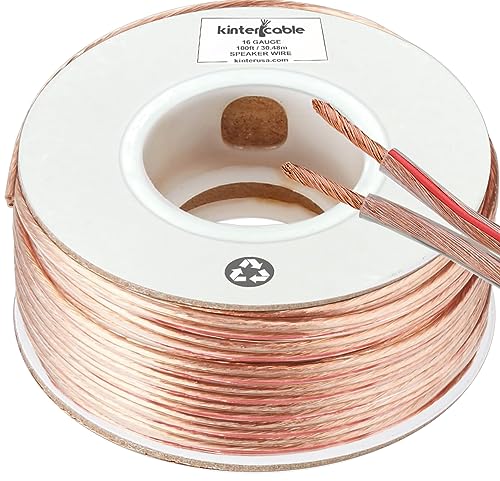
Kinter offers spooled speaker wire with a high strand count CCA (copper-clad aluminum) conductor and a clear PVC jacket marked with a polarity stripe. The flexible jacket and fine-strand construction target easy routing in home theater and surround setups.
Key attributes include high strand count for flexibility and clear polarity marking to reduce installation errors. As a CCA wire, it is lighter and often more affordable than pure copper equivalents but has higher resistivity; gauge and run length should be considered when matching to amplifier power and speaker impedance.
Buying Guide: How To Choose The Right Speaker Cable
When selecting speaker cables — whether targeting premium or high-power applications — assess the following factors to match cable attributes to your system needs.
- Conductor Material: Pure copper (OFC) offers lower resistance and better long-term conductivity than CCA. For critical listening or high-current demands, OFC is preferred.
- Gauge (AWG): Lower AWG numbers mean thicker wire and lower DC resistance. Use 12–14 AWG for long runs or high-power speakers; 16+ AWG may be acceptable for short runs and low-power speakers.
- Strand Count & Flexibility: Higher strand counts increase flexibility and ease of routing. For portable or frequently reconfigured setups, choose fine-strand construction.
- Termination Type: Pre-terminated banana plugs, spades, or 1/4″ connectors reduce installation variability. Ensure connectors are gold-plated or corrosion-resistant for longevity.
- Capacitance & Inductance: For long runs or high-resolution systems, low capacitance and inductance help preserve high-frequency detail; cable geometry and separation of conductors influence these parameters.
- Shielding: Not always necessary for basic speaker runs, but useful for sensitive link cables (near electronics) or balanced/proprietary connectors to reduce interference.
- Application Matching: Stage/PA use requires rugged jackets and locking connectors; studio monitors may require specific pinouts or shielded master-slave links; home theater favors discreet, flexible spools with polarity marking.
- Run Length Considerations: Calculate total run resistance. For long distances, increase gauge to maintain damping factor and reduce power loss.
- Durability & Flexibility: Consider jacket material (PVC, rubber, proprietary blends) for abrasion resistance, kinking resistance, and environmental exposure.
- Connector Quality: High-quality connectors reduce contact resistance and corrosion over time. Look for reinforced strain relief on high-use cables.
Comparative perspectives:
- Audiophile Perspective: Favor pure OFC conductors, tight control of capacitance/inductance, and premium plated connectors for sonic transparency.
- Pro Audio Perspective: Prioritize mechanical durability, locking connectors, and gauges that handle high current without excessive stiffness.
- Budget/Installation Perspective: Spools with clear polarity marking and flexible jackets provide value and ease of installation; be mindful that CCA increases resistivity and may impact performance on longer runs.
Match cable choice to your system priorities: conductor quality for critical listening, gauge and robust termination for power handling, and jacket/connector design for durability and ease of use.