Answer: If you’re adding an aftermarket amplifier or subwoofer to a factory radio, a line-out converter (LOC) is essential to translate speaker-level signals into clean RCA outputs. These five picks cover common setups from compact two-channel needs to subwoofer-focused boosts, helping a broad range of buyers. Best for upgrading factory systems without rewiring, best for subwoofer-focused setups, and best for flexible installations across OEM and aftermarket radios.
| Product | Best For | Key Benefit |
|---|---|---|
| KICKER 46KISLOC2 | Compact systems | Remote turn-on and high-quality line-out |
| Skar Audio SKAR2CH-LOC | OEM or smart radios | Wide compatibility, solid input handling |
| Scosche LOC2SL | Subwoofer integration | Versatile high/low options, easy install |
| CT Sounds CT-LC2 | Balanced main and sub outputs | BassLift tech for factory bass restoration |
| PAC SNI-35 | Factory radios with aftermarket amps | Adjustable line output, noise isolation |
Kicker 46KISLOC2 K-Series Stereo Line-Out Converter

The KISLOC2 transfers a speaker signal to both RCA and a 12-volt remote wire for an integrated amp setup. It supports up to 55 watts (16 volts) input, offering sonic accuracy at various volume levels. This unit is best for buyers who want a compact LOC with a built-in remote turn-on feature and clean, neutral sound for small to mid-sized systems.
Best for: aftermarket amps on factory radios where space is limited and a clean remote trigger is needed. Limitations: remote turn-on performance can depend on vehicle electrical conditions; ensure compatibility with your car’s wiring harness.
Skar Audio SKAR2CH-LOC 2-Channel Line-Out Converter

This converter is versatile for OEM radios, aftermarket radios, and even smart radios, accepting up to 55 watts (16 volts). It delivers a flat 20 Hz–20 kHz range across all volume levels, helping maintain treble and bass consistency when amplifying. Best for: users wanting broad compatibility and reliable high-to-low conversion for accurate subwoofer or speaker output. Limitation: performance varies with very high-impedance factory systems; verify impedance matching with your amp.
Scosche LOC2SL Line Output Converter
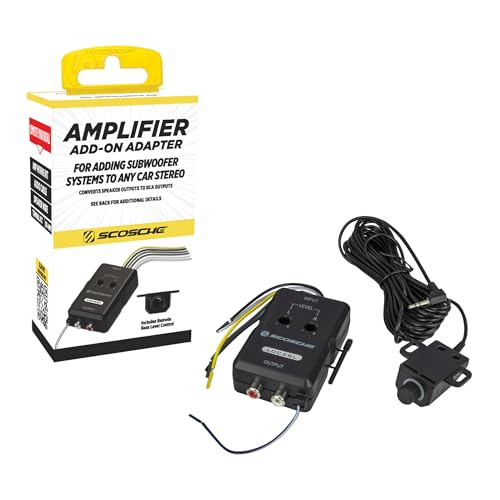
LOC2SL emphasizes seamless integration with a wide range of car audio systems. It converts speaker-level signals to RCA line level with an emphasis on preserving sound quality for subwoofers. Best for: drivers upgrading a factory stereo to a capable aftermarket amp while maintaining strong bass. Caution: consider the install space and routing to avoid interference with nearby wiring or airbags.
CT Sounds CT-LC2 2-Channel Premium LOC with BassLift

The CT-LC2 offers a two-channel premium line-out with BassLift technology that compensates for factory bass roll-off. It provides a full-range main output and a dedicated low-pass output for a subwoofer, which helps preserve bass integrity when driving a powered sub. Best for: users who want a single LOC that handles mains and sub with bass restoration. Limitation: BassLift is beneficial but may require tuning to match vehicle acoustics and amplifier gain settings.
PAC SNI-35 Variable LOC

The SNI-35 is adjustable and designed to convert a factory radio’s speaker output to an amplifier’s RCA input. The device uses an audio transformer for noise isolation, helping minimize interference in some vehicle environments. Best for: buyers who want adjustable level control and improved noise isolation in complex electrical setups. Caution: adjustable controls require careful tuning; improper gain settings can lead to distortion.
Buying Guide
What should I consider when choosing a line-out converter?
- Power handling: Match the LOC’s input range with your amplifier’s requirements. Most models handle up to 55 watts per channel, but confirm your system’s needs.
- Output features: Decide if you need a dedicated sub output, BassLift restoration, or a remote turn-on, depending on your amp and sub configuration.
- Compatibility: Check compatibility with OEM, aftermarket, or smart radios. Some models emphasize broad compatibility; others are specialized for factory systems.
- Installation space: Some LOCs are compact while others offer multiple mounting options. Consider where you’ll route wires and the availability of a clean, secure mount.
- Noise and signal integrity: Look for isolation, grounding considerations, and features that minimize noise and interference in vehicle electrical systems.
Frequently Asked Questions
- Do I need a line-out converter for my amp? If your factory radio lacks RCA outputs and you want to power an amplifier or sub, a LOC translates speaker-level signals to RCA signals safely.
- Can LOCs work with any car radio? Most LOCs support a wide range of OEM, aftermarket, and smart radios, but always verify input voltage compatibility and recommended load.
- Is BassLift important? BassLift helps restore bass that factory systems may roll off, improving subwoofer performance in many installations.
- What about remote turn-on? A remote turn-on wire ensures your amp powers on with the radio. Some LOCs include this feature; confirm your vehicle’s wiring harness compatibility.
- Do LOCs affect sound quality? A proper LOC preserves signal integrity and minimizes noise. Selection should emphasize the vehicle’s electrical environment and the amplifier in use.
- How many channels should I choose? For two-channel amps, a 2-channel LOC is common; for subwoofers, a 2-channel or dedicated sub output can be advantageous depending on the setup.