The following guide compares top in-wall center channel speakers suitable for home theater, LCR arrays, and whole-house audio. Each selection highlights core features, installation notes, and performance characteristics to help match speakers to room and system needs.
| Product | Brand | Key Feature |
|---|---|---|
| Micca M-CS Dual 5.25 Inch In-Wall Center Channel | Micca | MTM LCR Design, Paintable |
| Polk Audio 255c-RT In-Wall Center Channel | Polk Audio | Power Port, Rotating Cam |
| Klipsch R-5502-W II In-Wall LCR Three-Pack | Klipsch | Titanium Compression Driver, Dual Woofers |
| Monoprice Alpha 2-Way Carbon Fiber In-Wall Center | Monoprice | Carbon Fiber Drivers, Silk Dome Tweeter |
| Legrand HT1LCRV1 In-Wall Speaker Bundle (3) | Legrand | Bundle For L/C/R, 150W/75W Dual Woofer |
Micca M-CS Dual 5.25 Inch In-Wall Center Channel Speaker

The Micca M-CS Is Designed As An MTM LCR Center Channel With Dual 5.25″ Poly Woofers And A 1″ Pivoting Silk Tweeter. The manufacturer lists smooth natural sound signature and robust bass output suitable for background music and home theater dialogue. The speaker features mounting tabs for drywall or wood panels for simplified installation and a minimal flange grill that can be painted to match decor. As an in-wall center, the MTM alignment emphasizes clear midrange and focused dialog reproduction. The pivoting tweeter supports aim adjustment when precise imaging is required. Intended use cases include living rooms, family rooms, and multipurpose spaces where discreet placement is preferred.
Polk Audio 255c-RT In-Wall Center Channel Speaker

Polk’s 255c-RT Is Part Of The Vanishing Series And Features Two 5.25″ Mid/Woofers With A 1″ Swivel-Mount Silk Dome Tweeter. Key listed technologies include Dynamic Balance, a Power Port for bass extension, and a Rotating Cam mounting system for secure, vibration-free installation. The distance toggle and driver configuration are intended to reduce reflections and preserve clarity in 3.1 to 7.1 systems. Polk highlights a precision flange and templates to assist cutout accuracy. These characteristics target users seeking a near-invisible in-wall center with bass venting and adaptable installation options for wall cavity variations.
Klipsch R-5502-W II In-Wall Left, Center Or Right (Three-Pack)

This Three-Pack From Klipsch Includes Identical In-Wall Units Intended For L, C, Or R Positions. Each Speaker Uses A 1″ Titanium Diaphragm Compression Driver Mated To A Pivoting 90° X 90° Tractrix Horn And Dual 5.25″ Cerametallic Woofers. The listed feature set Focuses On Horn-Loaded High-Frequency Efficiency And Rigid Ceramic-Based Woofers To Improve Transient Response And Sensitivity. As A Set, These Speakers Provide Consistency Across Front Channels For Matching Tonal Balance And Imaging. The pivoting horn allows aiming to accommodate different mounting heights and listening positions.
Monoprice 2-Way Carbon Fiber In-Wall Center Channel Speaker

The Monoprice Alpha In-Wall Center Emphasizes Carbon Fiber Drivers For Reduced Distortion And Deeper Bass Response. The listed features include carbon fiber woofers and a 1″ silk dome tweeter aimed at delivering detailed highs and defined vocal clarity. The product is described as versatile for use as primary home theater speakers or surrounds. Installation is intended to be straightforward for common in-wall mounting scenarios. The presence of carbon fiber drivers suggests an emphasis on power handling and tighter low-frequency control compared to conventional cone materials.
Legrand HT1LCRV1 Left Center Right In-Wall Speaker Bundle
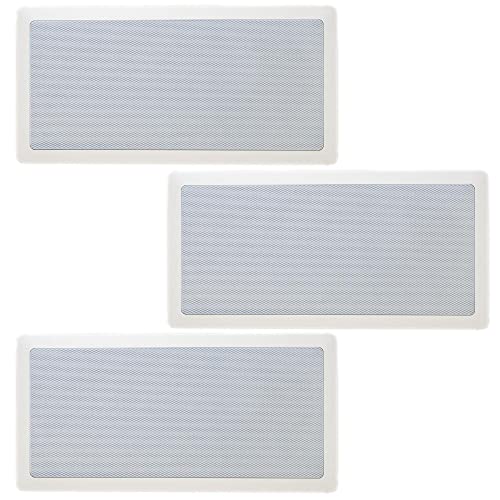
The Legrand Bundle Includes Three HT1LCRV1 Speakers Specified As 5.25″ LCR In-Wall Units With Dual-Woofer Designs And 150W/75W Dual Woofer Rating. This set Is Marketed For Complete L/C/R Front-Channel Deployment In A Single Purchase, Simplifying Component Matching. As A Manufacturer-Supplied LCR Bundle, It Targets Installers Or Homeowners Seeking Consistent On-Wall Tonal Matching Across The Front Soundstage. The grill finish is white and intended to be paintable for a low-visual impact installation.
Buying Guide: How To Choose An In-Wall Center Channel Speaker
Choosing the right in-wall center speaker requires matching speaker characteristics to room acoustics, system design, and installation constraints. Consider the following factors.
Speaker Configuration And Driver Layout
- MTM vs. Single-Driver Centers: MTM (midwoofer-tweeter-midwoofer) designs can improve dialogue focus and controlled beamwidth but may require careful vertical placement and toe-in to avoid lobing.
- Horn-Loaded Tweeters: Horns (seen on some Klipsch models) increase sensitivity and controlled dispersion, useful in larger rooms or with lower-powered amplifiers.
Frequency Response And Dialogue Clarity
- Midrange Emphasis: Centers should prioritize clean midrange for intelligible dialogue. Dual midwoofers or dedicated center-engineered crossovers assist with vocal clarity.
- Tweeter Type: Silk domes provide smooth highs; titanium or compression drivers can add detail and projection—choose based on desired treble character and system matching.
Bass Extension And Porting
- Ported Designs: Built-in bass ports or PowerPort-style vents extend low-frequency response in-wall but depend on available cavity depth.
- Room Size Consideration: Larger rooms benefit from speakers with stronger low-end capability or from supplementing with a subwoofer.
Installation And Mounting
- Mounting Systems: Rotating cams, flange templates, and pre-construction brackets ease installation and produce secure, vibration-free mounts.
- Grill And Aesthetics: Minimal flanges and paintable grills reduce visual footprint. Measure cavity depth and stud placement before purchase.
System Matching And Sensitivity
- Sensitivity Rating: Higher-sensitivity speakers pair well with lower-power receivers. Horn-loaded designs often have higher sensitivity.
- Power Handling: Ensure speaker power handling aligns with amplifier output, and consider headroom for dynamic home theater peaks.
Channel Matching And Bundles
- LCR Sets vs. Single Units: Buying matched LCR sets or identical models for left/center/right reduces tonal mismatch and simplifies tuning.
- Three-Packs And Bundles: Bundles provide consistent voicing across the front stage and may include installation accessories.
Acoustic Placement And Aiming
- Tilted Or Pivoting Drivers: Pivoting tweeters/horns allow aiming toward the listening area, improving imaging when mounting height varies.
- Vertical Alignment: In-wall centers should be mounted near the display’s centerline; MTM designs may require precise vertical placement to avoid lobing artifacts.
Material And Driver Construction
- Woofer Materials: Carbon fiber, cerametallic, or treated poly cones change weight, stiffness, and breakup modes; those influence bass control and coloration.
- Tweeter Materials: Silk and ring-radiator tweeters emphasize smoothness and dispersion, while metal or titanium diaphragms emphasize detail and output.
Comparative Perspectives
- Value-Oriented Options: Look for simplified installation features and paintable grills for discreet installations without premium horn performance.
- High-Output/High-Sensitivity Choices: Horn-equipped or high-sensitivity models are preferable in larger rooms or when used with lower-power amps.
- Complete LCR Matching: Purchasing a three-pack or matched series reduces voicing differences and shortens setup time for multi-channel front arrays.