Choosing the right speaker wire improves clarity, reduces signal loss, and makes installations smoother for home theater, car audio, or DIY projects. This guide highlights five strong options suitable for different setups and budgets. It helps DIY enthusiasts and professionals decide which wire matches their speakers, environment, and preferred handling. Each product section notes who it’s best for and any caveats to consider.
Summary table of selected products:
| Product | Best For | Key Strength | Approx. Length |
|---|---|---|---|
| Install Link 14 Gauge 100 ft CCA | Home theater and car installs | Budget-friendly, flexible | 100 ft |
| Amazon Basics 16-Gauge 100 ft | Basic multi-room wiring | Clear signals, easy handling | 100 ft |
| GEARit 14 Gauge 100 ft (CCA) | DIY projects and professional installs | Color-coded, foot markers | |
| MaxBrite 50 ft 14 Gauge OFC | High-fidelity listening rooms | Oxygen-free copper | 50 ft |
| GEARit 14 Gauge OFC with Banana Plugs | HiFi systems and studio setups | Banana plug termination | 6.6 ft bundles |
Install Link 14 Gauge 100 ft CCA Speaker Wire

Best for budget-conscious DIYers building home theater or car audio systems. This 14-gauge, double-conductor wire uses copper-clad aluminum (CCA) for a cost-effective balance of conductivity and flexibility. The jacket supports easy stripping and clear polarity identification, helping quick, accurate terminations.
- Best for: DIY audio setups and basic installations where cost matters.
- Why chosen: Solid balance of price, flexibility, and format for long runs.
- Limitations: CCA has higher resistance than pure OFC; consider for shorter runs or non-critical channels.
Amazon Basics 16-Gauge Speaker Wire Cable, 100 ft

A straightforward choice for straightforward listening rooms and basic multi-room setups. The 16-gauge wire offers reliable signal transmission with a clear jacket to minimize interference and preserve audio fidelity across standard home systems.
- Best for: Entry-level installations and general-purpose speaker wiring.
- Why chosen: Clear signal transmission with simple handling and polarity marking.
- Limitations: Slightly higher resistance than 14 AWG on long runs; plan length accordingly.
GEARit 14 Gauge 100 ft (CCA) Speaker Wire

This 14-gauge CCA speaker wire is ideal for home theaters, DIY installations, and car audio projects. A flexible jacket and included polarity markings help ensure quick setup and correct connections, while durable construction stands up to frequent rerouting in furniture-heavy rooms or vehicle interiors.
- Best for: DIY projects needing reliable 14 AWG performance.
- Why chosen: Flexible jacket; clear polarity markers aid accuracy.
- Limitations: CCA is less conductive than OFC; better suited for moderate-length runs.
MaxBrite 50 ft 14 Gauge High Performance Speaker Wire
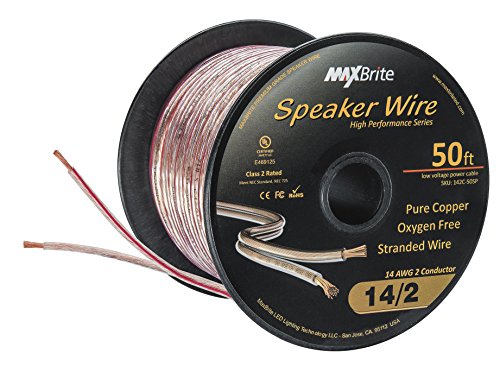
Designed for higher-fidelity listening rooms, this 14-gauge, 50-foot spool uses pure copper and a clear PVC jacket with a red stripe for polarity. OFC conductors deliver low signal loss, supporting clean bass and crisp highs in home theaters or studio setups.
- Best for: Small-to-medium rooms needing dependable, clear signal transmission.
- Why chosen: Oxygen-free copper design offers enhanced signal integrity.
- Limitations: Limited length; not ideal for long cable runs without stacking splices.
GEARit 14 Gauge OFC with Banana Plugs (2-Pack)
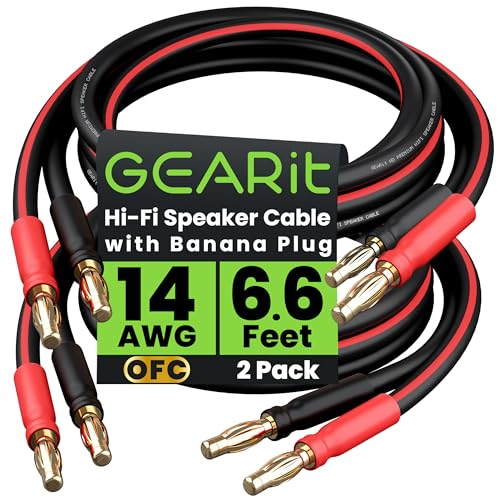
HiFi-focused option with banana plugs for quick, secure terminations. The 14 AWG OFC wire and gold-plated banana plugs support high-fidelity audio across center channels, subwoofers, and stereo pairs in hi-fi systems. Color-coded plugs help maintain correct polarity during setup.
- Best for: HiFi enthusiasts and studio setups requiring reliable plug-and-play connections.
- Why chosen: OFC copper and banana plug termination minimize signal distortion.
- Limitations: Includes banana plugs only; may need adapters for some installations.
Buying Guide
What gauge should you choose?
14 AWG wires offer lower resistance and are common for longer runs or higher-power speakers. 16 AWG works well for shorter runs or budget projects. Consider run length, speaker impedance, and total system power when selecting gauge.
CCA vs OFC: what’s the difference?
CCA (copper-clad aluminum) is more affordable and lighter but has higher resistance than OFC (oxygen-free copper). OFC provides better conductivity and lower signal loss, making it preferable for longer runs or high-fidelity systems.
In-wall and outdoor considerations
UL-listed CL3-rated and outdoor-rated jackets offer safer in-wall and exterior use. If you plan to run wires through walls or outside enclosures, choose a jacket designed for those environments to meet safety standards.
Termination options: bare wire, banana plugs, or spade tips
Bare wire is common for straightforward installs. Banana plugs and spade tips speed setup and reduce terminal wear. Banana plug configurations are especially convenient with color coding to avoid polarity errors.
Length planning and future proofing
Measure carefully and consider extra slack for future upgrades or rearrangements. Running a few extra feet can simplify future moves, but avoid excessive lengths that introduce unnecessary resistance in short-range systems.
Compatibility and installation tips
Always verify speaker terminal compatibility with your amp or receiver. Use proper stripping tools and avoid nicking conductor strands. Route wires away from heat sources and sharp edges to extend longevity.
FAQ
- What wire gauge is best for most home theaters? – 14 AWG is a common choice for a balance of distance and performance; 16 AWG can be fine for shorter runs.
- Is copper-clad aluminum wire good enough? – CCA is budget-friendly and acceptable for many setups, but OFC offers better conductivity for longer runs or critical channels.
- Do I need in-wall rated wire for my media room? – If wiring through walls or ceilings, choose UL-listed CL3-rated or in-wall approved cable to meet safety standards.
- Are banana plugs necessary? – Not required, but they speed installation and help maintain secure connections, especially in HiFi systems.
- How much length should I buy? – Plan for a little extra to accommodate future layouts, but avoid excessive slack on fixed routes to minimize resistance.
- Can I mix different gauge wires in the same system? – It’s possible, but keep balance across channels to avoid uneven volume or bass response.