Choosing the right headset microphone and speaker system depends on coverage, connectivity, battery life, and intended use like teaching, fitness, touring, or karaoke. The table below summarizes five relevant options selected for portability, wireless pairing, and compatibility with voice amplifiers and PA systems.
| Product | Type | Key Strength |
|---|---|---|
| Bietrun Wireless Microphone Headset | UHF Wireless Headset/Handheld | 160 ft range, 2-in-1 headset/handheld |
| ResponseBridge B002 Voice Amplifier | Portable Voice Amplifier With Bluetooth | Auto-pairing, multifunctional Bluetooth speaker |
| MICVISTA 2.4G Dual Wireless Headset Mics | 2.4G Dual Headset Mic System | Two-person use, wide compatibility |
| HW HAOWORKS S98 40W Portable PA | 40W Wireless Speaker With Headset Mic | Higher wattage coverage, strap for portability |
| WinBridge 60W Wireless Voice Amplifier S97 | 60W PA System With Headset And Handheld | Comprehensive connectivity, instrument input |
Bietrun Wireless Microphone Headset For PA Systems
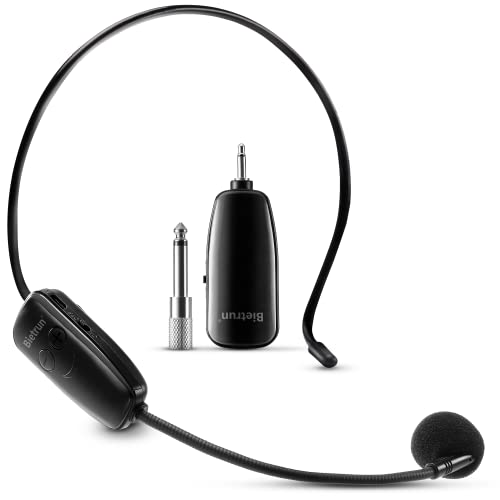
This UHF wireless headset offers a 160-foot transmission distance and a built-in high-sensitivity condenser microphone. The design supports a 2-in-1 headset and handheld mode, and the receiver provides 3.5mm output with an included 6.35mm adapter for larger amplifiers.
Key technical points: the system is intended for devices with a microphone jack (not AUX or Bluetooth devices), uses rechargeable 400mAh batteries with about 6 hours runtime, and charges both transmitter and receiver simultaneously via the included dual micro USB cable.
Signal features include anti-howling, anti-jamming, stable frequency, and no noticeable delay. The product obtained FCC testing per its listing. Compatibility excludes iPhones, Bluetooth speakers, PCs, and laptops, and it is positioned as portable karaoke and voice amplification equipment.
ResponseBridge B002 Voice Amplifier With Bluetooth

The ResponseBridge B002 is a portable voice amplifier and Bluetooth speaker designed for classrooms, tours, and events. The manufacturer highlights instant auto-pairing between mic and speaker and extended battery life—up to nine hours of continuous use—aimed at minimizing signal drops and setup time.
Audio claims include crystal-clear output with no distortion, feedback, or noise, and coverage for large spaces when used as a personal PA. Functionality extends to Bluetooth streaming, USB playback, and a mute button for quick audio pauses.
As listed, this system emphasizes user convenience: lightweight form factor, multifunctional playback options, and simplified wireless pairing to keep speakers focused on delivery rather than technical setup.
MICVISTA 2.4G Dual Wireless Headset Mics For Two People

Designed around 2.4GHz digital transmission, this MICVISTA kit supports two simultaneous headset transmitters paired to a single receiver. The kit lists a 160-foot open-area range and plug-and-play operation using the supplied 3.5mm and 6.35mm jacks.
Practical applications include paired instruction, joint fitness sessions, and co-hosted guided tours. The system emphasizes easy pairing where the indicator light stops flashing once matched, and it supports common PA systems, mixers, and voice amplifiers with microphone jacks.
Feature highlights: dual-user capability, broad compatibility, and stable transmission. The listing positions it as a scalable option when two presenters require independent microphones without separate receivers for each person.
HW HAOWORKS S98 40W Portable PA With Headset

The S98 lists 40 watts of output and is marketed for teachers, outdoor events, and medium-sized audiences up to 200 people. It emphasizes reliable wireless connectivity for hands-free movement and easy adjustments via onboard controls.
Design notes: compact dimensions, a soft handle and adjustable shoulder strap for portability, and intuitive controls for quick volume and setting changes. The listing positions the S98 as a mid-power portable PA that prioritizes clarity and freedom of movement.
Use cases include classroom instruction, fitness classes, and small events where a balance of power and portability is needed. The S98 highlights mobility features and an emphasis on distortion-free audio for vocal projection.
WinBridge 60W Wireless Voice Amplifier With Instrument Port

The WinBridge S97 is presented as a versatile 60W portable PA system suitable for teaching, outdoor activities, and music use. It supports Bluetooth playback, USB/TF inputs, AUX, and both 3.5mm and 6.35mm mic ports, plus a dedicated instrument input for guitars.
Controls include an LED display and separate knobs for instrument, reverb, microphone, and overall volume—allowing fine-grained adjustments during live use. The package lists both handheld and headset microphone support, expanding usage scenarios from speeches to musical performances.
The listing positions this product as a feature-rich option when connectivity flexibility and higher output are priorities, particularly for users who may need instrument support or granular audio control.
Buying Guide: How To Choose A Headset Microphone And Speaker System
Selecting the right system requires balancing coverage, connectivity, and use-case needs. Below are key considerations to compare models objectively.
1. Coverage And Wattage
Wattage affects how far and how loudly a system projects. Higher wattage (40–60W) typically covers larger rooms or outdoor areas. For classrooms or small group settings, lower wattage or compact amplifiers may suffice.
2. Wireless Technology And Range
Common wireless types include UHF and 2.4GHz. UHF can offer robust penetration in crowded RF environments; 2.4GHz systems are often easier to pair and may support digital stability. Check listed range (e.g., 160 ft / 50 m) but expect environmental factors to reduce effective distance.
3. Compatibility And Ports
Ensure the receiver and speaker support the outputs you need: 3.5mm and 6.35mm (1/8″ and 1/4″) jacks, AUX, Bluetooth, USB, or instrument inputs. If you need to connect to a particular amplifier or mixer, verify included adapters and supported connections.
4. Battery Life And Charging
Battery runtime matters for full-day teaching or long events. Look for systems with multi-hour runtimes and charging convenience. Some listings note simultaneous charging for transmitter and receiver or multi-hour continuous use figures.
5. Number Of Users And Expandability
If two presenters need mics simultaneously, choose systems designed for dual transmitters or multiple mic inputs. Confirm whether the receiver supports pairing multiple transmitters and how audio mixing is handled.
6. Audio Features And Controls
Independent volume knobs, reverb controls, and LED displays offer precise adjustments. For musical use, instrument inputs and reverb can be important; for spoken-word use, prioritize clarity and anti-feedback features.
7. Portability And Mounting
Consider weight, handles, shoulder straps, and form factor. Lightweight, strap-equipped units simplify mobile teaching and outdoor use. For stationary PA setups, form factor matters less than connectivity and power.
8. Noise, Feedback And Signal Stability
Look for listings that specify anti-howling, anti-jamming, and no-delay performance. Digital systems sometimes provide cleaner signal integrity, but real-world tests depend on local RF conditions and device pairing behavior.
9. Use Case Matching
Match features to the primary use: teaching and tours often need long battery life and comfortable headset mics; karaoke and musical events may require instrument inputs and higher wattage; fitness instructors need secure headset fit and sweat resistance where specified.
10. Objective Verification
Check product specifications and verify listed claims such as FCC testing, stated ranges, and battery capacities. Where possible, compare multiple models on the above criteria to determine the best fit for your specific environment and audience size.