Choosing the right HDMI ARC/eARC splitter or audio extractor matters when you want TV sound routed to a soundbar and other audio devices. Below is a quick comparison of five relevant Amazon options that support ARC/eARC, optical/Toslink, and multiple audio outputs.
| Product | Key Capabilities | Best For |
|---|---|---|
| avedio links 4K@60Hz HDMI Audio Extractor Converter | HDMI ARC, Optical Toslink, 3.5mm, 4K60, 2CH/5.1CH modes | Basic ARC extraction to soundbar or amp |
| avedio links 4K@60Hz HDMI eARC Splitter 1 in 2 Out | Bi-directional eARC/ARC, 1×2 eARC outputs, EDID modes | Split TV eARC to two audio devices |
| CORSAHD 8K@60Hz / 4K@120Hz HDMI 2.1 Splitter 1 in 2 Out | HDMI 2.1, 48 Gbps, Dolby Atmos, EDID, downscale, HDCP bypass | High-bandwidth setups needing Atmos + multi-display |
| HDIWousp HDMI ARC To Optical Audio Adapter | ARC to Optical/RCA/3.5mm/Coaxial, 192KHz support, TV remote volume | Multi-output ARC extraction for legacy audio systems |
| Ozvavzk HDMI ARC To Optical Converter | ARC to Optical/3.5mm/RCA, 192KHz sampling, plug-and-play | Simple ARC conversion for soundbar or stereo receiver |
avedio links 4K@60Hz HDMI Audio Extractor Converter

This adapter functions as an HDMI audio splitter/extractor that pulls audio from an HDMI source and outputs via HDMI, Optical Toslink SPDIF, and 3.5mm. It supports HDMI ARC so the TV can return audio to the extractor without powering the TV display.
- Video Support: 4Kx2K@60Hz, HDR10, HDCP2.2, 18 Gbps bandwidth.
- Audio Modes: TV, 2.0CH, 5.1CH selectable. Optical supports Dolby Digital/DTS formats, 3.5mm provides stereo PCM.
- Uses: Suitable for sending TV audio to a standalone soundbar or amplifier while preserving UHD video to the TV.
The unit is positioned for users who need basic ARC extraction with multiple output options and support for common surround formats.
avedio links 4K@60Hz HDMI eARC Splitter 1 in 2 Out

This bi-directional eARC/ARC switch and splitter can function as a 2×1 switcher or split a TV’s eARC audio to two downstream audio devices simultaneously. EDID switches let you choose one output at a time or both in splitter mode.
- Topology: Bi-directional: switches two HDMI sources to one display or splits TV eARC to two devices.
- EDID Settings: Two modes—single-output switch or simultaneous-split for synced audio to two devices.
- Compatibility: Advertised support for Ultra HD 4K and stable audio distribution to eARC-enabled soundbars and amplifiers.
This device is relevant when you need the TV’s eARC to feed multiple audio systems such as a primary soundbar and a second amp or zone speaker system.
CORSAHD 8K@60Hz / 4K@120Hz HDMI 2.1 Splitter 1 In 2 Out

This HDMI 2.1 splitter emphasizes high bandwidth and advanced formats. It supports 48 Gbps, 4K@120Hz, 8K@60Hz, VRR, ALLM, and audio formats including Dolby Atmos and DTS-HD. EDID, downscale, and HDCP bypass are also included.
- Audio/Video: Dolby Atmos, Dolby TrueHD, DTS-HD Master Audio; supports simultaneous outputs to two displays or a display plus capture device.
- Features: EDID management, duplicate/mirror, downscaling to match differing display capabilities.
- Use Cases: Ideal for high-end gaming consoles and setups where both advanced video and multichannel audio must be preserved to a soundbar or receiver.
This product is focused on systems that need both high refresh-rate video and multi-channel audio passthrough to a soundbar or AVR while mirroring to another display.
HDIWousp HDMI ARC To Optical Audio Adapter
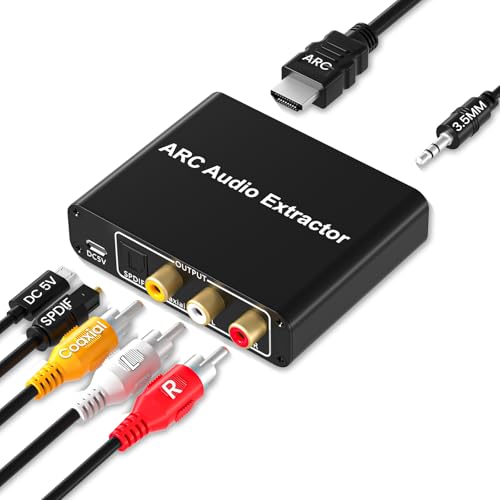
This adapter extracts HDMI ARC audio and provides multiple simultaneous outputs: optical, coaxial, RCA L/R, and 3.5mm. It supports sampling rates up to 192 kHz and common surround formats like Dolby Digital Plus.
- Multi-output: Optical for surround, RCA/3.5mm for stereo, coaxial for legacy receivers.
- Sampling & Formats: Supports 32–192 kHz sampling and 24-bit S/PDIF streams; Dolby AC3/Dolby Digital Plus supported.
- Remote Volume: In ARC mode, stereo outputs can be controlled by TV remote via CEC; optical/coaxial remain fixed level.
This is practical for setups mixing modern soundbars and older stereo equipment where simultaneous connections are needed.
Ozvavzk HDMI ARC To Optical Converter

This device is a compact HDMI ARC audio extractor designed for simple TV-to-soundbar or amp conversions. It supports 192 kHz sampling, multiple outputs, and emphasizes plug-and-play operation with HDMI 1.4 compatibility notes.
- Supported Outputs: Optical (Toslink), 3.5mm analog, and RCA L/R.
- Sampling/Formats: 32/44.1/48/96/192 kHz and 24-bit; supports PCM and requires setting TV audio to PCM/LPCM for some outputs.
- Notes: Intended for TVs with an ARC-labeled HDMI port; not all eARC features are available on ARC-only hardware.
The unit targets users who want a simple, reliable ARC conversion for legacy or stereo gear without complex EDID or eARC handling.
Buying Guide: How To Choose An HDMI ARC/eARC Splitter For Your Soundbar
Selecting the right device requires matching your TV, audio device, and use case. Below are key considerations to compare across products.
ARC vs eARC
ARC supports compressed multichannel audio (Dolby Digital, DTS). eARC
Audio Outputs And Formats
- Optical (Toslink): Good for 5.1 Dolby Digital/DTS but not for high-bitrate lossless Atmos.
- HDMI eARC/ARC Out: Best for full multichannel and high-bitrate formats.
- Analog (RCA/3.5mm): Useful for stereo speakers or older amps but limited to 2-channel audio.
- Coaxial: Alternative to optical for digital 5.1 in some setups.
EDID, Downscaling, And HDCP
EDID management helps resolve handshake issues by presenting supported resolutions and audio capabilities to the source. DownscalingHDCP bypass
Number Of Outputs And Bi-directional Needs
Decide whether you need one-way extraction (TV to soundbar) or a splitter that feeds two audio devices simultaneously. Bi-directional switches allow use as a normal switcher when routing sources to displays.
Video Bandwidth And Features
If you use gaming consoles or 4K HDR sources, confirm support for the resolution and features you need (4K@60Hz, 4K@120Hz, HDR, VRR). Higher bandwidth (HDMI 2.1 / 48 Gbps) maintains advanced video while extracting audio.
Compatibility And Setup
- Check that your TV’s HDMI port is labeled ARC or eARC and that the soundbar supports the same feature set.
- For optical-only soundbars, an extractor with Toslink is sufficient; for full Atmos over HDMI, select an eARC-capable device.
- Some extractors require TV audio output to be set to PCM/LPCM
Latency, Remote Control, And CEC
Some extractors preserve TV remote volume via HDMI-CEC on analog outputs; optical and coax often are fixed-level. Consider whether remote control passthrough or low-latency lip-sync correction is important for your setup.
Future-Proofing
If you expect to upgrade to Atmos or higher-resolution sources, prefer devices with eARC and HDMI 2.1-level bandwidth. For basic stereo or 5.1 needs, an ARC extractor with optical and analog outputs may be sufficient.
Summary Comparison Perspectives
- Value / Simplicity: ARC extractors with optical + analog outputs suit legacy systems.
- High-End Audio / Gaming: HDMI 2.1 splitters with eARC, EDID, and HDCP handling preserve both advanced video and Atmos audio.
- Multi-Room / Dual Audio Devices: eARC splitters with 1-to-2 outputs and EDID modes support simultaneous audio to two devices.
Assess the formats you need, confirm your TV/soundbar ports (ARC vs eARC), and match bandwidth and output options for the cleanest integration.