The following guide compares top dual 18-inch passive subwoofers and equivalent high-power 18″ passive subs suitable for stages, clubs, tours, and pro PA systems. Each selection lists key specifications and features to help match subs to amplifiers, enclosures, and venue needs.
| Model | Brand | Key Feature |
|---|---|---|
| SRX828S | JBL | Dual 18″, 4800W peak, tour-grade |
| ZETHUS-218S | Sound Town | Dual 18″, 3200W program, birch plywood |
| CARME-218SB | Sound Town | Dual 18″, 3200W program, heavy magnets |
| PRX418S | JBL | Single 18″ passive, pole mount option |
| SBG1188 | Rockville | 18″ passive, versatile inputs, high-power handling |
JBL SRX828S Dual 18 Subwoofer

This JBL Professional Compact Passive System features dual 18″ drivers designed for high SPL touring and pro installations. Listed specs include 141 dB maximum SPL and a wide operating range described as 30–150 Hz with a stated response band of 47–120 Hz. Power handling is significant: 1200W continuous, 2400W program, 4800W peak, useful when planning amp selection and headroom.
Construction highlights include 18mm wood enclosure, 14-gauge steel grille, JBL DuraFlex finish, ergonomic handles, and M10 suspension points. These elements signal a design focused on durability and rigging flexibility for arrays and flown configurations.
Sound Town ZETHUS-218S Dual 18

The ZETHUS-218S offers two 18″ high-power transducers with 4″ voice coils and aluminum demodulating rings. Rated at 1600W RMS and 3200W program, it targets clubs, stages, and touring rigs that require punchy low-end with consistent thermal handling.
Build quality emphasizes premium multi-layer birch plywood and a 14-gauge steel grille with anti-corrosion treatment. The cabinet is intended to integrate with ZETHUS array speakers via a mounting frame, supporting cohesive system design for line-array or flown configurations.
Sound Town CARME-218SB Dual 18
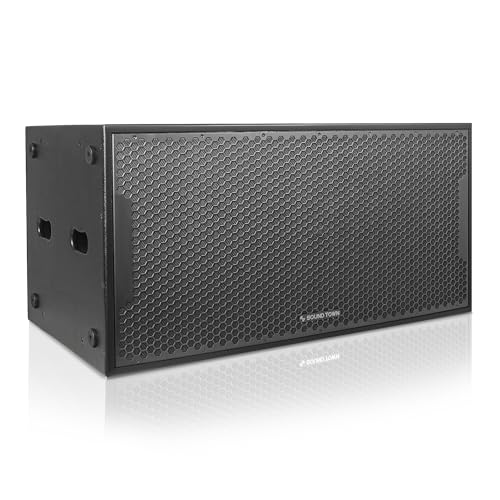
The CARME-218SB is specified for deep bass to ~35 Hz using dual woofers with 100 oz. magnets and 4″ voice coils. Rated at 1600W RMS and 3200W program into 4 ohms, it positions itself as a PA/DJ subwoofer for robust low-frequency impact.
Cabinet notes include rugged textured paint and a perforated grille designed for touring durability. The feature set is targeted at operators who prioritize excursion and low-frequency extension in live sound contexts.
JBL PRX418S 18-Inch Passive Subwoofer

The PRX418S from JBL is a single 18″ passive subwoofer designed for portability and system integration. Power ratings are 800W continuous, 1600W program, and 3200W peak. Frequency specifications are noted as 35–250 Hz with a stated response of 52–120 Hz, making it suitable for full-range reinforcement where a compact sub is preferred.
It includes a pole mount option to pair with satellite cabinets and has sensitivity figures that support efficient amplifier matching for medium-sized venues or portable rigs.
Rockville SBG1188 18-Inch Passive Subwoofer

The Rockville SBG1188 is an 18″ passive sub designed for DJs and live sound. Published figures include 1000W peak (500W RMS) and 750W program, with a 3″ high-temp aluminum voice coil and a 90 oz magnet for reliable thermal performance in sustained use.
Connectivity is broad—binding post, banana, 1/4″ jack, and SpeakON—allowing flexible wiring. Built with high-density MDF and braced construction, this sub aims to balance durability and affordability for mobile applications.
Buying Guide
Selecting a suitable passive 18″ subwoofer depends on technical matching, venue needs, and system architecture. Below are core considerations and comparison perspectives to guide selection.
Power Handling And Amplifier Matching
- RMS, Program, Peak: Use RMS and program ratings as primary guides for continuous and sustained output. Peak ratings indicate short-term capability but are less useful for amp sizing.
- Amplifier Headroom: Choose an amplifier that provides adequate headroom—generally 1.5–2x the subwoofer’s RMS rating for reliable transient response and reduced clipping risk.
- Impedance: Confirm the sub’s nominal impedance (4Ω, 8Ω, 1Ω car subs) and ensure amplifier stability and proper wiring when combining multiple cabinets.
Frequency Response And Low-End Extension
- Lowest Usable Frequency: For club and concert bass impact, subs that extend into the mid-30s Hz or lower provide palpable low-end; check specified low-frequency response and real-world reported performance.
- System Crossover: Plan crossovers to complement full-range tops—typical sub crossover points range from 80–120 Hz depending on main speaker capability and venue acoustics.
Maximum SPL And Venue Size
- Maximum SPL: Higher SPL ratings (e.g., JBL’s 141 dB spec) indicate capability for large venues and touring systems.
- Coverage Strategy: For wide-area coverage, consider quantity and placement of sub cabinets (cardioid arrays, flown stacks, or distributed subs) rather than only per-cabinet SPL.
Build Quality, Rigging, And Portability
- Enclosure Material: Birch plywood is preferred for touring and rigging durability; MDF may be acceptable for mobile DJs and less demanding use.
- Hardware: Check for suspension points, handles, pole mounts, and protective finishes. These determine transport longevity and mounting options.
Connectivity And Integration
- Inputs/Outputs: Professional SpeakON and binding post options simplify amp wiring and parallel chains. Multiple connectors add flexibility.
- Bi-Amp/Passive Switching: Some models offer passive/bi-amp switching—useful when integrating with active crossovers or powered tops.
Application And Use Case Comparison
- Touring Large Venues: Favor tour-grade cabinets with high peak/program power, suspension hardware, and protective finishes (e.g., JBL SRX828S).
- Clubs And Fixed Installations: Consider durable plywood cabinets and mounting compatibility for flown or stacked arrays (e.g., ZETHUS-218S).
- Portable DJ/Small Venues: Lighter MDF alternatives with flexible connectivity and pole-mount options may suffice (e.g., Rockville SBG1188 or JBL PRX418S).
Thermal Management And Voice Coil Specs
- Voice Coil Size: Larger voice coils (3–4″) typically offer better heat dissipation—important for continuous high-output use.
- Magnet Size And Excursion: Higher magnet mass and designed excursion increase low-frequency output and durability under heavy excursions.
System Design Tips
- Match Sensitivity: Align subwoofer sensitivity with tops to avoid level chasing and ensure coherent low-frequency summation.
- Phase And Polarity: Use polarity and delay alignment tools to maintain coherent summation between subs and mains across the crossover band.
- Array Considerations: For cardioid or directional low-frequency control, plan cabinet count and spacing and confirm manufacturer rigging supports array construction.