Answering the need for reliable Toslink and SPDIF adapters, this guide highlights five practical options that maximize compatibility and sound quality. The top picks cater to different buyers: performance-focused enthusiasts, budget-conscious setups, and those upgrading older gear. A quick summary table helps compare core details at a glance.
| Product | Best For | Key Benefit | Limitations |
|---|---|---|---|
| Optical Fiber Digital Extender Coupler 2 Pack | Home theater and source-to-display extensions | Two-pack versatility for connecting two optical cables | Only supports optical-to-optical extension |
| 192KHz DAC Optical to 3.5mm Converter (ESWN DNXB) | TVs, Blu-ray players, set-top boxes to AUX | High sample rate support up to 192kHz/24-bit | Unidirectional; cannot convert 3.5mm to optical |
| LiNKFOR 3.5mm to SPDIF Converter | Audio enthusiasts with analog sources | Converts 3.5mm to optical SPDIF | Not a true digital-to-analog path from 3.5mm to optical |
| eSynic 192KHZ Optical to RCA Adapter | Bridging modern to vintage systems | 192kHz/24-bit DAC with RCA output | Optical to RCA; not bidirectional |
| Tackston 192KHz Optical to 3.5mm Converter | Optical to AUX for soundbars and TVs | Solid 192kHz/24-bit performance | Only optical-to-3.5mm, not reverse |
Optical Fiber Digital Extender Coupler 2 Pack

This product serves as a practical extension connector for Toslink cables, enabling two optical fibers to be joined or extended. Best for buyers who need flexibility in routing a long optical path without changing components. The 2-pack design adds value for multi-room setups or future-proofing.
- Best for: Extending two optical cables in a single setup or creating a longer run without replacing existing cables.
- Why selected: Simple, passive connector that preserves S/PDIF optical integrity.
- Caution: Performance depends on cable quality and cleanliness of connectors; inspect for dust before use.
192KHz DAC Optical to 3.5mm Converter (ESWN DNXB)
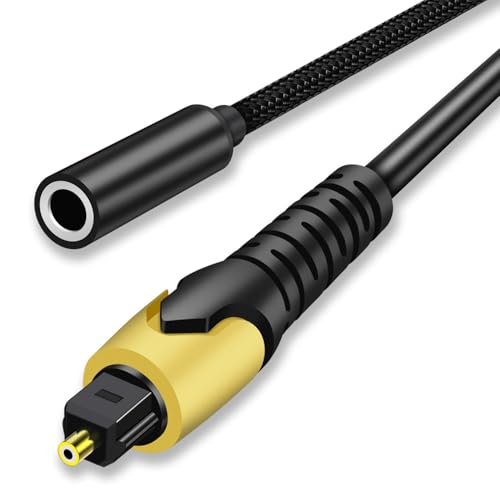
This unidirectional converter turns optical digital audio into a stereo 3.5mm AUX signal. It supports up to 192kHz/24-bit, making it suitable for TVs, DVD players, and set-top boxes where a legacy analog output is needed. It is not reversible, so use it where the source is optical and the destination is a 3.5mm input.
- Best for: Upgrading a TV or Blu-ray setup to an analog speaker or headphone system without losing audio clarity.
- Why selected: High sampling rate support helps preserve sound detail.
- Caution: Ensure the connected device outputs PCM; some TVs require settings adjustments for proper audio format.
LiNKFOR 3.5mm to SPDIF Converter

This device converts analog 3.5mm audio to digital SPDIF optical output. It is best for users with analog sources like older turntables or some amplifiers wanting to feed a digital soundbar or receiver. It outputs two-channel PCM and supports up to 48kHz, with a focus on maintaining fidelity.
- Best for: Sending analog audio from a 3.5mm source to an optical digital input.
- Why selected: Keeps a clean, uncompressed digital signal for compatible downstream gear.
- Caution: Not a true bidirectional converter; it does not take digital optical input and convert to analog.
eSynic Portable 192KHZ Optical to RCA Adapter

The eSynic adapter bridges modern digital sources with vintage RCA-equipped amplifiers or speakers. It supports 192kHz/24-bit, ensuring detail retention during the digital-to-analog conversion. It is ideal for setups where a digital optical output must feed older stereo systems.
- Best for: Connecting a modern TV or media player to an older analog amplifier via RCA.
- Why selected: High-resolution DAC delivers clear, crisp audio at 192kHz/24-bit.
- Caution: Not a bidirectional solution; optical input to RCA output only.
192KHz DAC Optical to 3.5mm Converter (Tackston)

This Tackston converter focuses on optical-to-X functionality, turning SPDIF digital audio into a 3.5mm AUX signal. It supports up to 192kHz/24-bit for reliable high-fidelity output. It is a straightforward option for TVs or sound systems that rely on a 3.5mm input.
- Best for: Converting optical audio to a 3.5mm AUX input on speakers or headphones.
- Why selected: Clear, uncompressed digital-to-analog conversion at high sample rates.
- Caution: Only supports optical input to 3.5mm output; not bidirectional.
Buying Guide
Key purchase considerations help pick the right optical adapter for your setup:
- Directionality: If you need to convert optical to analog, verify that the device is unidirectional in that direction. Some adapters do not support reverse flow.
- Output type: Choose between 3.5mm AUX, RCA, or SPDIF depending on your speakers, soundbars, or receivers.
- Sampling rate and bit depth: Look for support up to 192kHz/24-bit for high-fidelity audio, especially for music and gaming.
- Compatibility with devices: Some TVs require PCM output or specific audio formats. Check your TV’s audio settings to ensure compatibility (PCM/Stereo is often needed).
- Build and cables: A durable connector and clean cable paths reduce signal loss. For multi-room setups, a two-pack like the Extender Coupler can be cost-effective.
- Bidirectional needs: If you require opposite-direction conversion, ensure the product explicitly supports it or consider a different solution.
Frequently Asked Questions
- What is a Toslink optical cable adapter used for? — It connects or extends digital optical audio paths or converts optical signals to analog formats depending on the model.
- Can these adapters work with all TVs? — Most work with standard optical outputs; but some require PCM mode or specific settings on the TV to function correctly.
- Does a DAC adapter always improve sound quality? — A DAC can improve fidelity when converting digital to analog, but results depend on the source and connected equipment.
- Are unidirectional adapters sufficient for home theater? — Yes, if your goal is optical to analog or analog to optical in one direction; bidirectional needs are separate.
- Do I need external power for these adapters? — Most operate passively by drawing power from the optical port and do not require external power supplies.
- What should I check before buying? — Ensure the required direction, output type, and sampling rate are compatible with your devices and listening goals.