Class D amplifiers offer high efficiency, compact size, and strong power output for home, desktop, car, and DIY audio setups. Below is a concise comparison of five relevant Class D amplifiers selected for versatility and performance.
| Product | Brand | Key Strength |
|---|---|---|
| Fosi Audio BT20A Bluetooth Stereo Amplifier | Fosi Audio | Compact, Bluetooth, 100W x2 capability |
| Fosi Audio BT20A Pro Bluetooth 5.0 Amplifier | Fosi Audio | TPA3255 chip, high SNR/low THD, op-amp swap |
| Fosi Audio V1.0G TPA3116 Mini Stereo Amplifier | Fosi Audio | TPA3116D2 chipset, silent idle noise, solid chassis |
| Fosi Audio TB10D 2 Channel TPA3255 Amplifier | Fosi Audio | High power 300W per channel, bass/treble control |
| AIYIMA A07 Premium TPA3255 Power Amplifier | AIYIMA | High-fidelity TPA3255 design, NE5532 op-amp, pre-out |
Fosi Audio BT20A Bluetooth Stereo Amplifier
Brand: Fosi Audio
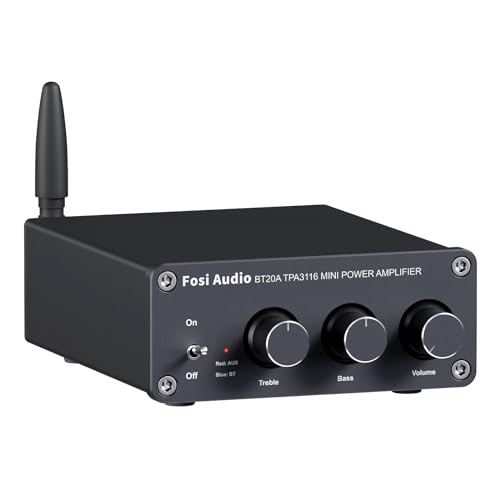
This compact Class D integrated amp is positioned as an entry-level power amplifier for small rooms and multi-use spaces. The unit advertises a peak of 100W x 2 and supports passive speakers around a typical bookshelf or small outdoor setup. Controls include volume plus simple bass and treble adjustment knobs for tonal shaping. The BT20A emphasizes an easy, no-frills setup and a one-touch power switch. For users needing Bluetooth streaming with compact footprint, this model balances functionality and convenience. It is most suitable where space and simplicity are priorities.
Fosi Audio BT20A Pro Bluetooth 5.0 Amplifier
Brand: Fosi Audio
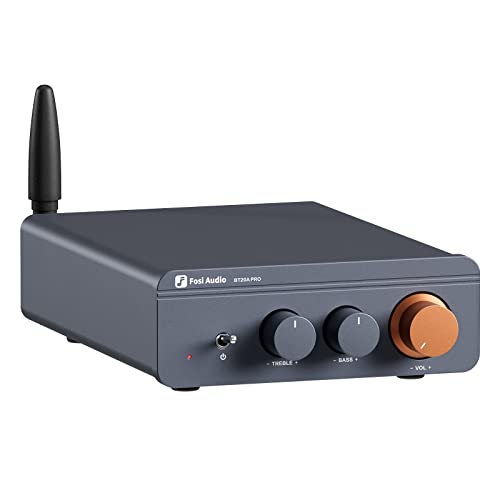
The BT20A Pro upgrades to a TI TPA3255 Class D chip and claims 300W x 2 power capability using its design metrics. It highlights Bluetooth 5.0 connectivity with pairing memory and a user-accessible reset. Key measurement claims include SNR ≥108dB and THD ≤0.005%, indicating a focus on low noise and low distortion. The board also supports replaceable op-amps for voicing changes, appealing to DIY-minded listeners who want to tailor tube-like or analytically neutral signatures. Overall, this model targets users seeking higher power and upgrade paths for sonic tuning.
Fosi Audio V1.0G TPA3116 Mini Stereo Amplifier

Brand: Fosi Audio
The V1.0G uses the TPA3116D2 chip, a well-known Class D solution for efficient stereo amplification. Rated at 50W x 2 under common conditions, the unit supports input voltages from 12V to 24V and includes a solid aluminum chassis plus speaker protection circuits. The design emphasizes dead-silent idle noise and switching frequency options that reduce audible interference. This amp suits compact bookshelf systems, DIY installs, and users who value reliability with a proven TI chip in a small footprint.
Fosi Audio TB10D 2 Channel Stereo Amplifier

Brand: Fosi Audio
The TB10D features the TPA3255 chip and is marketed for 300W per channel capability (spec sheet context). It emphasizes flexibility, stating compatibility with 2–8Ω speakers and integration with subwoofers or bass shakers. Front-panel bass and treble controls allow quick tonal adjustments, and a physical power switch simplifies operation. This model is positioned for listeners who want a compact but high-power Class D amp capable of driving demanding bookshelf or desktop setups while offering basic tone shaping.
AIYIMA A07 Premium TPA3255 Power Amplifier

Brand: AIYIMA
The AIYIMA A07 employs the TPA3255 chip plus an NE5532 dual op-amp and markets itself as a premium mini HiFi amplifier. It highlights low distortion, low noise, and an available pre-out and 3.5mm aux output for integration into active speaker or subwoofer setups. The A07 is aimed at desktop or home audio use where a compact profile and clean, high-power output are required. Its design supports use as the core of a 2.1 system or paired with passive bookshelves for nearfield listening.
Buying Guide: How To Choose A Class D Speaker Amplifier
Choosing the right Class D amplifier depends on use case, speaker compatibility, power needs, and connectivity. Below are the chief factors to consider across multiple comparison perspectives.
1. Power And Speaker Matching
- RMS vs Peak Power: Look for continuous (RMS) power ratings and match amplifier output with speaker RMS power and impedance (2Ω, 4Ω, 8Ω). Overpowering speakers can damage them; underpowering may cause clipping.
- Impedance Load: Verify amp stability at the speaker impedance you intend to use. Many Class D amps can drive 4Ω loads easily; check ratings for 2Ω performance if needed.
2. Efficiency, Heat, And Enclosure
- Efficiency: Class D amps run cooler than Class A/B, but higher power still generates heat. Ensure the chassis and ventilation match your placement (shelf, enclosed cabinet, car trunk).
- Power Supply: External vs internal supplies affect noise and heat. Some mini amps include DC adapters; verify voltage requirements for desired power output.
3. Sound Quality Metrics
- SNR (Signal-To-Noise Ratio): Higher SNR means lower background noise. Look for figures above 90dB for quiet backgrounds in typical environments.
- THD (Total Harmonic Distortion): Lower THD (e.g., ≤0.01% or better) implies cleaner amplification at normal listening levels.
- Chipset Differences: TI TPA3116 is common for efficient mid-power stages. TPA3255 is a modern high-performance selection offering higher output and lower distortion; op-amp swap ability enables voicing customization.
4. Connectivity And Features
- Bluetooth: Built-in Bluetooth (versions matter) provides convenience for streaming. Bluetooth 5.0 yields more stable connections and lower latency than older versions.
- Pre-Out/Line-Out: Pre-outs allow expansion to powered subwoofers or external amplifiers.
- Tone Controls & DSP: Simple bass/treble knobs provide quick adjustments; DSP or parametric EQ offers more precise tuning in some models.
5. Form Factor And Installation
- Size: Mini amps are ideal for desks and small cabinets; larger enclosures often provide better cooling and lower noise.
- Mounting & Build: A solid metal chassis can reduce EMI and vibration; check terminal quality for speaker and power connections.
6. Use-Case Perspectives
- Desktop/Nearfield Listening: Favor compact amps with low noise floor, pre-out, and modest power (30–150W/channel) and good SNR.
- Home Stereo/Bookshelf Systems: Prioritize clean power delivery, support for 4–8Ω speakers, and features like bass management or pre-outs for sub integration.
- Car/Auto Installations: Choose units designed for automotive voltage ranges and mounting, with high RMS output and robust thermal handling.
- DIY Projects: Models with replaceable op-amps or modular boards are better for experimentation and tuning.
7. Reliability, Protection, And Warranty
- Protection Circuits: Look for short-circuit, thermal, and speaker-protection features to prevent failures under stress.
- Brand Support: Consider availability of documentation, replacement power supplies, and community feedback for troubleshooting.
8. Comparative Trade-Offs
- Power vs Size: Higher power typically requires larger supplies and better cooling — mini amps trade absolute power for compactness.
- Flexibility vs Simplicity: Replaceable op-amps and pre-outs offer expansion at the cost of complexity; plug-and-play amps favor simplicity.
- Cost vs Performance: More advanced TI chips like TPA3255 deliver measurable performance improvements but may be unnecessary for casual listening volumes.
Assess your speaker specs, room size, preferred connectivity, and willingness to tweak components to choose the best Class D amplifier for your setup.