For buyers seeking precise, studio-grade control of car audio, a dedicated sound processor can dramatically improve clarity, imaging, and bass performance. This guide highlights five top options, explaining who each is best for and why they stand out. Whether you’re a casual listener upgrading a factory head unit or an enthusiast building a multi-amp, multi-speaker system, these processors offer robust EQ, crossovers, time alignment, and more to tailor your ride’s sound profile.
Summary of selected products:
| Product | Key Strengths | Best For |
|---|---|---|
Taramp’s Pro 2.4S DSP Crossover

The Taramp’s Pro 2.4S is a full digital signal processor with 12 preset EQs and a 15-band graphic equalizer. It supports 2 channels in and 4 channels out, with ISO-standard center frequencies for 25 Hz to 16 kHz. It includes multiple crossover options and filter slopes, enabling precise high-pass and low-pass tuning. This model suits builders who want direct hardware control and detailed per-output configuration, making it ideal for custom installs in vehicles with mixed OEM and aftermarket gear.
Best for: Enthusiasts who want deep hands-on tuning and flexible crossover options in a compact unit. Better for projects requiring explicit filter slopes and multi-input processing. Caution: Interface complexity may require time to learn the full capabilities.
Banda Audiopart X8AiR DSP Car Audio Processor
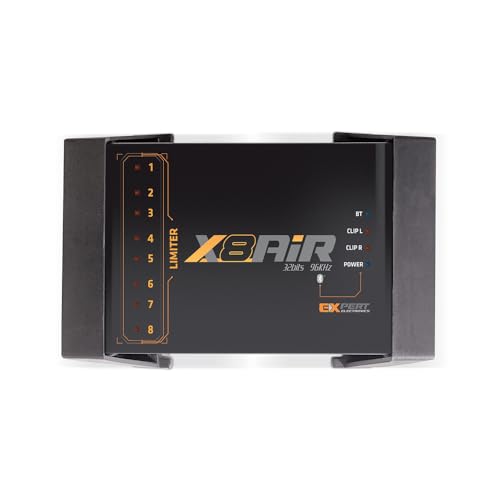
The Banda Audiopart X8AiR uses a 32-bit/96kHz DSP with 79 bands per channel, plus Bluetooth app control for real-time adjustments. It features advanced crossover settings, time alignment, phase control, and peak limiting. The design supports a premium, studio-like tuning workflow directly from a smartphone, which is attractive for those who want precise sonic shaping without frequent head-unit changes.
Best for: Sound purists who want high-resolution parametric control and wireless management. Better for: Users who prioritize app-driven tuning and extensive EQ bands. Caution: App reliability and firmware updates can influence long-term ease-of-use.
PRV AUDIO Car Audio DSP 2.4X

The PRV DSP 2.4X offers two inputs (A and B) and four independent outputs with routing options, plus a 15-band graphic EQ and 12 presets (including Flat, Loudness, Bass Boost, and Hip Hop). Its intuitive LCD interface supports real-time adjustments, making it a flexible choice for multi-source systems that require quick tuning changes and a straightforward workflow.
Best for: Installers and enthusiasts needing practical, on-device editing with preset versatility. Better for: Systems where source selection per output matters. Caution: Fewer built-in advanced processing features than some higher-end rivals.
AudioControl The Epicenter
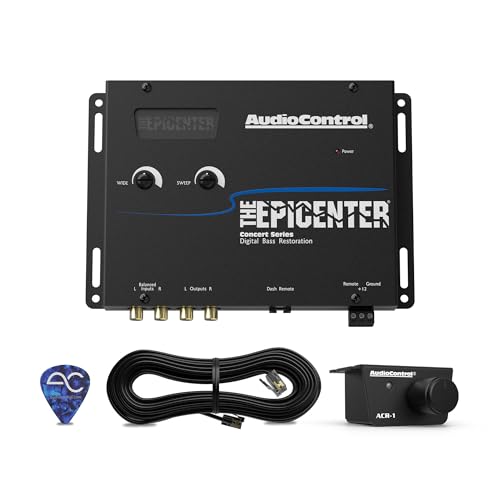
The Epicenter focuses on bass restoration, using a patented circuit to recover low-end content by synthesizing foundations from upper-range harmonics. It includes line-level inputs and outputs for compatibility with downstream crossovers and amps, plus dedicated controls for adjusting the bass signal’s center frequency and bandwidth. This processor is designed to maximize subwoofer impact in systems that otherwise lack bass authority.
Best for: Those seeking dramatic bass reinforcement and a tuned, musical feel. Better for: Enhancing perceived bass without adding excessive distortion. Caution: Primarily a bass-focused tool; may require pairing with other EQ and crossover stages for full-range balance.
Taramp’s Pro 2.8S Black DSP

The Pro 2.8S is designed for 8-way projects with 15-band EQ, 12 presets, and a 2-channel in/8-channel out configuration. It supports detailed graphic and parametric equalization, high-precision crossovers, time alignment, and phase control. It also includes an integrated audio generator for calibration and testing, making it suitable for complex builds where precise channel management is essential.
Best for: Advanced multi-amp installations requiring extensive channel management. Better for: Calibrations and on-site testing with built-in signal generation. Caution: Higher channel count can increase setup complexity and tuning time.
Buying Guide: Key Purchase Considerations
- Sound shaping depth: Look for devices with both graphic and parametric EQ, plus flexible crossovers and time alignment to tailor response across all channels.
- Input/output flexibility: Ensure the unit supports your head unit, amplifiers, and any active subwoofers. Consider whether you need 2-in/4-out, 4-in/8-out, or more complex routing.
- Control method: Bluetooth/app control is convenient for quick tuning from a smartphone, but on-device controls and an easy UI can speed adjustments during installs.
- Measurement tools: Some processors include built-in analyzers, sweeps, or test signals to simplify calibration; this can reduce trial-and-error tuning time.
- Compatibility and system goals: For factory-head-unit upgrades, choosing a DSP with robust OEM integration and line-level options helps minimize adapters and wiring.
- Ease of use vs. depth: If you need rapid tuning, simpler presets and a user-friendly interface may trump the deepest possible control.
Frequently Asked Questions
- What is a car audio DSP, and why should I consider one? A digital signal processor adjusts equalization, crossovers, delay, and dynamics to optimize sound staging, bass, and clarity beyond what a factory head unit offers.
- Do I need Bluetooth control, or is on-device control enough? Bluetooth control is convenient for frequent tuning, but some setups benefit from on-device controls and software-based editors for precision work.
- Can DSPs replace a separate equalizer or crossover? In many setups, a DSP combines these functions, reducing the need for standalone units. However, complex builds may still require multiple processors.
- Is high-channel-count DSP necessary for most cars? For simple two-channel systems, a basic 2-in/4-out DSP may suffice. Enthusiasts with multi-amps or multi-woofers often benefit from higher channel counts.
- How important is time alignment? Time alignment ensures that sound from all speakers reaches your ears simultaneously, improving imaging and stage width, especially in front-seat-focused setups.
- What should I calibrate first? Start with a flat or reference EQ, set crossovers to protect each driver, then fine-tune bass via a dedicated bass processor or Epicenter-like tool if needed.