Choosing the right Bluetooth chip or module affects connection stability, latency, audio quality, and compatibility when building or buying a wireless speaker. Below is a concise comparison of selected Amazon products that highlight different Bluetooth chip versions and amplifier solutions useful for DIY projects and ready-made speakers.
| Product | Bluetooth Level / Chip | Form |
|---|---|---|
| FULMINARE Portable Bluetooth Speaker | Bluetooth 6.0 | Complete Portable Speaker |
| DAMGOO 440W Audio Amplifier Board | Bluetooth 5.2 | Amplifier Board (TPA3251) |
| ARRAROWN ZK-1602T Amplifier Board | Bluetooth 5.0 | Amplifier Module (TDA7498E) |
| DAMGOO 2.1 Subwoofer Amplifier Board | Bluetooth 5.0 | 2.1 Amp Board (TPA3116) |
| DROK Bluetooth Board | Bluetooth 4.2 | Receiver Module |
FULMINARE Portable Bluetooth Speaker

This complete portable speaker advertises a Bluetooth 6.0 chip designed for improved connection range and lower latency versus earlier versions. The unit uses dual 13W drivers for a combined 26W output and promises reduced dropouts and interference resistance.
- Key Features: 26W HD sound, Bluetooth 6.0, IPX5 waterproof, up to 16-hour playtime, RGB mood lighting.
- Bluetooth 6.0 claims include extended range and fewer dropouts; practical performance depends on host devices and firmware.
- Offers standard inputs (AUX/TF/USB) in addition to Bluetooth for compatibility with non-wireless sources.
DAMGOO 440W Audio Amplifier Board

This amplifier board integrates dual TPA3251 class D chips and a built-in Bluetooth 5.2 receiver. It targets DIY speaker builders who need high output and modern wireless connectivity.
- Key Features: 220W+220W output, Bluetooth 5.2, smart protection, multiple inputs (AUX/USB), DC 13–36V supply.
- Bluetooth 5.2 offers improved throughput and audio link management compared to Bluetooth 5.0; useful when pairing with compatible source devices.
- The board includes protection mechanisms (over-voltage, short circuit, thermal) beneficial for high-power builds.
ARRAROWN ZK-1602T Bluetooth Power Amp

The ZK-1602T is a stereo mini amplifier module that includes a Bluetooth 5.0 interface and dual TDA7498E chips geared for audiophile-style amplifier builds. It emphasizes low distortion across the audio band.
- Key Features: 160W+160W rated, TDA7498E chips, treble and bass controls, USB/AUX inputs, DC 15–36V.
- Bluetooth 5.0 provides stable connections and reasonable range for most consumer setups.
- On-board tone controls and a multi-function dial enable on-device adjustments for room tuning and user preference.
DAMGOO 2.1 Channel Subwoofer Amplifier Board

This 2.1 amplifier board features dual TPA3116D2 chips and an integrated Bluetooth 5.0 receiver. It’s intended for DIY systems that require a subwoofer channel and adjustable treble/bass on-board.
- Key Features: 50W+50W+100W outputs, TPA3116D2 chips, treble & bass controls, Bluetooth 5.0, DC 12–24V.
- Bluetooth 5.0 offers dependable wireless audio for most mobile devices; the module includes AUX fallback.
- Treble and bass knobs allow real-time tonal tweaks important when integrating subs and satellites.
DROK Bluetooth Receiver Board
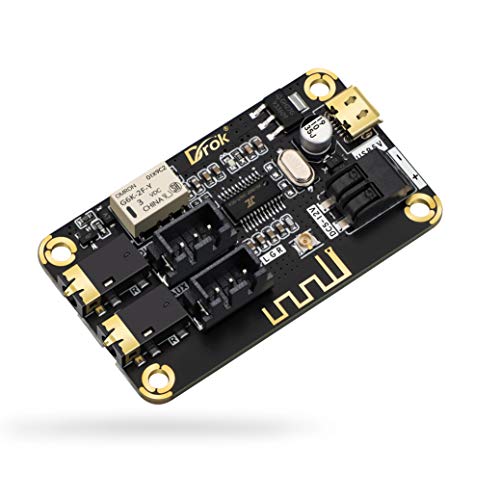
This compact receiver module uses Bluetooth 4.2 and supports DC 5–12V operation. It’s aimed at simple DIY conversions of passive speakers and headphones into wireless devices.
- Key Features: Bluetooth 4.2, micro USB power, 3.5mm AUX in, 2.54mm pin inputs.
- Bluetooth 4.2 provides basic wireless audio and low power draw but lacks many enhancements present in Bluetooth 5.x.
- Appropriate for low-cost retrofits where advanced features like LE Audio or extended range are not required.
Buying Guide — Choosing The Best Bluetooth Chip For Speakers
Selecting the right Bluetooth chip or board requires considering several technical and practical factors based on your project goals, source devices, and listening environment.
Bluetooth Version And Compatibility
Bluetooth 5.2 / 5.0 vs 4.2: Newer versions (5.0, 5.2, 6.0) provide longer range, improved throughput, and better multi-device handling. Bluetooth 5.2 also adds LE Audio support in some implementations and improved power management. Bluetooth 4.2 remains usable for basic streaming but may show shorter range and more dropouts with modern phones.
Audio Latency And Codec Support
Low-latency codecs (e.g., aptX Low Latency) matter for video sync and gaming. Most generic modules list only SBC or AAC; if you need tight lip-sync, verify codec support on both the source and the receiver. For music-only use, SBC or AAC may be sufficient.
Connection Stability And Interference Resistance
Modules with modern Bluetooth chips often include improved interference resistance and connection management. In crowded environments, higher Bluetooth versions can reduce dropouts. Antenna layout and enclosure design also influence real-world reliability.
Power Requirements And Thermal Management
Amplifier boards with integrated Bluetooth need appropriate DC supply ratings and adequate heat sinking. High-power TPA/ TDA amplifier chips generate heat; include ventilation or heatsinks to prevent thermal throttling or protection shutdowns.
Inputs, Outputs, And Expandability
Consider whether you need AUX, USB, TF card playback, or preamp outputs. Some Bluetooth boards include multiple inputs for flexibility. If building a multi-driver speaker, ensure the board supports subwoofer crossovers or provides line-level outputs to external amps.
Protection And Reliability
For high-power designs, smart protection (over-voltage, short-circuit, thermal) reduces failure risk. Choose amplifier boards with proven protection circuits if speakers will see heavy use or variable power supplies.
Form Factor And Integration
Small receiver modules (like DROK) are easy to fit inside compact cabinets, while full amplifier boards require more space and mounting points. Check voltage ranges and connector types to match your enclosure layout and wiring.
Use Case Considerations
- Portable Speakers: Prioritize power efficiency, small size, and waterproofing compatibility.
- Home Hi‑Fi: Prioritize higher-quality codecs, low distortion amplifiers, and local tone controls.
- DIY Loudspeakers: Choose robust amplifier chips (TPA/TDA families), thermal protection, and Bluetooth 5.x for range and stability.
Comparison Perspectives
When comparing options, weigh Bluetooth version vs amplifier quality. A modern Bluetooth chip with a weak amplifier will still produce poor sound, and a high-power amp with an outdated Bluetooth module may suffer connectivity issues. Match the Bluetooth capability to the amplifier and the expected listening environment.
Also consider future compatibility: newer Bluetooth versions are more likely to support upcoming phones and wireless features, while legacy modules may require wired fallback options for longevity.