Answering the ask for portable, battery-powered loopers, these options cover compact, feature-rich pedals ideal for practice, street performances, and quick songwriting sessions. The top picks below are best for solo artists, guitarists seeking simple looping, and performers who need USB import/export or built-in drum or tuner features. This guide compares five strong battery-powered looper pedals to help you choose the right one for your needs.
Selected products at a glance
- BOSS RC-1 Loop Station Pedal — simple, dependable looping with 12 minutes of record time.
- LEKATO Looper Guitar Pedal Drum Machine — 2-in-1 looper and drum machine, USB import/export.
- LEKATO Looper Guitar Pedal with Tuner — compact 9-loop setup, long single-loop duration.
- Donner Triple Looper Pedal — three loops, bright display, up to 90 minutes total recording time.
- Zoom G1X Four — multi-effects with a built-in looper and battery power option.
BOSS RC-1 Loop Station Pedal

The BOSS RC-1 is a straightforward, industry-standard loop pedal designed for guitar, bass, and keyboard players who want reliable, no-fuss looping. It features a stereo looping path, a single footswitch operation, level control, and a visible 24-segment LED indicator for clear progress and status. Best for players who value simplicity and robust performance in a compact package. A potential limitation is its lack of built-in drum tracks or advanced tempo sync, which makes it less suited for complex backing arrangements.
Who it’s best for: Beginners and performers needing a dependable, easy-to-use looper with clear feedback in live or practice settings.
Why selected: It remains a staple in many rigs due to its reliability, straightforward controls, and sturdy build—ideal for everyday looping needs without feature bloat.
LEKATO Looper Guitar Pedal Drum Machine
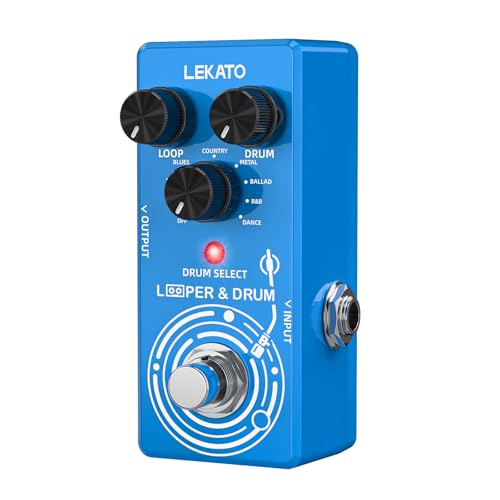
This 2-in-1 device combines a high-quality looper with a built-in drum machine, offering up to six minutes of loop time and eight drum grooves. It supports USB import/export of loop files, and overdubs can be added indefinitely. The dual-module design is ideal for solo practice, street performances, or home studios where you want a compact device that can provide both rhythm and guitar loops. Limitation: the 6-minute loop limit may require more frequent overdubs for longer performances.
Who it’s best for: Solo artists who want a compact unit that can provide drum backing and looping without carrying multiple devices.
Why selected: The combination of looper and drum machine with USB file handling gives flexible workflow for practice and idea capture on the go.
LEKATO Looper Guitar Pedal With Tuner

This LEKATO model emphasizes long recording time and clear visual indicators, offering up to 10 minutes in a single loop and 40 minutes total with nine loops. It uses a 48K/24-bit sample rate for high-quality audio and provides an analog-dry-through design to preserve dry signal when effects are engaged. The built-in tuner function minimizes setup changes mid-performance. Caution: some users may find the single-knob operation limits on-the-fly control compared to larger multi-parameter pedalboards.
Who it’s best for: Guitarists who want longer single-loop durations and solid, high-fidelity audio in a compact pedal, plus on-board tuning.
Donner Triple Looper Pedal

The Donner Triple Looper provides three independent loop slots and up to 90 minutes of total recording time. A bright built-in screen clearly displays loop status, making it easier to manage multiple sections during live sets or songwriting. This model uses a simple one-footswitch control scheme for recording, overdubbing, playback, and clearing, which is ideal for beginners and performers who prefer straightforward operation. Limitation: three loops may require more planning for complex song structures beyond three sections.
Who it’s best for: Players who need multiple loop sections with clear visibility and a large total recording time for longer jams or multi-part songs.
LEKATO Guitar Looper Effect Pedal

This LEKATO model offers nine loops with up to 40 minutes of total recording time and USB for upload/download of WAV loop files. It emphasizes uncompressed 24-bit audio and an analog-dry-through path to preserve signal quality. A built-in tuner function assists on-the-fly tuning, and a single-knob control streamlines playback and level adjustments. Caution: the product’s feature set is compact, so users seeking advanced effects beyond looping and tuning may need an additional pedal or processor.
Who it’s best for: Guitarists who want a compact, high-fidelity looper with USB file handling and an integrated tuner for quick performance tweaks.
Zoom G1X Four Guitar Multi-Effects Processor

The Zoom G1X Four offers a versatile set of 71 effects and 13 amp models, plus a built-in looper with 30 seconds of real-time looping. The device also includes a rhythm section with 68 built-in patterns to act as a backing band. Battery operation makes it practical for on-the-go practice and street performances where space and power are limited. Note that the looper time is shorter than dedicated looper pedals, so this device is best for quick ideas, layering, and practice rather than long-form looping projects.
Who it’s best for: Players seeking a portable multi-effects unit with a built-in looper and rhythm backing, suitable for practice, songwriting, and small gigs.
Buying Guide: Key Considerations For Battery-Powered Loopers
- Loop time vs. portability: Longer loops are great for full compositions but often increase size or require more power. Balance your need for endurance with the device’s footprint.
- Battery life and power options: Confirm runtime on batteries and whether USB or AC power is required for longer sessions. Some units support only battery operation for practice but still require an external power source for long gigs.
- Number of loops and overdubs: More loops allow building complex sections. Unlimited overdubs enable richer textures but add complexity in control.
- Built-in features: Tuner, drum machines, bass/drum backings, and USB import/export can dramatically affect workflow and creativity. Decide which extras you actually use.
- Ease of use: Simple one-footswitch designs are quick to learn, while more feature-rich models may require time to master. Consider your experience level and performance needs.
- Audio quality: Look for at least 24-bit/44.1kHz audio for clean, transparent loops. Analog-dry-through paths help preserve your dry signal.
- Connectivity: USB export/import supports backup and collaboration. Check compatibility with computer software if you plan to edit loops on a PC/Mac.
Frequently Asked Questions
- What is a looper pedal best used for? – It records a phrase, plays it back, and allows overdubs to create layered loops, making practice and live performance more versatile.
- Do I need extra power supplies for these battery-powered loopers? – Some units run on batteries for portable use, but many require USB power or an adapter for extended sessions. Check your model’s power options.
- Can loopers sync with a drummer or metronome? – Some devices offer built-in drum patterns or tempo sync; others rely on manual timing. Review the drum and tempo features before buying.
- Is USB import/export necessary? – USB support helps back up ideas and transfer loops to a computer for editing, storage, or sharing with collaborators.
- Are there toy-quality loopers vs. professional-grade loopers? – Entry-level models emphasize simplicity, while higher-end devices offer longer loop times, more tracks, and advanced editing features.
- Should I choose multiple small loopers or one multi-function unit? – If you need portability and simplicity, a single dedicated looper may be best. For broader capabilities (drum, tuner, effects), a multi-function unit could be preferable.