Choosing the right 70V speaker volume control affects zone balancing, installation ease, and long-term reliability. The table below summarizes five reliable inline and in-wall controls selected for commercial and light-commercial installations.
| Product | Type | Power | Key Feature |
|---|---|---|---|
| Monoprice 100W In-Wall Rotary | In-Wall Rotary | 100 W | 11 Positions, Make-Before-Break |
| Monoprice 50W In-Wall Rotary | In-Wall Rotary | 50 W | Fits Single-Gang Box |
| Rockville VOL70100 100W Wall Control | 1-Gang Wall Rotary | 100 W | Euro-Block Terminal, Dust-Protected |
| Rockville VOL7035 35W Volume Control | 1-Gang Wall Rotary | 35 W | 11-Step, 30 dB Attenuation |
| OSD MVC50 50W Mono In-Wall Thru-Put | In-Wall Mono Thru-Put | 50 W | Daisy-Chain Thru Output, Multiple Colors |
Monoprice 70 Volt Rotary In-Wall 100W Volume Control

This in-wall inline volume control is designed for 70V systems and supports up to 100 watts. It uses an 11-position rotary attenuator with make-before-break contacts, which helps prevent audio dropouts when changing levels. The control accepts up to 12 AWG wire, making it suitable for longer runs or higher-gauge installations. Its design fits standard in-wall mounting for a flush, discreet install.
Monoprice 70 Volt Rotary In-Wall 50W Volume Control

The 50W variant provides a smaller capacity option optimized for single-zone or low-power runs. It features 11 volume positions with make-before-break switching and is made to fit a single-gang junction box. This model is useful when the amplifier or speaker taps limit power per zone, or where compact, low-profile controls are required.
Rockville VOL70100 100 Watt 70V Wall Volume Control
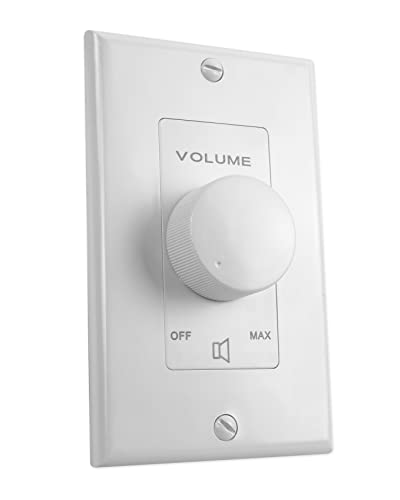
The Rockville VOL70100 handles up to 100 watts and uses an 11-step rotary attenuator with an absolute off position, enabling precise zone-level tuning. It includes detachable Euro-block terminal connectors for quick wiring and a dust-protected circuit to extend longevity in commercial environments. This model targets installers seeking tool-free terminal access and a robust mounting solution.
Rockville VOL7035 35W 70V Wall Volume Control

The VOL7035 is a compact 35W control for low-power zones or where fewer speakers are used. It offers an 11-step rotary knob with up to 30 dB attenuation and an absolute off position. The unit installs in a standard 1-gang box, uses detachable Euro-block connectors, and is built with a dust-protected internal board and rugged ABS frame for commercial durability.
OSD 70V Mono 50W In-Wall Volume Control (MVC50)
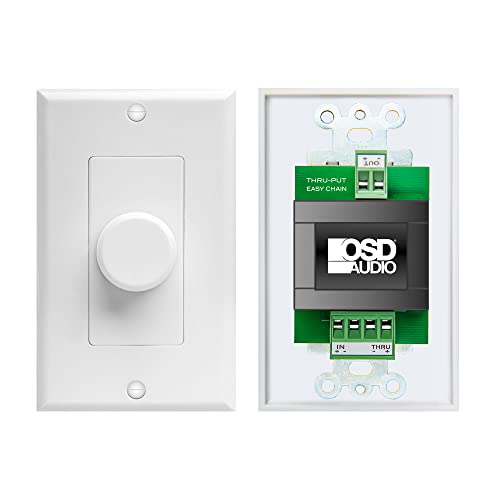
The OSD MVC50 emphasizes installation flexibility with a thru-put output that allows easy daisy-chaining between multiple controls. It supports 50 watts and is built for low insertion loss and reliable frequency response in 70V systems. The package includes multiple color inserts and knobs for matching decor in commercial settings.
Buying Guide: How To Choose A 70V Speaker Volume Control
Choosing the right control requires matching system power, installation topology, and control granularity. Below are the key considerations.
Power Rating And Speaker Taps
Match the volume control’s power rating to the amplifier and total speaker load in a zone. Controls rated at 100W suit denser zones or multiple speakers; 35–50W units are adequate for small zones or single-speaker lines. Ensure the sum of speaker taps does not exceed amplifier capacity at 70V.
Control Type: Rotary, Inline, Or Thru-Put
- Rotary In-Wall: Common for wall-mounted zones, fits standard junction boxes.
- Inline: Often used in conduit runs or behind panels where a flush wall control isn’t needed.
- Thru-Put/Daisy-Chain: Allows multiple controls on a single run—useful for linear layouts or chained rooms.
Installation Considerations
Check terminal type and wire gauge support. Euro-block terminals
Attenuation Steps And Off Position
Controls with 11 steps provide predictable level increments. An absolute off position for quickly muting a zone. Consider whether fine-grain control or simple coarse steps fit the use case.
Durability And Environmental Fit
Commercial settings demand dust protection, robust frames, and secure mounting. Look for dust-protected circuits and materials rated for frequent use. Color-matching plates and knobs may be important for visible installations in retail or hospitality spaces.
Compatibility With 70V System Topology
Confirm whether the control is designed for true 70V constant-voltage operation rather than low-voltage speaker-level. For stacked zones, confirm if the control supports pass-through wiring or stacking multiple units while respecting 70V rules for speaker counts and total wattage.
Comparative Perspectives
- High-Capacity vs Low-Capacity: 100W units are better for larger zones or many speakers; 35–50W units reduce cost and footprint for single rooms.
- Feature-Rich vs Simplicity: Thru-put models add wiring flexibility; basic rotary models simplify installation and reduce potential failure points.
- Install Time vs Flexibility: Euro-block connectors speed installation, while hardwired screw terminals may be marginally cheaper but slower to service.
Typical Use Cases
- Restaurants and retail: multiple zones with 100W controllers for open areas and 35–50W for private rooms.
- Offices and meeting rooms: in-wall 50W–100W controllers with make-before-break for smooth adjustments.
- Warehouses or industrial spaces: rugged units with dust protection and higher wattage capacity.
When selecting a 70V speaker volume control, validate power handling, terminal types, mounting compatibility, and whether you need daisy-chaining. Matching these factors to installation layout and expected usage patterns ensures reliable zone control and consistent audio performance.