Finding the right enclosure blueprint for four 15-inch subs means matching driver specs to enclosure type, internal volume, and port tuning. Below is a concise comparison of five components and prefab box options that fit common 15-inch subwoofer builds. Use this overview to pair driver specs with ported or sealed designs for a 4×15 configuration.
| Product | Type | Key Specs |
|---|---|---|
| Skar Audio EVL-15 D4 | 15″ Subwoofer | 2,500W Peak, Dual 4Ω, 3″ voice coil |
| Skar Audio SDR-15 D4 | 15″ Subwoofer | 1,200W Peak, Dual 4Ω, 2.5″ voice coil |
| CT Sounds Bio 15″ | 15″ Subwoofer | 1,000W Max, Dual 4Ω, 2.4″ voice coil |
| Q Power Q Bomb 15″ Dual Vented | Ported Enclosure | Dual vented chambers, 0.75″ MDF, spring terminals |
| Q Power Q Bomb 15″ Single Vented | Ported Enclosure | Single vented chamber, 0.75″ MDF, bed liner finish |
Skar Audio EVL-15 D4 15″ Subwoofer
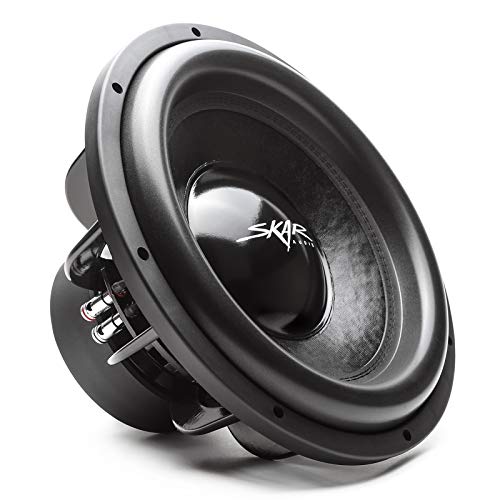
Features: 15-inch Dual 4 Ohm competition-grade driver, Peak Power 2,500W, RMS 1,250W, 3″ high-temp dual voice coil with black coating.
This driver is built for high-power ported or large-volume sealed enclosures. The 3-inch voice coil and high RMS rating require an enclosure design with sufficient internal volume and airflow to avoid mechanical limits. For a 4×15 layout, combine four drivers in separate chambers or a shared chamber engineered to match combined displacement and tuned port frequency. Use sturdy bracing and consider vent cross-sectional area to prevent port compression in a multi-driver ported layout.
Skar Audio SDR-15 D4 15″ Subwoofer

Features: 15-inch Dual 4 Ohm, Peak Power 1,200W, RMS 600W, 2.5″ 4-layer copper voice coil.
The SDR-15 is a mid-power 15″ option well-suited to compact ported chambers or medium-volume sealed boxes. When designing a 4×15 enclosure, calculate the combined displacement (Vas and Xmax) to specify total internal volume. A common approach is to use four separate identical chambers (one per driver) for controlled tuning, or pair drivers into two shared chambers with matched port dimensions. The SDR-15’s 2.5″ coil favors designs with moderate excursion allowance and port tuning near the driver’s Fs for impactful low-end response.
CT Sounds Bio 15” Dual 4-Ohm Subwoofer

Features: 15″ Dual 4Ω, RMS 500W, Max 1000W, 2.4″ 4-layer copper voice coil, single-stacked motor.
The CT Sounds Bio 15 offers conservative power handling that can simplify enclosure design for a 4×15 system—smaller internal volumes and gentler port tuning can still produce controlled bass. For four CT Bio drivers, a multi-chamber ported box with separate tuning per pair can yield balanced output while reducing interaction between drivers. This driver’s lower RMS suggests attention to amplifier matching and wiring strategy to reach desired impedance and power distribution across four drivers.
Q Power Q Bomb 15″ Ported Subwoofer Box (Dual Vented)

Features: Dual vented chamber design, 0.75″ MDF construction, bed liner finish, spring-loaded terminals.
This prefab enclosure is optimized for deep bass with two vented chambers, simplifying multi-driver integration. For a 4×15 layout, verify internal chamber dimensions and port tuning frequency against your drivers’ Thiele/Small parameters. The dual chamber design is compatible with pairing drivers per chamber (two drivers per chamber) and tuning each chamber to a target resonance. Sturdy 0.75″ MDF and factory bracing help manage flex and maintain tuning under high SPL, making this a practical option when custom blueprints are not used.
Q Power Q Bomb 15″ Ported Subwoofer Box (Single Vented)

Features: Single vented chamber design, 0.75″ MDF, bed liner spray finish, spring-loaded terminal.
The single-vented Q Bomb is intended for one or two 15″ drivers in a larger shared chamber. For a true 4×15 custom blueprint, a single-vented design can be scaled into a larger multi-chamber ported box or used as a module replicated across the vehicle. Check port area and length: when scaling enclosures, preserve port cross-sectional area to avoid chuffing and maintain tuned frequency. This unit serves as a reference for port dimensions and build materials when drafting your own 4×15 blueprint.
Buying Guide: Designing Or Choosing Blueprints For 4×15 Enclosures
Creating a reliable 4 x 15-inch subwoofer enclosure requires balancing driver specs, enclosure type, amplifier power, wiring complexity, and vehicle space. Below are key considerations and comparison perspectives:
Enclosure Types And When To Use Them
- Ported (Vented): Greater low-frequency output and efficiency. Best for SPL and deeper extension. Requires larger internal volume per driver and careful port tuning to match Fs and xmax.
- Sealed: Tighter transient response and smaller footprint. Easier to design for predictable behavior but needs more amplifier power for equivalent SPL.
- Bandpass: Can be used for extreme SPL in a narrow band but is complex and harder to tune for multiple drivers.
Volume, Tuning, And Scaling For Four Drivers
- Start with manufacturer Thiele/Small parameters (Vas, Fs, Qts, Xmax). Multiply driver displacement when combining drivers in one chamber.
- Decide whether drivers share chambers or have dedicated chambers. Shared chambers require careful modeling to avoid modal interactions.
- When scaling ported designs, preserve port area-to-volume ratios. Doubling drivers does not mean simply doubling port length; use enclosure calculators or speaker-design software.
Wiring And Impedance Planning
- With dual 4Ω voice coils, plan series/parallel wiring to achieve amp-safe impedance (commonly 1Ω, 2Ω, or 4Ω). Calculate final load before finalizing wiring schematic.
- Ensure amplifier capability for low-impedance loads and continuous RMS power matching combined driver RMS ratings.
Materials, Bracing, And Build Quality
- Use at least 3/4″ MDF or marine plywood for large 15″ enclosures to avoid flex. Reinforce with internal bracing, especially for large multi-driver walls.
- Bed liner or vinyl finishes help damp panel resonance; add internal damping material to control standing waves.
Port Design And Airflow
- Calculate port diameter and length to reach desired tuning (Fb). For high SPL, larger diameter ports reduce air velocity and port noise.
- Consider flared ports to minimize chuffing at high excursion. Maintain smooth internal transitions and avoid abrupt corners near drivers.
Mounting Depth, Vehicle Fit, And Practical Constraints
- Measure available vehicle space and door/seat access for installing large 4×15 modules. Depth and mounting flange clearance will dictate possible designs.
- Modular designs (two mirrored boxes) can simplify installation and tuning while maintaining balanced output.
Amplifier Matching And Power Handling
- Match amplifier RMS to combined driver RMS; avoid continuous clipping. For ported systems, allow headroom for peaks and dynamic content.
- Use proper gain setting, low-pass filtering, and subsonic filters to protect drivers from over-excursion below tuned frequency.
Comparison Perspectives
- Performance vs. Simplicity: Prefab Q Power boxes offer tested port dimensions and robust construction but may not exactly match every driver’s parameters.
- Cost vs. Customization: Custom blueprints permit perfect tuning and driver-specific volumes but require time, tools, and design validation.
- SPL vs. Fidelity: Large ported multi-driver boxes favor SPL and low extension; sealed or smaller-volume designs favor transient accuracy and tight bass.
When drafting or selecting a 4×15 blueprint, begin with driver Ts parameters, choose enclosure type based on target response, model combined system behavior with software, and plan wiring and amplifier matching to preserve driver longevity and performance.