If you’re shopping for a 4,000-watt car amplifier, you’re likely chasing bone‑rattling bass and clean, distortion-free sound at high power. This guide highlights five top monoblock and multi‑channel options that deliver robust power, efficient Class D design, and practical tuning features. Whether you’re building a dedicated subwoofer rig or a full-range system, these models aim to balance output with thermal reliability and user controls.
| Product | Power (1 Ohm RMS) | Type | Best For |
|---|---|---|---|
| ORION CBA4500.1D | 4500W | Monoblock Class D | Loud, clean bass for single subwoofer |
| Taramps MD 4000.1 | 4000W RMS | Monoblock Class D | High-demand sub setup with precise tuning |
| Skar Audio RP-4500.1D | 4500W RMS | Monoblock Class D | Strong bass with remote level control |
| Taramps DS 4000×4 | 4000W total (4x1000W) | 4-channel Class D | Multi‑channel system with strong subs |
| Rockville dB14 | 4000W peak; 1000W RMS at 2Ω | Monoblock Class D | Subwoofer-focused, subsonic control |
ORION CBA4500.1D Cobalt Monoblock 4500W

This monoblock Class D amp is designed for subwoofers with a high power demand. It supports continued operation at 1 Ohm, helping maintain strong bass without overheating. The cobalt build suggests a durable, heat-tolerant construction, and low-level RCA inputs simplify integration with standard receivers.
Best for: Audiophiles seeking maximum subwoofer power in a single channel with reliable efficiency. Good for large, single-sub setups where space is limited.
Caution: Data notes potential heat management concerns at extreme temperatures; ensure adequate ventilation in the installation area.
Taramp’s MD 4000.1 1 Ohm Monoblock

This 4000W RMS monoblock uses Class D MOSFET technology for dynamic bass and low heat. Adjustable crossovers, bass boost, and gain control offer precise tuning to align with your subwoofers and overall system response.
Best for: Users who want strong, clean bass with flexible tone controls to match multiple subwoofers or a custom multi‑sub setup.
Caution: As a high‑power device, install with proper mounting and wiring to prevent thermal strain and ensure safe operation.
Skar Audio RP-4500.1D

Competition‑grade Class D MOSFET monoblock with 4500W RMS at 1 Ohm and a remote subwoofer level control. The power rating suits aggressive sub setups, with an emphasis on bass impact and control in a compact footprint.
Best for: Enthusiasts who want remote level management and strong 1 Ohm performance for a high‑volume subwoofer rig.
Limitation: The high peak rating may be more than necessary for lighter subs; consider matching to a compatible sub to avoid over‑driven bass.
Rockville RVA-M3 4000W Mono
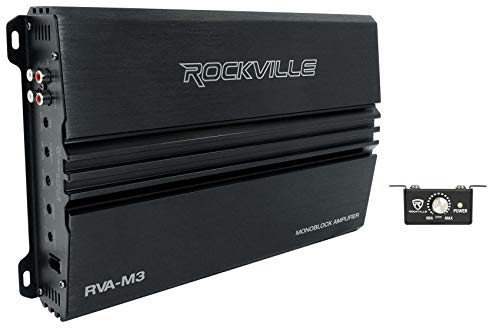
Rockville’s mono amplifier delivers 4000W total with 1000W RMS at 1 Ohm. It emphasizes heat efficiency through a robust MOSFET supply and a double‑sided SMT PCB, aiding reliability during long listening sessions.
Best for: Systems needing precise tuning with robust heat management, including multi‑sub setups where sub control matters. Consider this when you want a capable, steady performer.
Caution: As with other high‑power amps, ensure proper clearance for airflow in the installation space.
Rockville dB14 Subwoofer‑Focus Amp

Rockville dB14 provides 4000W peak and 1000W RMS at 2 Ohms, with a 12dB/octave crossover and a subsonic filter. The built‑in bass EQ and remote sub control help tailor bass presence for subwoofers while maintaining overall system balance.
Best for: Car audio enthusiasts focusing on precise subwoofer control and strong bass emphasis without needing a full multi‑channel amp.
Limitation: Higher power requires careful wiring and adequate fuse protection to avoid electrical issues.
Buying Guide: Key Considerations For 4,000 Watt Amps
- Power rating vs. subwoofer compatibility: Match RMS ratings to your subwoofer and overall system to avoid damage and ensure efficient performance.
- Impedance stability: Look for amps rated at 1 Ohm stability if you plan to run a single sub with maximum output or multiple subs at low impedance.
- Class D efficiency: Class D designs minimize heat and maximize output in small enclosures, which is ideal for car trunks with limited ventilation.
- Crossovers and bass controls: Adjustable low-pass/high-pass filters and bass boost help integrate the amp with speakers and subs for a cohesive sound.
- Remote controls: A remote sub level control is valuable for on‑the‑fly bass adjustments without reaching to the main head unit.
- Installation considerations: Ensure adequate mounting space, proper wiring gauge, and fusing appropriate to peak current needs.
- Durability and heat management: Aluminum or cobalt enclosures and good thermal paths improve long‑term reliability in warm environments.
- System goals: If you want a dedicated subwoofer focus, prefer monoblock amps with strong sub control; for multi‑sub systems, a 4‑channel option may offer better overall balance.
Frequently Asked Questions
- What is RMS power and why does it matter for car amps?
RMS power reflects continuous, real-world output, which correlates with consistent bass performance and heat management, rather than peak ratings that may entice over‑rating. - Is 1 Ohm stability important for subwoofers?
Yes, 1 Ohm stability allows higher continuous power delivery, which can maximize bass output for a single sub or compact multi‑sub setups, but ensure your sub is compatible. - Do I need a dedicated subwoofer amplifier?
If you want the loudest, cleanest bass with dedicated control, a monoblock amp engineered for subwoofers is recommended. Multi‑channel amps can also drive subs, but may be less efficient for pure bass. - What is the benefit of a remote sub level control?
It lets you adjust bass output from the seating position, enabling quick tuning for different music genres or listening preferences. - How do I choose the right power for my sub?
Select an amplifier whose RMS rating matches or slightly exceeds the sub’s RMS rating, and consider headroom for dynamic peaks to avoid clipping.