Replacing factory speakers with a 3-way car speaker can improve clarity across lows, mids, and highs by using separate drivers for each frequency band. Below is a concise comparison of top 3-way options chosen for balance of performance, compatibility, and features.
| Product | Type / Size | Brand |
|---|---|---|
| Pioneer TS-A1671F | 6.5″ 3-Way | Pioneer |
| JBL Stage 3637F | 6.5″ 3-Way | JBL |
| Rockford Fosgate R165X3 | 6.5″ 3-Way | Rockford Fosgate |
| JVC CS-J6930 | 6″x9″ 3-Way | JVC |
| CT Sounds Meso 6.5” Component | 6.5″ 3-Way Component | CT Sounds |
Pioneer A-Series Standard TS-A1671F 6.5” 3-Way Speakers

Design And Performance: The TS-A1671F is a 3-way coaxial design with dedicated drivers for bass, midrange, and treble. Pioneer lists a broad frequency response of 37 Hz to 31 kHz, which supports deep lows and extended highs for many music genres.
Power Handling And Usability: Rated at 320W peak and 70W RMS, these speakers suit typical factory headunit upgrades or aftermarket amplifiers when modest gain is applied. Installation adaptors are included for easier replacement of factory units.
Who It Suits: Drivers wanting a balanced, OEM-friendly upgrade with focus on clarity across the spectrum and improved bass over stock speakers.
JBL Stage 3637F – 6.5″ Three-way Car Audio Speaker

Acoustic Features: JBL markets this model for premium sound quality at an affordable price. The design uses a larger woofer cone area to increase efficiency and output by up to 2 dB compared to smaller designs.
Tweeter And Highs: An edge-driven dome tweeter provides a smoother high-frequency response, improving vocal and detail reproduction. The three-way arrangement separates frequencies to reduce distortion at higher volumes.
Use Case: A suitable choice for listeners seeking a noticeable upgrade from stock speakers with emphasis on output and clean highs without complex installation.
4 New Rockford Fosgate R165X3 6.5″ 180W 3 Way Coaxial Speakers

Build And Compatibility: Rockford Fosgate’s R165X3 are 6.5″ coaxial speakers designed as direct upgrades for many factory openings. The 3-way construction aims to deliver improved frequency separation and clearer midrange presence.
Practical Specs: Described with 180W peak handling, the set targets users who need higher output than stock speakers. The design balances portability and performance for varied vehicle installations.
Who Benefits: Drivers who prefer a trusted car audio brand with wide vehicle fitment and emphasis on reliability and established manufacturing support.
JVC CS-J6930 6″x9″ 3-Way Car Audio Speakers

Driver Configuration: The CS-J6930 uses a 6″x9″ woofer with a carbon mica cone, a 2-1/16″ midrange driver, and a 1/2″ dome tweeter. This three-driver approach targets smoother mids and clearer vocal reproduction.
Power And Response: With a stated peak power handling of 400W and a frequency response down to 30 Hz, these speakers are positioned as strong OEM replacements for vehicles with 6″x9″ factory locations.
Practical Considerations: Ideal for users who need larger footprint speakers to increase low-frequency output while maintaining midrange clarity and treble detail.
CT Sounds Meso 6.5” 500 Watt 3-Way Component Speaker Set
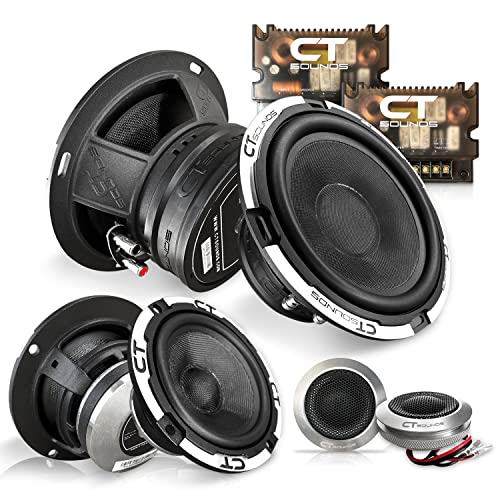
Component Versus Coaxial: The CT Sounds Meso is a 3-way component set, separating woofer, midrange, and tweeter into distinct components with crossovers. This layout often yields improved imaging and cleaner separation between instruments.
Power And Loudness: Rated for 250W RMS and 500W max per set, the Meso is built for high-output scenarios and retains clarity at elevated volumes when paired with adequate amplification.
Who Should Consider: Enthusiasts seeking louder, distortion-free playback and customizable installation who are prepared to accommodate component speakers and crossovers in the vehicle.
Buying Guide: How To Choose The Right 3-Way Car Speakers
Understand 3-Way Design Benefits: A true 3-way speaker uses separate drivers for bass, midrange, and treble. This reduces inter-driver distortion and provides clearer separation of vocals and instruments compared with two-way designs.
Match Speaker Size To Vehicle Fitment: Check factory speaker sizes (e.g., 6.5″, 6″x9″, 5.25″) and mounting depth. Larger woofers provide stronger low-end; 6″x9″ options often offer more bass than 6.5″ counterparts but require compatible openings.
Power Handling And Amplification: Compare RMS ratings to your head unit or amplifier output. For consistent performance and lower distortion at high volumes, choose speakers with RMS ratings that align with your amplifier’s output. Peak power numbers are less useful for long-term performance.
Sensitivity Ratings: Sensitivity (dB) indicates loudness per watt. Higher sensitivity suits low-power head units; lower sensitivity benefits from an external amplifier for dynamic range and headroom.
Component vs Coaxial: Coaxial 3-way speakers are simpler to install and save space. Component 3-way sets separate drivers and crossovers for improved soundstage and flexibility but require more installation space and planning.
Crossover Quality And Tuning: For component systems, look at the crossover type (passive vs active) and tuning options. Better crossovers ensure each driver only receives its intended frequency band, reducing distortion and improving clarity.
Materials And Durability: Woofer cone materials (polypropylene, mica, or composite) affect tone and durability. Tweeter materials (soft dome, PEI, ceramic) influence high-frequency smoothness and resilience to humidity and heat inside vehicles.
Installation Considerations: Verify mounting depth, grille fitment, and whether adapters are included. Some 3-way speakers require additional brackets or modifications; factor in installation complexity and potential extra components.
Listening Goals And Music Genres: For bass-heavy genres prioritize larger woofers or models with stronger low-frequency response. For vocal-centric or acoustic music prioritize midrange clarity and a smooth tweeter response.
Budget And Upgrade Path: Decide whether you want a simple headunit swap and coaxial speakers, or a multi-component system requiring an amplifier and crossovers. Plan upgrades across source unit, amplification, and speaker match for best results.