If you want clear highs, detailed mids, and solid bass from passive 3-way speakers, you’ve come to the right guide. This article highlights five well-rounded options that suit different rooms and setups. Best for dedicated home theaters, small-to-medium living rooms, or reference-grade listening, these picks balance vocal clarity with dynamic bass. Each product is described with who it’s best for, why it stands out, and a practical caveat to consider before buying.
| Product | Brand | Why it’s a good pick |
|---|---|---|
| Saiyin 3-Way Passive Speakers (Pair) | Saiyin | Great dedicated three-way design with clear highs, mids, and bass; good for home theater and turntables |
| Sony SS-CS5M2 3-Way 3-Driver | Sony | Compact 3-way with three drivers for balanced sound in small spaces |
| Rockville RSG-12 12″ 3-Way Passive PA Speakers | Rockville | High power, wide coverage—ideal for larger rooms or events |
| Acoustic Audio BR12 Passive 12″ 3-Way | Acoustic Audio by Goldwood | Traditional 3-way with durable build and wide frequency range |
| Acoustic Audio CR12 Passive 12″ DJ/PA Speaker | Acoustic Audio by Goldwood | Budget-friendly 3-way with solid bass and portability for larger setups |
Saiyin 3-Way Passive Speakers Pair

Best for: Small-to-medium living rooms or dedicated listening spaces where clarity and detail matter. The Saiyin model uses a dedicated tweeter, midrange, and woofer to separate frequencies, reducing muddiness.
Why selected: This is a true 3-way bookshelf option with a 5.25″ paper cone woofer offering deeper bass down to 48 Hz. Its separate drivers help vocals and instruments stay distinct, which benefits classical, jazz, and acoustic genres when paired with a receiver or amp.
Caution: These speakers require a powered amplifier or receiver; no built-in amplification and no Bluetooth. Speaker wires are not included, so you’ll need compatible wiring and an appropriate amp.
Sony SS-CS5M2 3-Way 3-Driver (Pair)

Best for: Small spaces where a compact, three-driver bookshelf speaker can still deliver a full-range sound. The Sony design emphasizes a balanced 3-way configuration for clear dialogue and enriched music.
Why selected: Its three drivers support better separation of highs, mids, and lows than typical two-way bookshelves, making it a versatile option for compact hi-fi setups and stereo systems.
Caution: As a passive speaker, it needs an external amplifier or receiver. Ensure your system can accommodate multiple drivers and a crossover arrangement inherent to 3-way designs.
ULTIMEA BS-3 3-Way Powered Bookshelf Speakers

Best for: Home theater and living rooms seeking built-in amplification with modern features. These are powered 3-way speakers, reducing the need for a separate amp while offering USB-Bluetooth connectivity.
Why selected: The 5.25″ woofer and 1″ tweeter with a 2.75″ midrange provide clear vocal presence and punchy bass. Bluetooth 6.0 adds convenient wireless streaming. BassMX and HDMI ARC options enhance TV sound compatibility.
Caution: As powered speakers, they include amps but check if the included processing suits your room acoustics. Some users may want a purely passive route to integrate into larger PA systems.
Rockville RSG-12 12″ 3-Way Passive PA Speaker
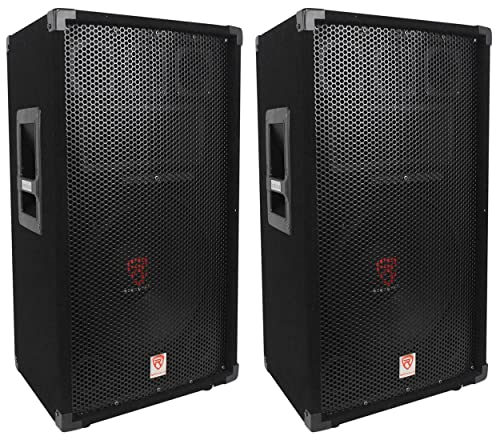
Best for: DJs, bands, or larger rooms where high SPL and broad coverage matter. Its 12″ woofer and three high-efficiency drivers deliver robust output and wide dispersion.
Why selected: The combination achieves powerful, full-range sound with 500 Watts RMS and 1000 Watts peak. It is built for durability and portability, suited to mobile setups and events.
Caution: This is a larger, heavier speaker setup intended for amplified environments. It may be overkill for small rooms or casual listening without a suitable PA system.
Acoustic Audio BR12 Passive 12″ 3-Way

Best for: Budget-conscious buyers who still want a robust 3-way system with a classic cabinet design for DJ, PA, or home use.
Why selected: A traditional 3-way configuration with a 12″ woofer, midrange, and a compression tweeter provides a broad frequency range and solid bass for the size and price. Durable MDF cabinet and protective features support regular use.
Caution: It’s a passive speaker, so a compatible amplifier is required. The cabinet and port design may be less optimized for ultra-small rooms.
Acoustic Audio CR12 Passive 12″ DJ/PA Speaker

Best for: Larger rooms or mobile setups where durability and portability matter but a 3-way system is still preferred for clarity.
Why selected: The CR12 offers a 12″ woofer with a 3-way arrangement and a wide frequency range, making it suitable for karaoke, bands, or PA applications. It balances bass with highs for more consistent performances.
Caution: It remains a passive design; ensure your amplifier or receiver can drive it effectively and match the impedance and crossover requirements.
Buying Guide: Key Considerations For 3-Way Passive Speakers
- What is a 3-way speaker and why does it matter? A true 3-way speaker uses separate drivers for high, mid, and low frequencies, reducing crosstalk and giving clearer separation than two-way designs. This improves vocal clarity and instrument definition in both music and home theater.
- Power handling and compatibility: Passive 3-way speakers require an external amplifier or receiver. Check the speaker’s impedance (ohms) and recommended power range to match your amp. Higher sensitivity can deliver more volume with less power, but efficiency varies by design.
- Size and cabinet design: Larger woofers (like 12″) provide deeper bass but require more space and a sturdy stand or shelving. Compact 5.25″ or 6.5″ woofers work well in small rooms but may miss deep bass without proper room tuning.
- Cabinet construction and durability: Look for MDF or similar sturdy enclosures, reinforced corners, and proper venting. A robust cabinet improves low-end control and reduces unwanted resonance.
- Room acoustics and placement: Place speakers at ear level when seated, with adequate distance from walls to avoid bass over-boost. A good subwoofer can complement 3-way bookshelves without overpowering mids and highs.
- Wiring and crossovers: Ensure you have appropriate speaker wires and compatible speaker cables. Crossovers inside 3-way designs influence the tonal balance; mismatched components can degrade performance.
- Use case considerations: For home theater, prioritize clear dialogue and dynamic range. For music, focus on instrument separation and vocal presence. For live events, aim for higher power handling and broader dispersion.
Frequently Asked Questions
- What is a 3-way passive speaker? A 3-way passive speaker uses three dedicated drivers (tweeter, midrange, and woofer) and requires an external amplifier. This design improves frequency separation and clarity across the sound spectrum.
- Do I need a subwoofer with a 3-way bookshelf speaker? Not always. Many 3-way speakers reproduce strong bass on their own, but a subwoofer can fill very low frequencies for room-scale bass in larger spaces or home theaters.
- Can I connect 3-way speakers to any amplifier? They require an amplifier that matches the speaker’s impedance and power rating. Verify the amp’s output power, impedance compatibility, and the crossover behavior of the speaker.
- Are passive 3-way speakers better than powered (active) ones? Passive speakers offer flexibility in choosing amplifiers and room setups, while powered speakers integrate amplification and processing in one unit, which can simplify setups but limit upgrade options.
- What should I consider when placing 3-way speakers in a room? Consider room size, speaker distance, wall reflections, and speaker height. Placing them at ear level and away from corners enhances imaging and reduces bass boom.