Quick Overview: This guide compares reliable 2-way speaker switch boxes that let you route one amplifier to two speaker pairs or compare two amps to one speaker set. Below is a concise summary table of the five selected products reviewed in this article.
| Product | Brand | Key Feature |
|---|---|---|
| SOLUPEAK P2 2-In/2-Out Switcher | SOLUPEAK | 2-IN-1-OUT reversible A/B switch, gold banana jacks |
| ADWITS 2-Channel Speaker Switcher | ADWITS | Play A, B, or Both; terminal clamps, 150W RMS per channel |
| SOLUPEAK SP2 2-Zone Selector | SOLUPEAK | Controls up to 2 speaker pairs, passive operation |
| Kurrent A/B A+B Switch | Kurrent Electric | 1 in – 2 out selector with metal construction |
| Audioflow Wi-Fi 2-Way Switch | Audioflow | Wi‑Fi control via app and Alexa integration |
SOLUPEAK P2 2-In/2-Out Switcher
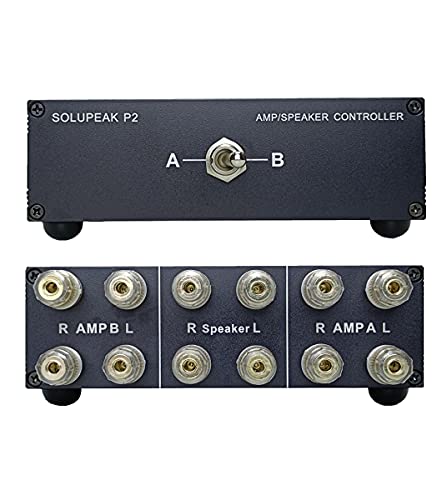
This SOLUPEAK unit is a passive amp and speaker switcher that supports reversible operation: 2-IN-1-OUT to compare two amplifiers with one speaker pair, or 1-IN-2-OUT to route a single amplifier to either of two speaker pairs. The device uses gold-plated banana jacks compatible with up to 12 AWG wire for secure connections. Operation is via a single A/B push switch, making toggling fast and cable-free. As a non-powered, plug-and-play solution, it is suitable for quick comparisons and switching without additional impedance matching circuitry.
ADWITS 2-Channel Speaker Switcher

The ADWITS speaker selector supports two pairs of speakers with one amplifier and offers selection of A, B, or Both simultaneously. It uses screw terminal clamps for secure wire attachment and is rated at 150W RMS per channel. The selector is intended for straightforward distributed audio applications in residential or commercial spaces where you might want simultaneous playback in two zones or the ability to isolate a zone for testing or comparison. It is passive and does not require an external power source.
SOLUPEAK SP2 2-Zone Selector

The SOLUPEAK SP2 is designed to control up to two pairs of speakers connected to a stereo amplifier. As a multi-channel passive speaker switcher, the unit requires no power and provides basic A/B switching between zones. This model is positioned for users who need simple distribution without advanced impedance protection or active electronics, helping keep installation straightforward with minimal wiring complexity.
Kurrent A/B A+B Switch
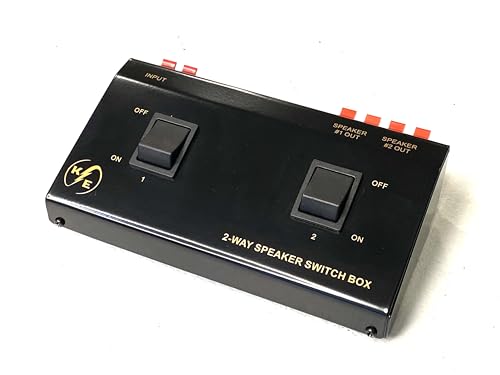
The Kurrent Electric A/B plus A+B selector provides 1 in – 2 out functionality and allows selection of Set A, Set B, or A+B. Built with a sturdy metal panel, this physical switch panel suits setups that require a durable, rack-or-wall-mountable control surface. It is tailored for users seeking a simple manual switcher with robust construction for repeated use, and it supports standard screw terminals for speaker connections.
Audioflow 2 Way Smart Wi-Fi Switch

Audioflow’s smart selector connects two pairs of speakers to a stereo amplifier while adding Wi‑Fi control through the Audioflow mobile app. It supports voice control via Amazon Alexa, enabling remote switching and integration into smart home ecosystems. This offers flexibility for users who prefer app-based control or automation over a physical switch, while providing the same fundamental A/B speaker routing functionality.
Buying Guide: How To Choose A 2 Way Speaker Switch Box
Choosing the right 2-way speaker switch box depends on installation needs, protection requirements, and control preferences. Below are key factors to evaluate before purchase.
1. Switch Type And Functionality
- A/B Only: Switches that select either Set A or Set B. Useful when only one pair should be active at a time.
- A+B Capability: Allows both pairs to play simultaneously. Ensure your amplifier can handle the combined load.
- Reversible Mode: Some units support 2-IN-1-OUT for A/B amp comparison; choose this if you test amplifiers or sources frequently.
2. Power And Passive Vs Active
- Passive Switchers: No power required, simple and reliable for basic routing. Common in SPLUPEAK and ADWITS models.
- Active Or Smart Switchers: Offer Wi‑Fi, app or voice control, and sometimes electronic protection—suitable for automation and remote control.
3. Wattage And Impedance Handling
- Check per-channel RMS ratings and maximum continuous power handling.
- Confirm supported impedance ranges (e.g., 4–16 ohms) to prevent amplifier stress or damage.
- If using A+B, ensure the amplifier can tolerate the effective load when both pairs are connected.
4. Connection Type
- Banana Jacks: Quick connect, often gold-plated for low resistance and durability. SOLUPEAK P2 uses these.
- Screw Terminals / Clamps: Secure for bare wire and thicker gauge runs; common in ADWITS and Kurrent designs.
- Consider the maximum gauge supported if running long cable runs (e.g., up to 12 AWG).
5. Build Quality And Mounting
- Metal housings or reinforced panels handle repeated switching and mounting better than plastic.
- Look for non-slip feet or rack-mount compatibility if the unit will be placed in equipment racks or wall panels.
6. Protection Features
- Some selectors include impedance protection networks or fuses to protect the amplifier when multiple loads are connected.
- Passive switchers typically omit active protection—verify amplifier tolerances if using without protection.
7. Use Case And Control Preferences
- For simple A/B testing or manual zone selection, passive mechanical switchers are effective and inexpensive.
- For smart home integration, look for Wi‑Fi or voice-capable models that provide remote switching and automation.
- If comparing amplifiers to one speaker pair, choose a reversible 2-IN-1-OUT design to avoid repetitive cable swapping.
8. Installation And Wiring Considerations
- Plan speaker cable lengths and gauge to maintain signal quality; longer runs may require thicker gauge wire.
- Label speaker runs and amplifier channels to simplify troubleshooting and switching during setup.
9. Multiple Comparison Perspectives
- Durability vs Functionality: Metal-constructed switches excel in durability; smart switches provide functionality but may add complexity.
- Passive Simplicity vs Active Features: Passive units are reliable and silent; active units add convenience and remote control.
- Impedance Risk vs Convenience: Playing A+B adds convenience but increases load on the amplifier—verify your amp’s specs before using both simultaneously.
Use these criteria to match a 2-way speaker switch box to your system needs—whether you require a basic mechanical selector for comparison and distribution or a smart switch for integrated control.