Selecting compact 2-inch full range speakers requires balancing size, power handling, and frequency response. Below is a concise comparison of well-regarded small full-range drivers suitable for DIY audio, portable projects, and repairs.
| Product | Brand | Key Feature |
|---|---|---|
| Visaton FRS 5X-8 | Best Price Square | Moisture-resistant paper cone, efficient for size |
| Dayton Audio PC68-4 | Dayton Audio | Poly cone with rubber surround for smooth response |
| Gikfun 2″ 4Ω 5W (Pack of 2) | Gikfun | Replacement for small enclosures, 5W rating |
| ACEIRMC 2″ 4Ω 10W (10pcs) | ACEIRMC | Higher 10W rating in bulk pack |
| Shutao 2″ 10W (4Pcs) | Shutao | 160Hz–20kHz stated bandwidth, compact design |
Visaton FRS 5X-8 2″ Full Range Speaker

The Visaton FRS 5X-8 is a compact 2″ driver noted for efficient output relative to its size. Its moisture-resistant paper cone expands suitability to damp environments such as covered outdoor enclosures or marine-adjacent installations. The driver is described as producing a surprisingly full sound for a 2″ unit, which indicates design focus on balanced midrange and usable upper bass for small sealed or ported boxes.
Key considerations include its 8-ohm impedance which pairs well with many amplifiers, and the efficiency advantage that may reduce power demand. This driver is well suited for compact DIY speakers, restoration of small vintage cabinets, or as mid/tweeter in multi-way compact systems.
Dayton Audio PC68-4 2.5″ Full-Range Poly Driver
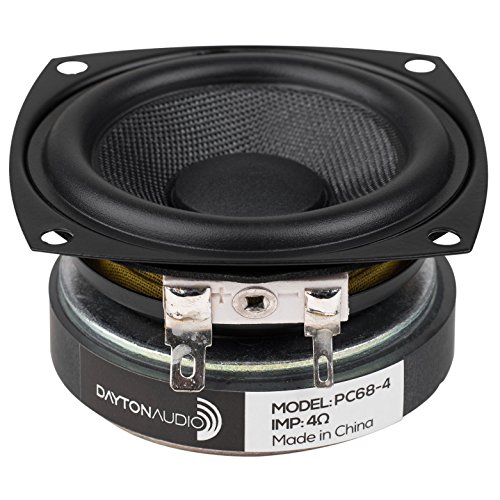
The Dayton Audio PC68-4 is a slightly larger compact driver (2.5″) with a poly-damped woven glass fiber cone and a rubber surround designed to control cone break-up and deliver a smooth roll-off. A stronger ferrite magnet improves motor strength, which can translate to higher efficiency and cleaner transient response for small enclosures.
This driver’s materials emphasize linearity and controlled dispersion, making it a good option where a neutral midrange and reliable off-axis behavior are prioritized. Its 4-ohm impedance and construction are typical for small sealed enclosures, portable speaker projects, and small monitors where driver breakup needs to be minimized.
Gikfun 2″ 4Ω 5W Full Range (Pack Of 2)

The Gikfun 2″ 4Ω 5W pair targets hobbyists and small electronics projects, including replacements for compact smart speakers or use in DIY enclosures. Rated at 5W with a resonance frequency around 190Hz, these drivers suit applications where limited low-bass is acceptable and compact size is mandatory.
Use cases include small Bluetooth speakers, Arduino audio projects, and table-top units. Their 4-ohm impedance is common for portable amplifiers, and the modest power rating emphasizes pairing with low-power Class D amplifiers or consumer electronics outputs.
ACEIRMC 2″ 4Ω 10W Full Range (10pcs)

The ACEIRMC 2″ driver lists a 10W rating and 4-ohm impedance, supplied as a multi-piece bulk pack. This configuration is advantageous for builders producing multiple units or stocking spare drivers for repairs. The higher power rating compared to many 2″ drivers suggests greater headroom for louder small enclosures, though actual output depends on enclosure design and amplifier pairing.
These drivers are positioned for repetitive installations, small bookshelf projects, and educational kits. Bulk packaging reduces per-unit handling and supports consistent matching across multiple speaker builds.
Shutao 2″ 4Ω 10W Full Range (4 Pack)
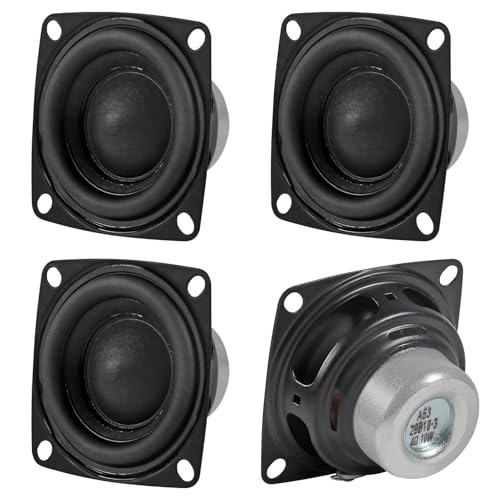
The Shutao 2″ full-range driver offers a stated effective frequency range of 160Hz–20kHz and 10W nominal power at 4 ohms. Specifying an effective bandwidth down to 160Hz indicates these drivers emphasize midrange clarity with limited low-bass extension, which is standard for compact radiators.
Sold in sets of four, these drivers are useful for multi-channel DIY arrays, small satellite speakers, or replacement needs. The combination of compact size and a claimed extended upper-range makes them suitable where clarity and multi-driver arrays are desired rather than deep bass performance.
Buying Guide For 2-Inch Full Range Speakers
Selecting the right small full-range driver depends on project goals and constraints. Below are the primary considerations to evaluate before purchase.
Impedance And Amplifier Compatibility
- 4 Ohm vs 8 Ohm: 4-ohm drivers draw more current and can deliver higher output from the same amplifier voltage, but require an amp that can drive lower impedances. 8-ohm drivers are easier on many consumer amps.
- Amplifier Power: Match driver power ratings with amplifier capability. Lower-rated drivers (3–5W) suit low-power portable amps; 10W drivers offer more headroom for louder use.
Frequency Response And Application
- Low-Frequency Extension: 2″ drivers generally lack deep bass. For fuller sound, plan a separate woofer or use a small ported enclosure tuned for the best trade-off between size and bass.
- Upper Range: Check the driver’s high-frequency behavior—some small drivers reproduce highs well enough to eliminate the need for a tweeter in compact systems.
Efficiency And Sensitivity
- Efficiency: More efficient drivers need less amplifier power to reach a given SPL. Consider efficiency if using battery-powered or low-power amps.
- Real-World SPL: Efficiency numbers and enclosure losses determine usable loudness. For group listening, multiple drivers or larger enclosures may be necessary.
Materials And Durability
- Cone Material: Paper, poly, or composite cones affect tonal balance and durability. Paper can sound natural but may be sensitive to moisture unless treated.
- Surround And Magnet: Rubber surrounds and stronger magnets help control cone motion and improve transient response.
- Environmental Resistance: Moisture-resistant cones are preferable for outdoor or high-humidity installations.
Enclosure Design And Integration
- Sealed Vs Ported: Sealed enclosures keep design simple but limit bass; ports can extend low-frequency output but require careful tuning.
- Volume Requirements: Small drivers need proper cabinet volume to optimize response. Refer to manufacturer recommendations or simulation tools when possible.
- Crossover Needs: For multi-driver systems, design crossovers to protect the small full-range driver from deep bass and to integrate with tweeters for extended highs.
Use Case Comparison
- DIY Portable Speakers: Choose efficient 4-ohm or 8-ohm drivers with modest power ratings and compact enclosure compatibility.
- Replacement Drivers: Match impedance, mounting dimensions, and resonance behavior to the original driver for best results.
- Multi-Unit Installations: Bulk packs (ACEIRMC, Shutao, or multi-packs) provide consistency and lower handling for array or replacement work.
Testing And Validation
- Listen In-Context: Evaluate driver performance in the intended enclosure and with the intended amplifier—measurements and subjective listening together give the best assessment.
- Check Specs Against Use: Pay attention to rated power, resonance frequency, and claimed bandwidth to ensure a fit for the desired sound profile.