Choosing the right 2-core speaker cable affects audio clarity, installation safety, and long-term reliability. This guide compares five relevant Amazon options across conductor type, gauge, shielding, and ratings to help match cable choice to application.
| Product | Type / Gauge | Key Feature |
|---|---|---|
| Cableague 16AWG 2 Conductor | 16 AWG, OFC | ETL, CL3, PVC insulation |
| Monoprice 16AWG CL2 Speaker Cable | 16 AWG, 99.95% Copper | CL2 rated for in-wall use |
| GEARit Outdoor Speaker Wire 14AWG CCA | 14 AWG, CCA | Outdoor/direct burial, CL3 |
| Kinter 16-Gauge CCA 100ft | 16 AWG, CCA | High strand count, polarity marked |
| WIDFDXDRE 20AWG Shielded 2 Conductor | 20 AWG, 100% OFC, Shielded | Double shielding for EMI/RFI |
Cableague 16AWG 2 Conductor Speaker Wire

This Cableague 16AWG speaker cable is built with oxygen-free copper (OFC) stranded conductors and a PVC jacket. The listing highlights ETL, CMR, and CL3 reference standards, a 300V voltage rating, and a rated temperature of 75°C. The product includes clear polarity insulation colors (black and red).
Suitability: Good for indoor and some in-wall installations where CL3/ETL compliance is required. OFC offers lower resistance and improved conductivity compared with many CCA offerings, making it a solid choice for longer runs at moderate power levels.
Monoprice 16AWG CL2 Loud Speaker Cable

Monoprice provides a 50-foot spool of 99.95% oxygen-free bare copper in 16AWG. The white outer jacket is CL2 rated for in-wall residential use. The high-purity copper conductor aims to minimize signal loss and resist oxidation over time.
Suitability: Designed for permanent in-wall speaker runs where CL2 rating and high-purity copper are preferred. Best for typical home theater and built-in speaker deployments that require compliance with residential wiring codes.
GEARit 14 Gauge Outdoor Speaker Wire CCA

GEARit’s cable is a 14 AWG copper-clad aluminum (CCA) speaker wire rated for outdoor direct burial and in-wall installation with CL3/CL2 ratings. It is described as lightweight and flexible, compatible with common connector types.
Suitability: Useful for long outdoor runs or landscape speaker systems where weight, flexibility, and cost matter. CCA reduces cost and weight but has higher resistance than pure copper; choose larger gauge (14 AWG here) to offset loss on longer runs.
Kinter 16-Gauge 2 Conductor Speaker Wire
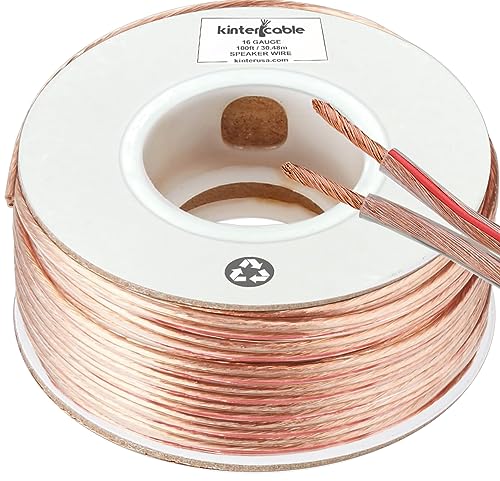
Kinter’s 100-foot 16AWG cable uses CCA conductors with a high strand count and a clear PVC jacket that includes a red polarity stripe. The product emphasizes flexibility and suitability for home theater, surround, and car audio applications.
Suitability: Appropriate for budget-conscious installations and shorter home audio runs. The high strand count improves flexibility and ease of termination, but CCA’s electrical characteristics should be considered for long-distance or high-power setups.
WIDFDXDRE 20AWG Shielded 2 Conductor Cable

This 20AWG cable features 100% oxygen-free copper conductors with double shielding (aluminum foil + braided copper) to block EMI/RFI. Rated for 300V and 80°C, it lists low conductor resistance and multiple strands per conductor for flexibility.
Suitability: Best for runs where interference rejection is important, such as near motors, routers, or long cable bundles. Its smaller gauge suits low-power or short-distance speaker lines and signal-level applications rather than high-power main speaker feeds.
Buying Guide
Choosing the right 2-core speaker cable depends on application, run length, and priorities such as cost, conductivity, and interference protection. Below are key considerations and comparison perspectives.
Conductor Material
- Oxygen-Free Copper (OFC / Bare Copper) — Lower resistance, better conductivity, and longer-term oxidation resistance. Preferred for high-fidelity or long runs.
- Copper-Clad Aluminum (CCA) — Lighter and cheaper with higher resistance than copper. Works for budget installs or shorter runs; compensate with heavier gauge.
- Tinned Copper — Good for corrosion resistance in humid or outdoor settings; easier soldering when required.
Gauge And Signal Loss
- Lower AWG numbers mean thicker wire and lower resistance (e.g., 14 AWG < 16 AWG < 20 AWG).
- For runs under 50 feet, 16 AWG is common. For longer runs or higher power, 14 AWG or thicker is recommended to reduce power loss and damping.
- Use conductor resistance specs to estimate voltage drop when planning long distances.
Shielding And Interference
- Shielded two-conductor cable offers EMI/RFI rejection useful when cables run near motors, power wiring, or network equipment.
- Shielding is most relevant for line-level or low-power speaker/monitoring runs; bulkive speaker runs rarely need full shielding if routed away from noise sources.
Ratings And Installation
- CL2 / CL3 / CMR / ETL / UL — Look for the appropriate rating for in-wall, in-ceiling, or outdoor use. CL2/CL3 indicate compliance with building fire safety standards for low-voltage audio cables.
- For outdoor or direct burial runs, choose cables explicitly rated for that use or use appropriate conduit and waterproofing.
Stranding And Flexibility
- Higher strand counts improve flexibility and ease of termination, useful for routing in tight spaces or frequent movement.
- Rigid solid-core conductors are less flexible but sometimes used in fixed, short runs.
Connectors And Termination
- Consider whether you will use bare wire, banana plugs, spade lugs, or soldered connections. Some conductors (tinned copper) are easier to solder.
- Ensure the conductor diameter and strand composition match your chosen terminals and amplifiers.
Application Scenarios
- Home Theater In-Wall: Prefer CL2/CL3-rated OFC 16 AWG or better for balanced cost and performance.
- Outdoor/Landscape Speakers: Use direct burial/UV-rated cable or thicker gauge CCA/OFC depending on run length.
- High-Power Main Speakers / Long Runs: Choose 14 AWG or thicker OFC to minimize loss.
- Interference-Sensitive Setups: Use shielded 2-conductor cable to reduce EMI/RFI pickup.
Comparison Checklist
- Conductor Type: OFC vs CCA vs tinned — impacts conductivity and corrosion resistance.
- Gauge: 14 AWG, 16 AWG, 20 AWG — impacts power handling and loss over distance.
- Ratings: CL2/CL3/UL/ETL — required for safe in-wall or outdoor installations.
- Shielding: Needed for interference-prone environments, not always necessary for typical speaker wiring.
- Stranding & Flexibility: Important for routing and termination quality.