Choosing the right 2.1 amplifier with subwoofer output means matching power, connectivity, and outputs to your speakers or powered sub. The table below summarizes five well-matched options chosen for compact home setups, car installations, and integrated soundbar solutions.
| Product | Form Factor | Notable Feature |
|---|---|---|
| Pyle PDA33BU 2.1 CH Mini Amp | Compact Mini Amp | Bluetooth 5.0, USB player, RCA inputs |
| JBL Bar 2.1 Deep Bass (MK2) | Soundbar + Wireless Sub | 300W system power, wireless 6.5″ subwoofer |
| Daakro KS-33BT Stereo Amp | Home Stereo Receiver | 2.0CH with active sub output, mic/echo |
| SOBATTY AV-302 Receiver | Stereo AV Receiver | Multiple inputs, subwoofer output, 3x outputs spec |
| Facmogu S-299 4.1 Power Amp | Multi-channel Mini Amp | Active subwoofer only output, Bluetooth 5.0 |
Pyle 200W 2.1 CH Wireless Mini Amp
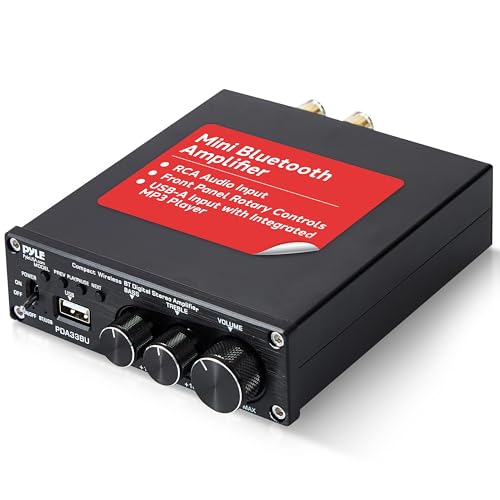
The Pyle PDA33BU is a compact 2.1 channel amplifier offering a peak 200W design in a small footprint. It provides a dedicated subwoofer output and bass/treble tone controls for basic EQ shaping. Bluetooth 5.0 enables wireless streaming with a practical range, while the built-in USB flash drive player and RCA inputs broaden source compatibility.
Recommended Use: Small rooms, desktop audio systems, and setups where space is limited but a powered sub or active subwoofer will be added. The amp’s control layout and USB playback are convenient for simple media rigs.
JBL Bar 2.1 Deep Bass Soundbar

The JBL Bar 2.1 MK2 is a complete 2.1 system combining a soundbar and a wireless 6.5″ subwoofer. With a total system output of up to 300W, it’s aimed at TV rooms requiring strong low-frequency impact without separate amplification gear. The sub connects wirelessly to the bar, eliminating the need for subwoofer cable runs.
Connectivity and Features: Bluetooth streaming and JBL Surround sound processing are included. This model integrates the amp and subwoofer into a unified solution, suitable for users who prefer plug-and-play 2.1 performance rather than separate amp + sub setups.
Daakro KS-33BT Stereo Amplifier Receiver

The Daakro KS-33BT is a versatile 2.0CH home amplifier that explicitly supports connecting an active subwoofer via its subwoofer output. Rated at 60W RMS with 200W peak, it includes treble, bass, echo, two mic inputs and Bluetooth 5.0. The unit also handles USB, SD, AUX, FM, and traditional RCA sources.
Applications: Multi-use home theaters that require both music playback and basic karaoke capability. The mic/echo functionality emphasizes utility in social listening environments. Its subwoofer output is appropriate for adding a powered sub to extend bass response.
SOBATTY AV-302 Stereo AV Receiver

The SOBATTY AV-302 is a compact AV receiver-style amplifier with multiple inputs including USB, coaxial and stereo RCA. The spec sheet notes subwoofer output capability and a broad frequency range (20Hz–20kHz). It lists multi-channel capability and supports a variety of source devices for home audio, karaoke, or portable event use.
Strengths: Flexible input set and an emphasis on broad compatibility make it a candidate for users needing a hub-style amplifier with an included subwoofer out. The receiver-style layout is useful when integrating TV or DVD sources alongside traditional stereo components.
Facmogu S-299 4.1CH Power Amplifier
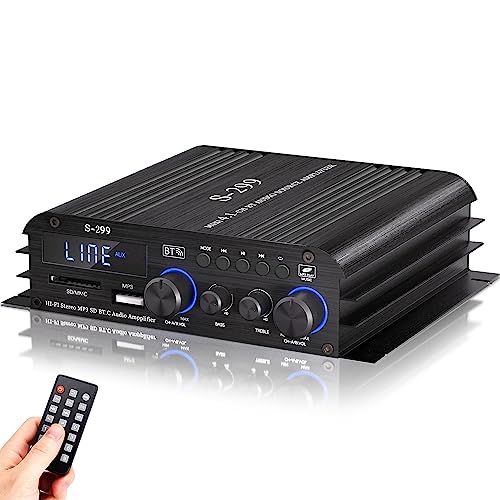
The Facmogu S-299 provides 4x40W RMS stereo outputs plus a dedicated output for an active subwoofer. The manufacturer explicitly warns that only an active subwoofer is supported (not passive). Bluetooth 5.0, USB, SD/TF, and AUX connections broaden source options, and the amp emphasizes low distortion and clarity for music playback.
Considerations: Ideal where a multi-channel mini amp is needed and a powered subwoofer will be used. The active-only sub output is a critical compatibility note; users with passive subs should select a different amplifier or an amp with speaker-level sub outputs.
Buying Guide: Choosing A 2.1 Amp With Subwoofer Output
When selecting a 2.1 amplifier with subwoofer output, prioritize the following factors to ensure compatibility and performance with your speakers and room.
Subwoofer Output Type
- Line-Level (RCA) Subwoofer Output: Most common for connecting powered (active) subs. Offers low-noise signal and is the preferred modern connection.
- Speaker-Level/Subwoofer Speaker Output: Some amps support passive subwoofers via speaker terminals; confirm if an amp supports passive subs or requires an active sub.
- Wireless Subwoofer Pairing: Some systems (soundbars, integrated systems) pair wirelessly to a sub—convenient but typically locked to specific models.
Power Ratings And Matching
- RMS Vs Peak: Use RMS ratings to match continuous power to speakers and subwoofer requirements. Peak numbers can be misleading for sustained performance.
- Impedance Compatibility: Confirm speaker impedance (ohms). Many small amps support 4–8 ohm speakers; mismatches can stress the amplifier or speakers.
Connectivity And Inputs
- Bluetooth / USB / AUX / RCA / Coaxial: Pick an amp with inputs matching your sources—TV, phone, PC, turntable (may need phono preamp) or streaming device.
- Mic Inputs and Extras: For karaoke or announcements, mic jacks and echo controls are useful but not necessary for pure music use.
Form Factor And Installation
- Compact Mini Amps: Good for desktops or small rooms; often lack heavy-duty cooling but save space.
- Soundbars With Subwoofers: Offer integrated solutions for TVs with minimal wiring; subwoofer is usually wireless and tuned to the bar.
- Receiver-Style Amps: Provide more inputs and routing flexibility for multi-source home systems.
Active Subwoofer Versus Passive Subwoofer
- Active Subwoofer: Contains its own amplifier; most modern 2.1 amps provide an RCA line-level output designed for powered subs.
- Passive Subwoofer: Requires speaker-level output or a dedicated subwoofer amplifier; ensure the amp explicitly supports passive subs before use.
Sound Shaping And Features
- EQ Controls: Bass/treble knobs help tune the system without external equalizers.
- Low-Pass Filters: Useful when the amp provides sub crossover controls to direct low frequencies to the subwoofer.
- Room Size And Crossover: Larger rooms may need stronger sub output and adjustable crossover points to integrate with main speakers.
Durability, Heat Management, And Noise
- Cooling And Build: Higher-power amps often need vents or heat sinks. Compact amps may be limited in continuous output.
- Electrical Noise: Line-level outputs and proper grounding reduce hum and interference when connecting subs.
Compatibility Checklist Before Purchase
- Confirm subwoofer type (active vs passive) and required connection.
- Match amplifier RMS output to speaker/sub RMS ratings and impedance.
- Verify input types match your source devices (HDMI/optical for TV, RCA for legacy devices, Bluetooth for mobiles).
- Decide if built-in subwoofer crossover or external crossover will be used.
- Ensure physical size and ventilation fit your installation location.