Focusing on 15-inch subwoofers that deliver the signature Punch bass experience, this guide compares high-performance options for car audio systems. The selection below includes Rockford Fosgate Punch models plus strong alternatives to match different power, enclosure, and impedance needs.
| Product | Type / Key Feature |
|---|---|
| Rockford Fosgate P3D4-15 Punch P3 | 15″ DVC, 600W RMS, anodized aluminum cone |
| Rockford Fosgate P1S4-15 Punch P1 | 15″ SVC, 250W RMS, kevlar reinforced paper cone |
| Rockford Fosgate (2) P2D2-15 Pair | Two 15″ dual 2-ohm subs, 400W RMS each, package pair |
| KICKER CVR154 CompVR | 15″ CompVR, 500W RMS, compact car subwoofer |
| Pyle PLPW15D 15″ Car Subwoofer | 15″ dual voice coil, high RMS/peak spec, foam surround |
Rockford Fosgate P3D4-15 Punch P3 15″ 4-Ohm DVC Subwoofer
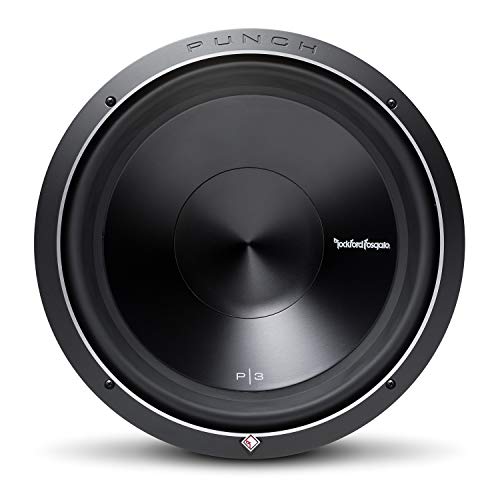
The P3D4-15 is billed as Rockford Fosgate’s high-performing Punch subwoofer in the P3 line. It is a 15-inch dual voice coil (DVC) model with a 4-Ohm configuration and a rated 600 Watts RMS. The cone and dustcap are anodized aluminum for rigidity and durability.
Key structural features include spider venting to cool the motor and a hybrid stamp-cast basket to reduce resonance. It uses 10-AWG nickel-plated push terminals for secure wiring. This model targets listeners who need high output and improved thermal control in demanding builds.
Rockford Fosgate P1S4-15 Punch 15″ P1 4-Ohm SVC Subwoofer

The P1S4-15 is from the original Punch P1 series, designed for impactful car bass with a simpler configuration. This 15-inch subwoofer is a single voice coil (SVC) 4-Ohm unit rated at 250 Watts RMS and a kevlar fiber reinforced paper cone.
Additional design elements include a spider plateau venting system to cool the voice coil and extend lifespan, plus 10-AWG nickel-plated push terminals. The P1 is positioned as a reliable option for systems where moderate power and reliable cone behavior are priorities.
(2) Rockford Fosgate Punch P2D2-15 800w 15″ Dual 2-Ohm Subwoofers

This listing includes two Rockford Fosgate P2D2-15 15-inch subwoofers. Each subwoofer is a dual 2-Ohm design with a 400W RMS rating, making the pair suitable for builders seeking greater combined output and wiring flexibility.
Construction highlights feature a kevlar fiber reinforced paper cone, dual linear spider with embedded tinsel leads, extended pole piece with vented backplate, and protective magnet covers. Terminals are custom 10-AWG nickel plated for robust connections. The pair format helps systems achieve lower impedance options and higher total power handling.
KICKER CVR154 (43CVR154) 15″ CompVR Series Subwoofer

The KICKER CVR154 CompVR 15-inch subwoofer is a compact design aimed at high-efficiency car installations. It is specified at 500 Watts RMS and a peak rating of 1000 Watts, offering a balance of power handling and installation flexibility.
This model is appropriate when space constraints matter but you still want substantial low-frequency output. The CompVR series focuses on delivering usable bass in smaller enclosures while maintaining durability for automotive use.
Pyle PLPW15D 15″ Car Vehicle Subwoofer

The Pyle PLPW15D is a 15-inch dual voice coil (DVC) subwoofer with high specification claims, including up to 2000 Watts peak and a 1000W RMS figure in its marketing. It features a non-pressed paper cone, foam surround, and a large magnet assembly (95 oz).
Wiring versatility is provided by the dual voice coil allowing different impedance wiring. The design emphasizes raw output potential and compatibility with powerful amplifiers. Consider thermal and enclosure requirements when integrating high-rated drivers into a system.
Buying Guide: Choosing The Right 15-Inch Punch Subwoofer
Selecting a 15-inch subwoofer requires balancing power handling, voice coil configuration, cone material, enclosure type, and wiring flexibility. Use the points below to compare options across multiple perspectives.
Power Handling And Amplifier Matching
- RMS vs Peak: Prioritize the RMS rating for continuous power handling. Match amplifier RMS output to the subwoofer’s RMS, allowing a small headroom margin.
- Multiple drivers: Pairing two subs can increase total output and allow lower impedance wiring for more amplifier power delivery.
Voice Coil Configuration And Wiring
- SVC (Single Voice Coil) offers simpler wiring and is often sufficient for lower-power systems.
- DVC (Dual Voice Coil) provides wiring flexibility to achieve different impedance loads and can simplify matching to available amplifiers.
Cone And Suspension Materials
- Aluminum, Kevlar, Paper: Aluminum or kevlar-reinforced cones offer stiffness for controlled excursion; treated paper cones can provide strong transient impact.
- Surround Type: Foam vs rubber affects longevity and compliance; rubber typically lasts longer in automotive environments.
Enclosure Considerations
- Vented (ported) enclosures generally extend low-frequency response and increase efficiency, but require more space and tuning.
- Sealed enclosures yield tighter, more accurate bass and a smaller footprint.
- Check recommended airspace (cubic feet) from the manufacturer and compare to available vehicle trunk volume.
Thermal Management And Durability
- Look for vented pole pieces, spider venting, and quality voice coil materials to reduce thermal compression during heavy use.
- Sturdy baskets and protective magnet covers improve resistance to road vibration and damage.
System-Level Comparisons
- High-Output Builds: Choose P3 or paired P2 models for higher RMS handling and robust motor structures.
- Balanced, Efficient Systems: Models like the KICKER CompVR provide effective output in tighter enclosures.
- Versatility And Wiring: DVC subs (e.g., P2D2, P3D4, Pyle DVC) allow multiple wiring schemes to match different amplifier setups.
Fitment And Installation
- Measure trunk space and port clearance for vented boxes. Confirm mounting depth and cutout diameter for direct-fit installations.
- Consider pre-built enclosures for simplified installation and correct internal volume if custom boxes are not desired.
Reliability And Use Case
- For competition-level SPL, prioritize robust thermal features and high RMS ratings.
- For daily driving with clean low-frequency response, focus on cone material, enclosure type, and amplifier tuning for tight bass.